Clear Sky Science · en
Cardiac synchrony, peer relationships, and affective experiences in children during group interactions
Why kids’ heartbeats can reveal hidden friendships
Children spend much of their lives surrounded by classmates, and those everyday interactions can shape their confidence, happiness, and school success. This study asks a surprising question: can we learn something about children’s friendships and feelings by quietly listening to their hearts—literally? By tracking how children’s heart rhythms rise and fall together while they discuss a story about bullying and exclusion, the researchers look for a kind of “body-level” connection that may act as social glue in peer groups.
Watching hearts during real conversations
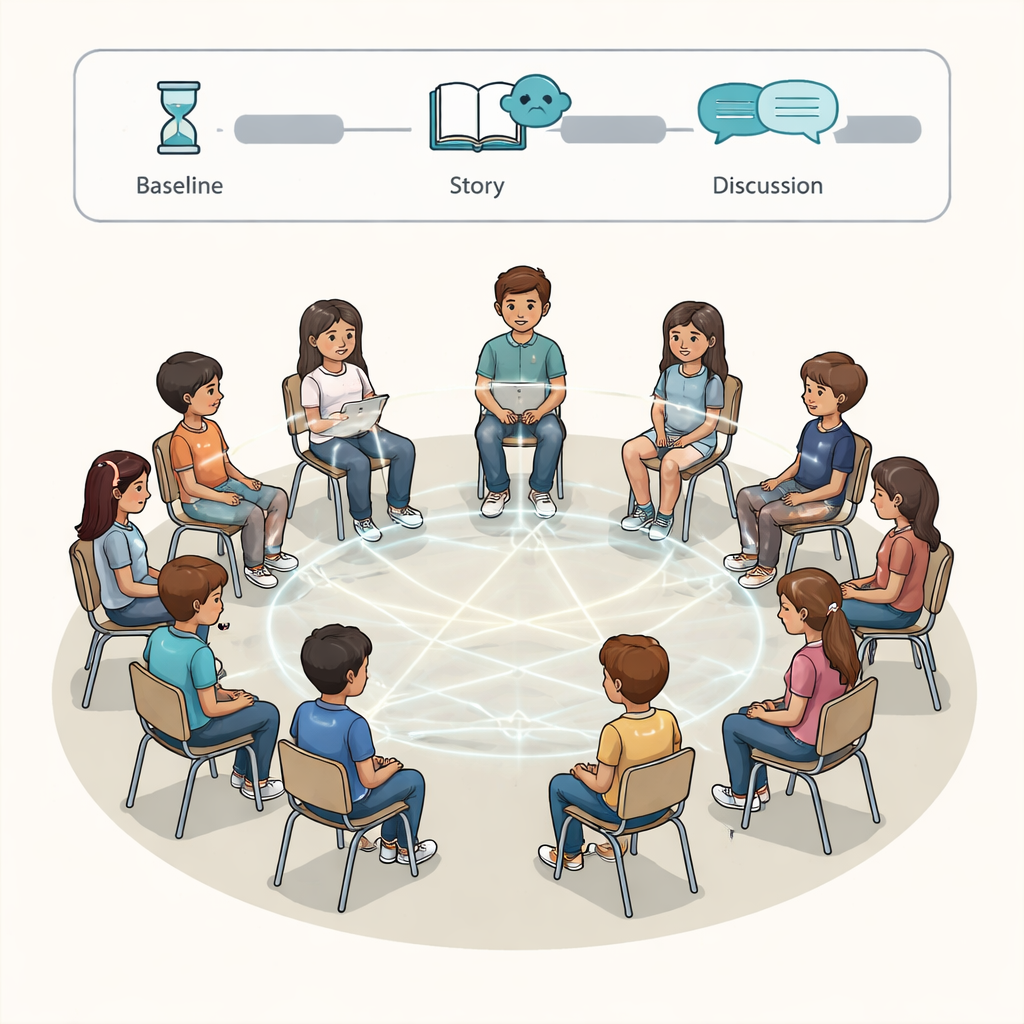
The research team invited 187 children, aged 10 to 13, to a university lab in small groups of classmates. These children already knew one another from school, and their relationships ranged from close friends to near strangers. First, each child completed short interviews and questionnaires about how much they liked and felt close to each group member, and whether they considered them a friend. Then, wearing small chest sensors that recorded every heartbeat, they watched a calm video to capture a resting baseline. After that, they listened to an audio story about a girl who is excluded and bullied by her peers and then took part in a group discussion about the fairness of the characters’ actions and how the characters might feel.
Measuring mood and body signals together
To understand how feelings and physiology fit together, the children repeatedly rated their own mood on a simple grid that captured how good or bad they felt and how energized or calm they were. They also guessed how their classmates felt. Meanwhile, the heart monitors provided two main types of data. First, the researchers measured heart rate variability, a subtle pattern in the timing between beats that is typically higher when people feel safe and relaxed and lower when they are tense. Second, they examined how similar two children’s heart patterns were from moment to moment—a phenomenon called synchrony. Using a detailed mathematical tool, they separated slower, low-frequency changes in heart rate from faster, high-frequency changes, which are more directly tied to the body’s calming system.
What changed when kids felt good or bad
Comparing the calm baseline with the more emotionally charged story and discussion, the researchers found that children’s bodies clearly registered the social situation. During the discussion, heart rate variability dropped, signaling heightened arousal. Yet children who maintained relatively higher heart rate variability tended to report feeling better and less stirred up, suggesting that a more flexible, well-regulated body state was linked to more positive experiences. Interestingly, these physiological patterns did not track how safe, content, or stressed children said they felt about the group as a whole, hinting that personal momentary mood may matter more than broad impressions of the group climate in this setting.
When friendships and feelings line up—or don’t
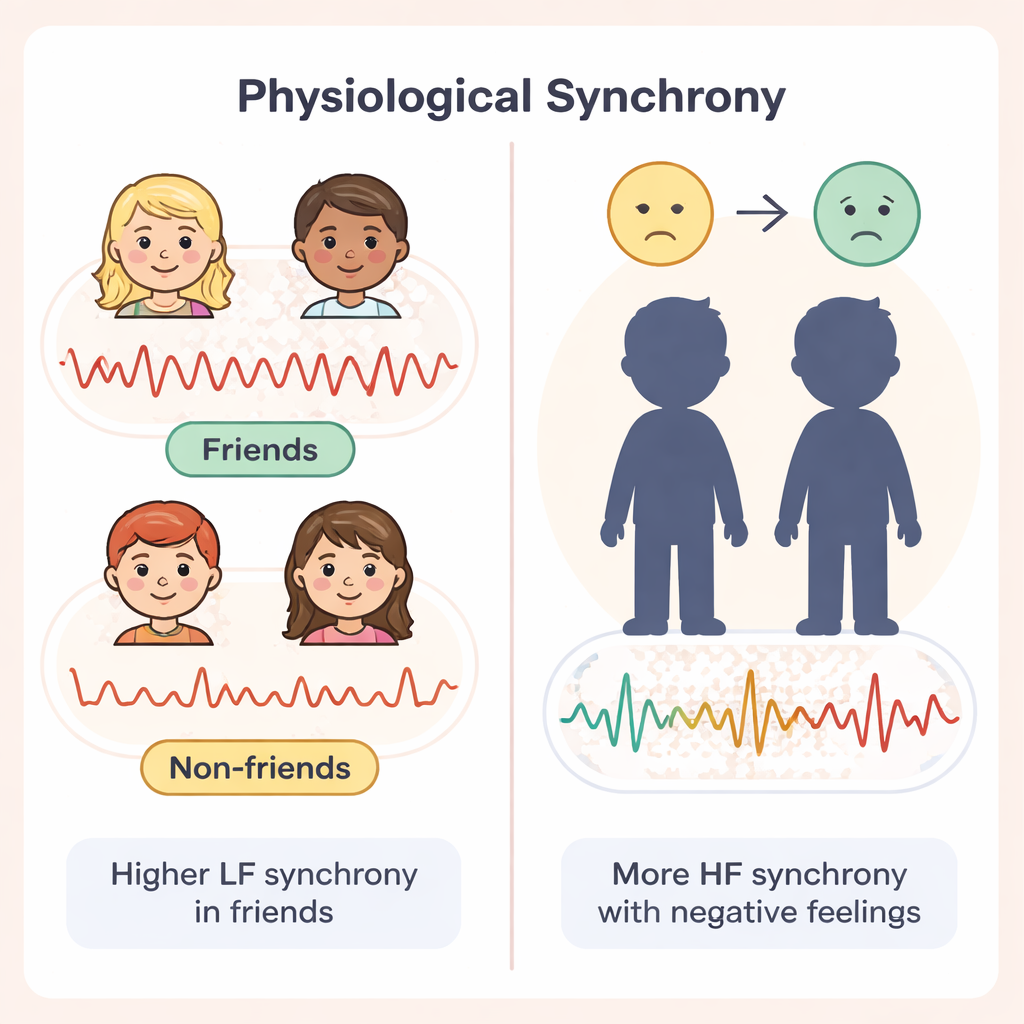
The most striking results appeared at the level of pairs. Overall, children’s heart rhythms became more synchronized during the open discussion than while they simply listened to the story, likely because active conversation demands attention to others’ voices and reactions. Among the slower, low-frequency changes in heart rate, pairs of mutual friends showed stronger synchrony than non-friends, suggesting that close relationships tune children’s bodies to respond in parallel during shared, emotionally meaningful activities. Faster, high-frequency synchrony told a different story. Pairs who reported more negative feelings after the discussion—feeling less good overall—showed more of this rapid, shared adjustment in their heart rhythms. In other words, bodies seemed to “lock in” together most when the shared experience felt emotionally heavy rather than cheerful.
What this means for real classrooms
To a lay reader, the message is that friendships and emotions leave fingerprints not only on what children say and do, but also on how their bodies function together in real time. Friends’ hearts tended to move in step during a demanding social task, and children who shared a more negative emotional tone also showed tighter physiological linkage. These findings support the idea that subtle body-level coordination may help cement bonds and shape how children experience tricky social situations, such as discussing bullying. In the future, such research could help teachers and psychologists recognize how group activities influence both feelings and friendships, and perhaps design classroom practices that foster supportive, healthy peer connections—from the inside out.
Citation: Denk, B.F., Pruessner, J.C., Farah, S. et al. Cardiac synchrony, peer relationships, and affective experiences in children during group interactions. Sci Rep 16, 7740 (2026). https://doi.org/10.1038/s41598-026-41275-y
Keywords: peer relationships, friendship, heart rate synchrony, child development, classroom social dynamics