Clear Sky Science · en
Silica based ZnFe2O4 nanocomposite as a novel photocatalyst for basic fuchsin dye degradation
Why cleaning colorful water matters
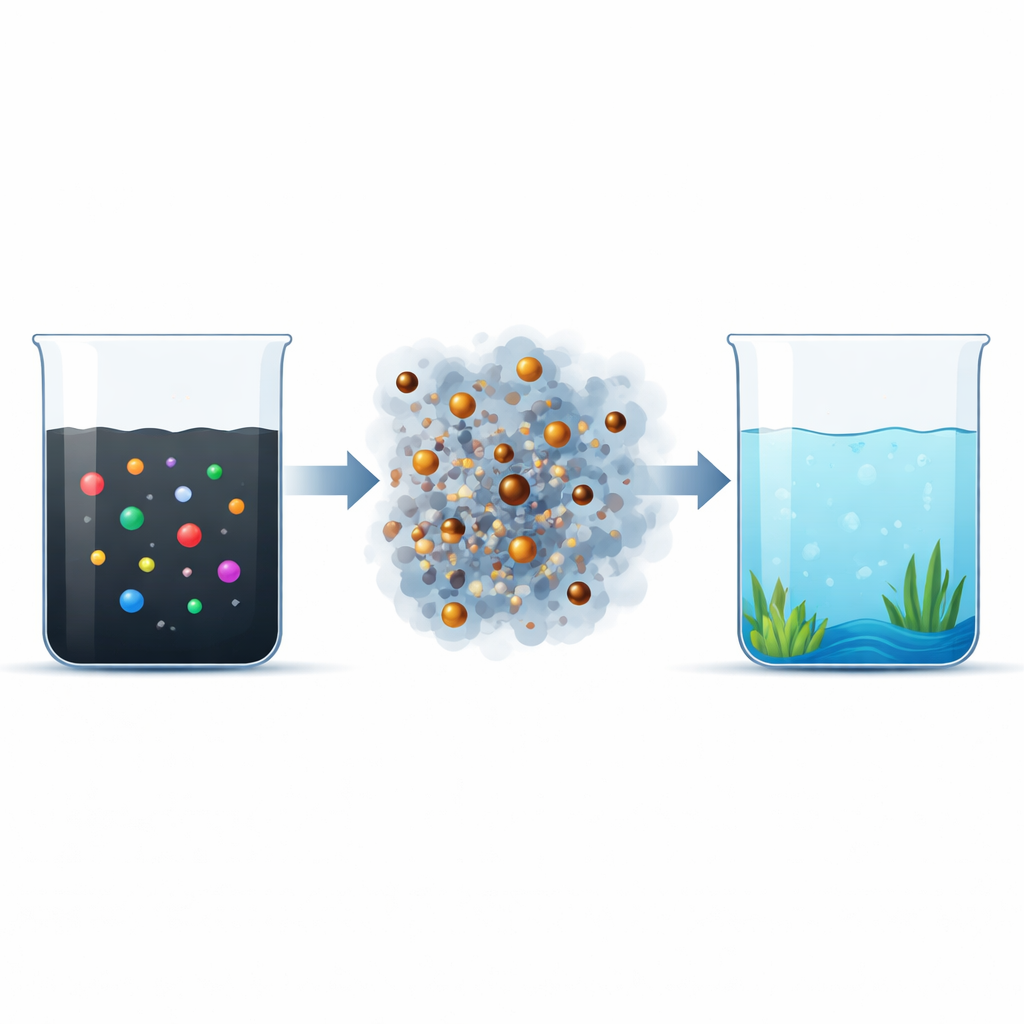
From the outside, a stream tinged bright pink or red might look like a minor eyesore. In reality, many industrial dyes that give wastewater its striking colors are toxic, long‑lasting, and hard to remove. This study focuses on basic fuchsin, a vivid dye used in textiles, paper, and printing that can irritate skin and eyes and is linked to cancer risks. The researchers set out to create a tiny, magnet‑responsive powder that can break this dye apart using light, offering a practical way to turn polluted water clear again.
Tiny helpers built from sand and metal
The team designed a new material by combining two familiar ingredients at the nanoscale. First, they made ultra‑small particles of zinc ferrite, a magnetic iron‑based compound that can absorb light and trigger chemical reactions. Then they produced fine silica particles from local desert sand using grinding methods. By mixing both in a one‑to‑one ratio and milling them together, they formed a blended "nanocomposite" where zinc ferrite particles are embedded and separated inside a silica network. Powerful microscopes showed that the resulting grains are only about 19 nanometers across—tens of thousands of times smaller than the width of a human hair—with zinc ferrite specks dispersed in a lighter silica background.
How the new material behaves under light
To understand how this powder would perform, the scientists probed its structure and how it interacts with light. X‑ray measurements confirmed that both building blocks kept their crystalline identity inside the blend, while infrared tests showed that chemical bonds formed between the metal oxide and the silica. These connections help stabilize the particles and influence how charges move when light hits them. Optical measurements revealed that the composite absorbs ultraviolet light efficiently and has an energy gap between its electronic states that sits between those of pure zinc ferrite and pure silica. This tuning is important: it means the material can use incoming UV light more effectively to drive the reactions that destroy dye molecules.
Putting the powder to work on dirty water
The researchers then tested how well the new nanocomposite removed basic fuchsin from water under UV lamps. They compared it with each ingredient alone and also checked what happens if the dye is simply exposed to light with no catalyst. In neutral water, the composite removed almost 90% of the dye in 150 minutes, far better than zinc ferrite or silica by themselves and vastly more effective than light alone, which barely changed the dye. When the water was made mildly alkaline, performance improved further: using just 0.01 grams of powder in the test solution, about 95% of the dye disappeared in the same time. The team also varied dye concentration and catalyst amount, showing that adding more of the powder increased efficiency and that the breakdown followed a simple, predictable rate pattern over time.
What happens during the clean‑up
To uncover how the particles actually destroy the dye, the scientists examined which short‑lived reactive species are involved. When UV light strikes the composite, it kicks electrons into motion inside the zinc ferrite, leaving behind "holes." At the particle surface, these charges react with water and oxygen to form highly reactive forms of oxygen, including hydroxyl radicals and superoxide. By adding chemicals that selectively neutralize each of these species, the team showed that hydroxyl radicals are the main attackers, with superoxide also playing a strong supporting role. These aggressive molecules tear the dye into smaller, less harmful fragments. The composite itself remains structurally stable through the process and can be pulled out of the water with a magnet and reused, although its activity gradually drops to about 70% after six cycles.

What this means for safer water
In everyday terms, this work shows that a powder made from ground sand and magnetic metal oxides can act like a reusable sponge for light‑driven chemistry, stripping a stubborn, toxic dye from water without adding new pollutants. While more research is needed to track all of the breakdown products and to scale up the method, the ZnFe2O4/SiO2 nanocomposite offers a promising, relatively low‑cost tool for cleaning industrial wastewater, especially in regions where dye‑rich effluents threaten rivers, groundwater, and the communities that depend on them.
Citation: Desouky, M.M., El-Sayed, M. & El-Khawaga, A.M. Silica based ZnFe2O4 nanocomposite as a novel photocatalyst for basic fuchsin dye degradation. Sci Rep 16, 9671 (2026). https://doi.org/10.1038/s41598-026-41259-y
Keywords: wastewater treatment, photocatalyst, nanoparticles, dye pollution, environmental remediation