Clear Sky Science · en
Optimization of split-ring resonator slots using levy-opposition-enhanced Newton Raphson method for high-gain UWB Vivaldi antenna design
Smarter antennas for sharper wireless vision
From medical scanners that spot tiny tumors to radars that see through walls or rubble, many modern systems rely on antennas that can handle a huge range of frequencies at once. This paper shows how a new math-driven design method can squeeze more performance out of a compact ultra‑wideband Vivaldi antenna, making it more powerful, more efficient, and still inexpensive to build. 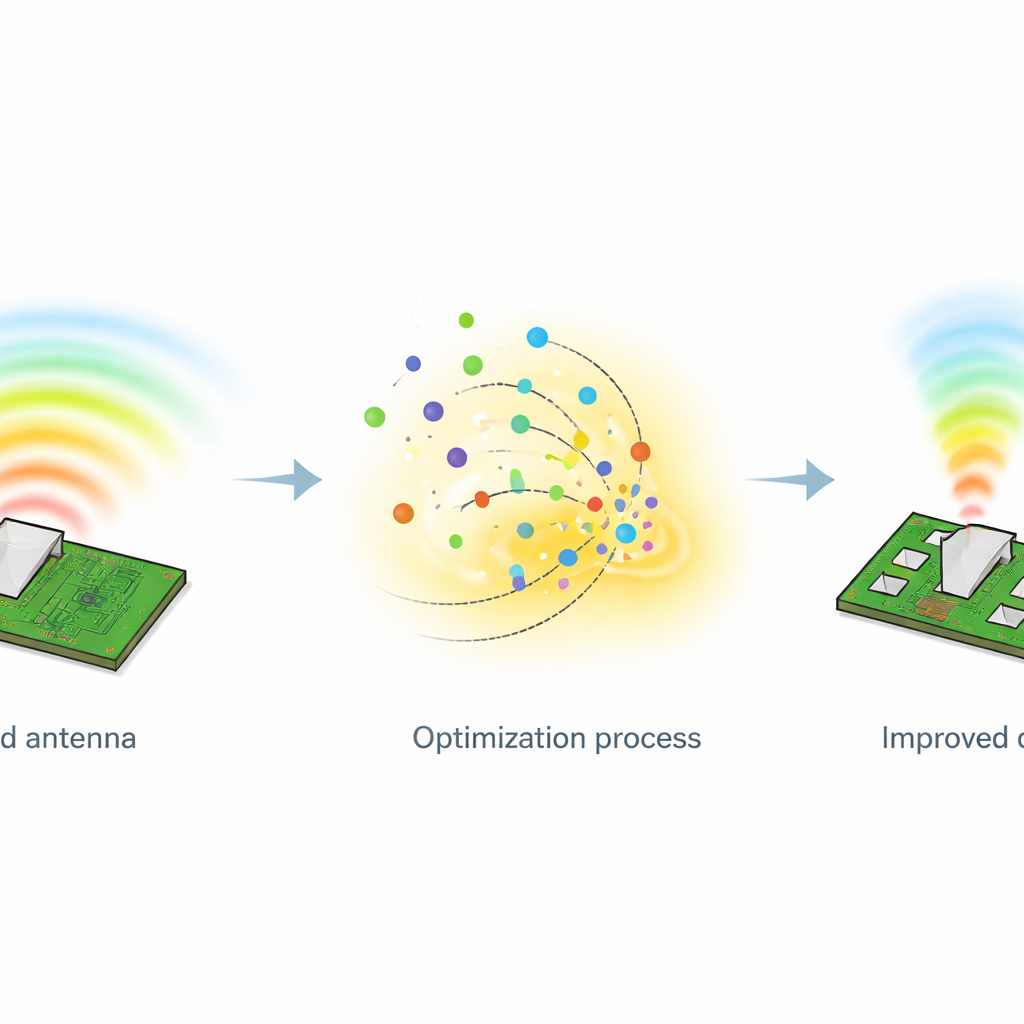
Why wideband antennas matter
Ultra‑wideband antennas are prized because they can send and receive very short pulses that carry a lot of information and penetrate materials such as human tissue, soil, or building materials. Vivaldi antennas are a popular choice here: they are flat metal shapes printed on circuit boards, naturally suited to wide frequency coverage and narrow, forward‑pointing beams. These traits are ideal for applications like breast cancer imaging, ground‑penetrating radar, and short‑range high‑speed wireless links. However, when engineers try to make Vivaldi antennas small and cheap—using compact layouts and low‑cost circuit materials—the gain often drops and the lowest usable frequency rises, limiting how deeply and clearly such systems can “see.”
Using nature‑inspired search to guide design
Instead of tweaking antenna shapes by trial and error, the authors rely on a computer‑based search strategy that looks for the best geometry automatically. Their starting point is a recent optimization approach derived from the classic Newton–Raphson method, which uses slope information to quickly home in on promising solutions. On its own, this method can get stuck in “good but not best” designs. To avoid that, the team augments it with two ideas borrowed from studies of animal behavior and randomized search. A “random opposition” step deliberately explores not only a candidate design but also its opposite within the allowed design space, broadening the search. A “Lévy flight” step introduces occasional long jumps as seen in the wandering paths of foraging animals, helping the algorithm escape dead ends and continue exploring.
Carving smart patterns into the antenna
Once they have this improved optimizer—called NRBO‑LO—the researchers turn it loose on a specific antenna challenge. They begin with a compact antipodal Vivaldi antenna printed on a standard FR‑4 circuit board only 40 by 40 millimeters in size. They then introduce tiny square ring‑shaped slots, known as split‑ring resonators, cut into both the radiating metal surface and the underlying ground plane. These rings behave like engineered “metamaterial” features: by disturbing how electric currents flow, they effectively lengthen the antenna without increasing its physical size. NRBO‑LO adjusts eight geometric parameters of these rings, communicating back and forth between MATLAB (which runs the optimizer) and a 3D electromagnetic simulator that evaluates how well each candidate design matches the desired behavior. 
What the optimized antenna can do
The best design found by the algorithm pushes the lower operating limit of the antenna down from about 4.8 gigahertz to roughly 3 gigahertz, fully spanning the standard 3.1–10.6 gigahertz ultra‑wideband window. At the same time, the maximum realized gain climbs from 7.7 to 9.2 decibels, meaning the antenna sends and receives energy more strongly in its main beam. Measurements also show a high average efficiency of about 75 percent, with a peak around 91 percent, indicating that most of the power fed into the antenna is actually radiated rather than lost as heat. Time‑domain tests, which compare transmitted and received pulses in different orientations, reveal low distortion and high similarity between outgoing and incoming waveforms—crucial for imaging and radar systems that depend on clean echoes.
How this compares and why it matters
When set alongside other Vivaldi designs reported in the literature, this antenna stands out for combining wide bandwidth, high gain, and very compact size on a low‑cost material. Some competing antennas offer similar or slightly higher gain, but at the price of much larger circuit boards or expensive specialty substrates. Others are small but lack the same bandwidth or power. Here, the clever use of split‑ring slots, tuned by the NRBO‑LO algorithm, allows the antenna to “punch above its weight,” making it an attractive candidate for portable medical scanners, compact wideband radars, and next‑generation short‑range wireless links.
Big picture takeaway
For readers outside antenna engineering, the core story is that smarter search methods can unlock better hardware designs without changing the basic materials or overall form factor. By letting an enhanced optimization algorithm reshuffle the fine details of ring‑shaped cuts in a tiny metal pattern, the researchers turned an ordinary Vivaldi antenna into a high‑gain, ultra‑wideband tool suitable for demanding imaging and sensing tasks. This approach—combining advanced mathematics with subtle structural tweaks—points toward a future in which many everyday wireless devices quietly benefit from similar invisible, algorithm‑driven refinements.
Citation: Özmen, H., Izci, D., Rizk-Allah, R.M. et al. Optimization of split-ring resonator slots using levy-opposition-enhanced Newton Raphson method for high-gain UWB Vivaldi antenna design. Sci Rep 16, 7828 (2026). https://doi.org/10.1038/s41598-026-41244-5
Keywords: ultra-wideband antenna, Vivaldi antenna, metamaterials, optimization algorithms, microwave imaging