Clear Sky Science · en
Sampled-data control under time-varying delays: a robust approach for high-renewable smart grids
Keeping Renewable-Powered Grids Steady
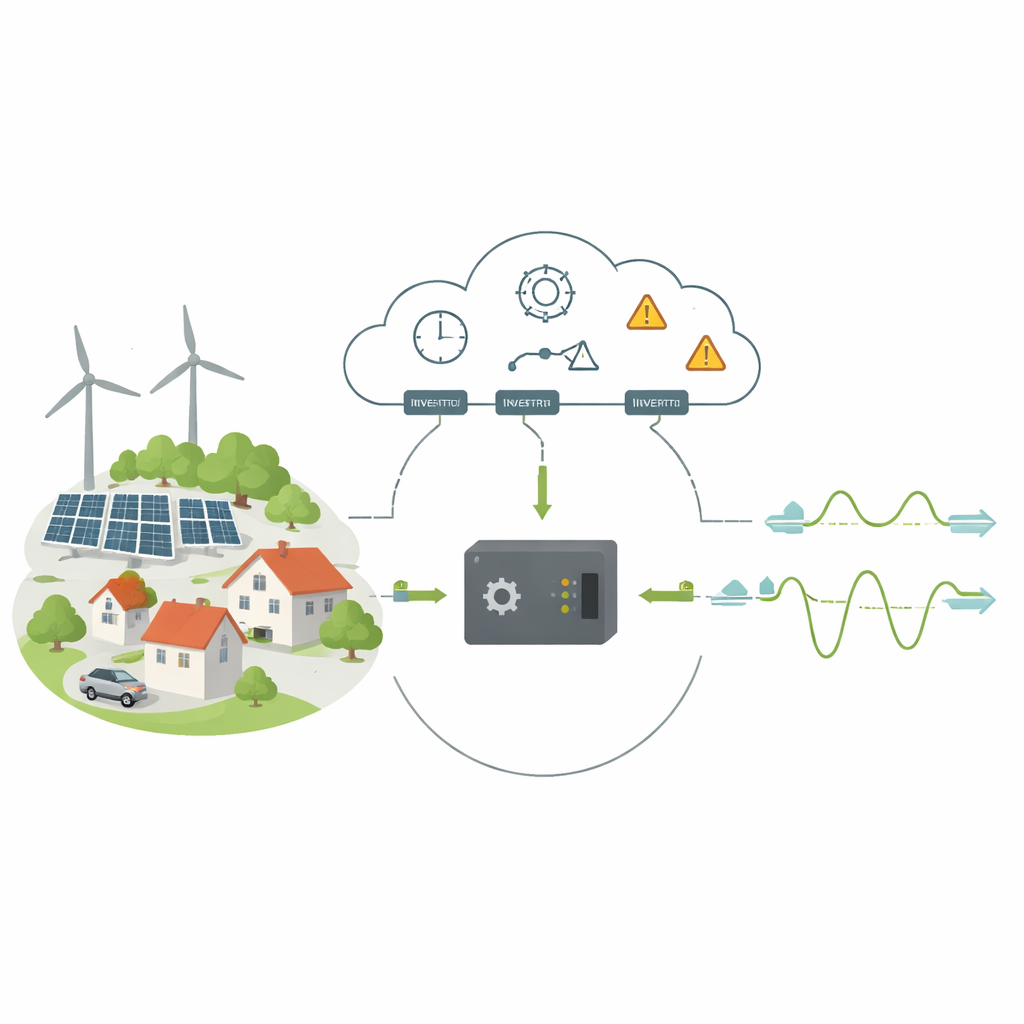
As solar panels and wind turbines spread across our power networks, the grid increasingly depends on fast digital control to keep lights on and voltages steady. But those control signals travel over the same kinds of imperfect communication networks we use for data and voice, where messages can be delayed, arrive irregularly, or vanish altogether. This paper explores how to keep a renewable-rich "smart" grid stable even when its digital nervous system is slow, jittery, or partly unreliable.
Why Communication Delays Matter
In today’s smart grids, sensors measure quantities like voltage and frequency, then send them over communication links to controllers that compute corrective actions for power electronics such as inverters. Unlike old, mostly analog grids, this loop depends on sampled digital data and networked communication. When messages are delayed, arrive at uneven time intervals, or are lost, the controller is effectively steering based on stale or missing information. In grids dominated by fast-acting inverter-based resources, this can shrink stability margins, produce large oscillations, or even cause local loss of synchronism, threatening reliable operation under high renewable penetration.
A New Way to Read the Health of the Network
The core idea of the study is to make the controller explicitly aware of how “healthy” the communication channel is at each instant, and to adapt its behavior accordingly. Instead of assuming fixed worst-case delays or treating each impairment separately, the authors introduce a single delay–jitter intensity index, denoted θk, which is always between 0 and 1. This index combines how long measurements are delayed with how much the sampling interval deviates from its nominal value, using only timing information that controllers can realistically estimate from timestamps and local clocks. When communication is fast and regular, θk is close to zero; when delays and irregularities grow, it approaches one.
A Controller That Automatically Backs Off
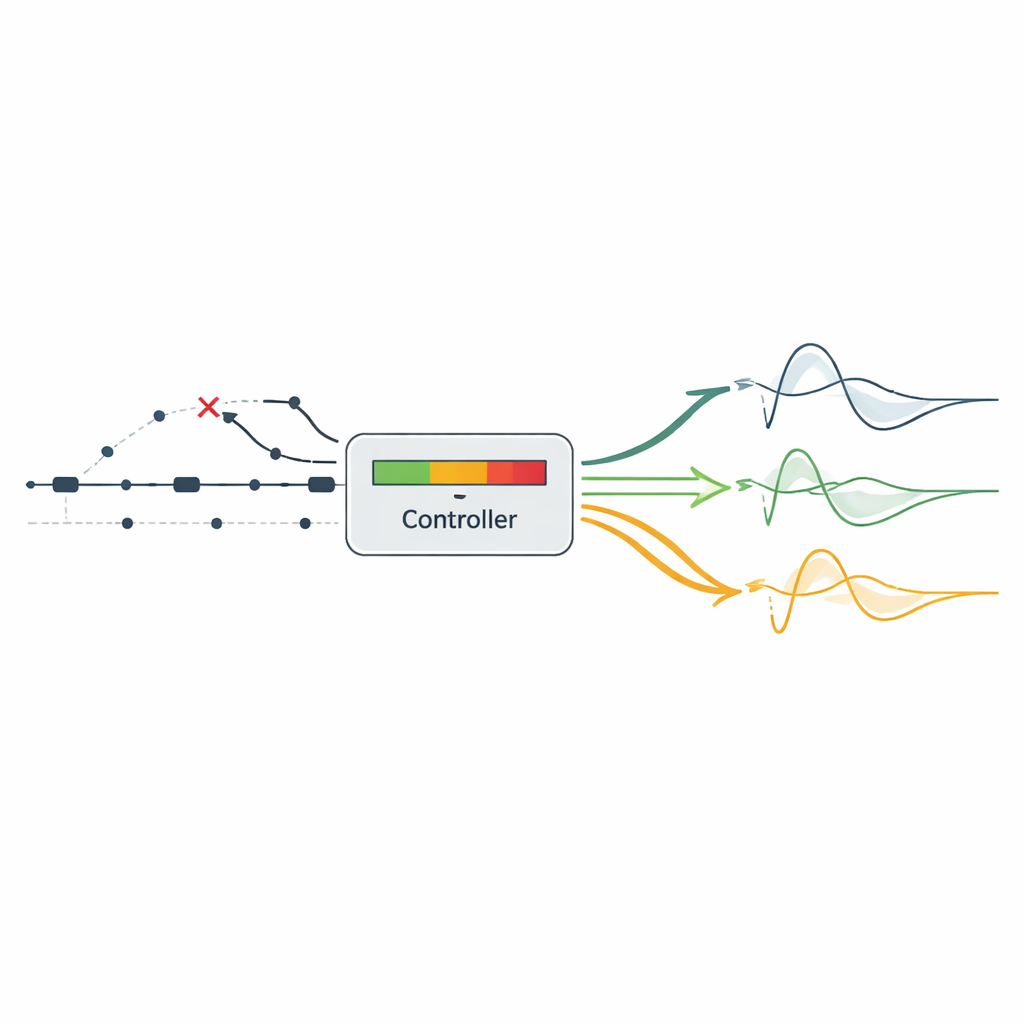
Armed with this live measure of communication quality, the controller adjusts how aggressively it reacts. Its feedback gain is scheduled as a simple linear function of the index: strong action when θk is small, and more cautious action as θk rises. This makes the control layer behave much like a careful driver who slows down in heavy fog. Mathematically, the paper shows that this adaptation can be done without sacrificing rigorous guarantees: by using a specially constructed energy-like function and linear matrix inequality tests, the authors prove that the system remains exponentially stable across all allowed combinations of delay, timing irregularity, and random packet loss. Crucially, stability needs to be checked only at the two extremes of θk (best and worst communication), which keeps the design computationally tractable.
Putting the Method to the Test
To see how this approach behaves in practice, the authors simulate a hybrid microgrid containing solar, wind, and dynamic loads, all tied together through inverters and a lossy digital network. They compare their adaptive controller with more traditional constant-gain and worst-case robust controllers, as well as with event-triggered and model-predictive schemes. Across scenarios with bounded delay, strong sampling jitter, and 10% random packet loss, the adaptive design consistently settles faster, overshoots less, and expends less control effort. Reported improvements include up to 33% shorter settling times, 52% lower overshoot, and 40% lower control-related energy cost. The paper also defines reliability indicators that count how often the system stays within safe operating bounds and how frequently interruptions occur, showing that the adaptive controller maintains safe margins even under compounded impairments.
What This Means for Future Smart Grids
For a general reader, the key takeaway is that stability in renewable-heavy grids is not only about how much sun or wind is available, but also about how reliably information flows through the grid’s digital nervous system. This work offers a way for controllers to “feel” when communication is degrading and to automatically dial back their aggressiveness while still guaranteeing mathematical stability. Instead of inventing new control mathematics, the contribution lies in cleverly embedding a communication-quality index into well-established stability tools, creating a bridge from network behavior to physical grid safety. As such, it provides a control-layer building block that can sit beneath data-driven forecasting, cybersecurity monitoring, and advanced energy management systems, helping ensure that future high-renewable grids remain both smart and steady even when their communications are far from perfect.
Citation: Hassan, M. Sampled-data control under time-varying delays: a robust approach for high-renewable smart grids. Sci Rep 16, 9674 (2026). https://doi.org/10.1038/s41598-026-41199-7
Keywords: smart grids, renewable integration, networked control, microgrid stability, communication delays