Clear Sky Science · en
Comparative evaluation of activated sludge and electrocoagulation for microplastics removal from sewage
Why tiny plastics in sewage matter to everyday life
Every time we wash clothes, rinse food containers, or use plastic-packed products, tiny plastic pieces too small to see slip down the drain. These “microplastics” can pass through sewage plants and end up in rivers and seas, where they may be eaten by fish and eventually return to our plates. This study asks a simple but important question: how well does a typical city sewage plant remove these particles, and can a relatively simple extra treatment step keep far more of them out of the environment? 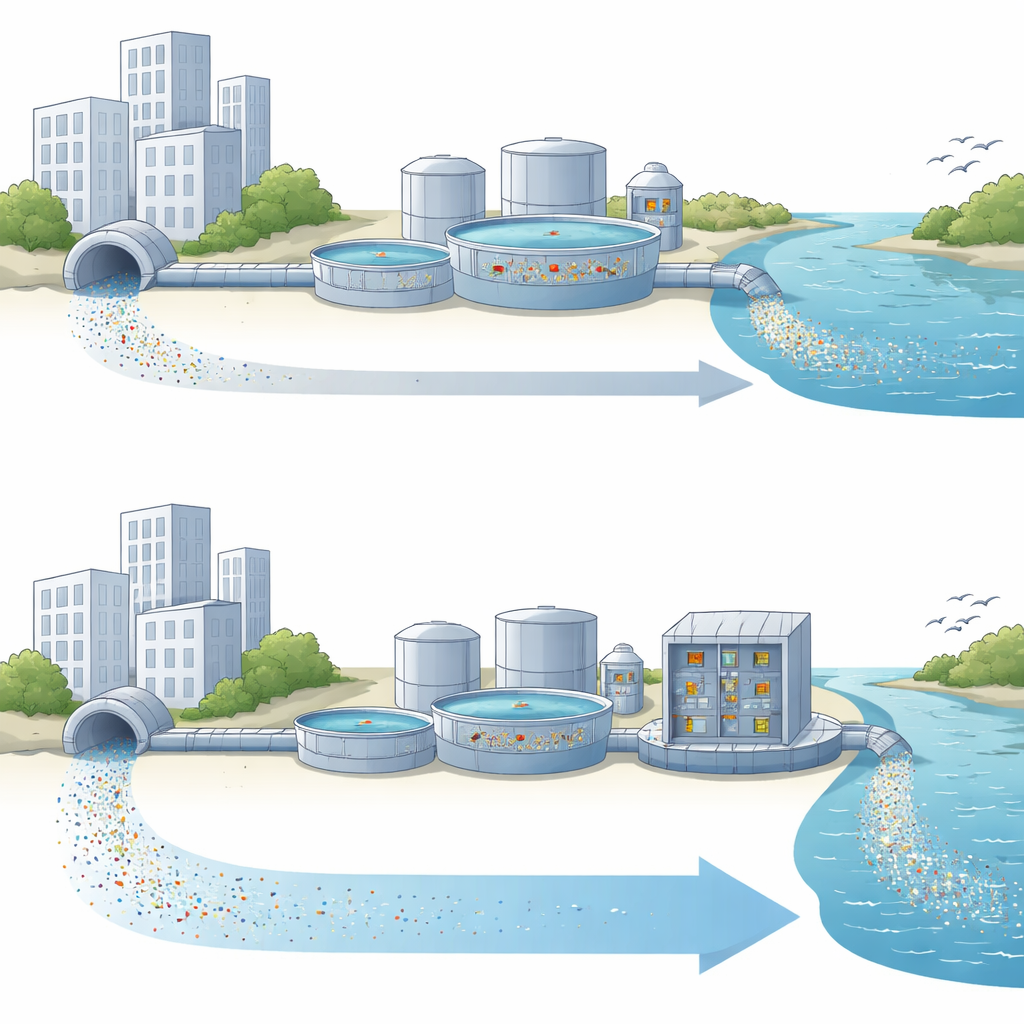
Small plastics, big environmental problem
Microplastics are fragments and fibers of plastic less than five millimeters across—often much smaller. They come from the breakdown of bags and bottles, the shedding of synthetic clothing in the wash, and tiny beads once used in personal care products. Because plastic breaks apart rather than fully decaying, these particles can linger in water for years. They can be swallowed by everything from plankton to fish, carry harmful chemicals and metals on their surfaces, and host microbial communities, including potential pathogens. Sewage treatment plants sit at a critical choke point: they handle huge volumes of wastewater and can either trap these particles or flush them into downstream waterways.
Taking a close look at a real treatment plant
The researchers focused on a sewage treatment plant in Kafr Saad City in Egypt that uses a common method called activated sludge, where microbes break down organic waste. Over a month in summer, they collected incoming sewage and the final treated water, then processed the samples carefully to avoid adding any stray fibers from the lab itself. They used chemical digestion to remove natural debris, density separation to lift plastics away from heavier grains, and fine filters to capture particles down to less than a micrometer. Under stereomicroscopes and electron microscopes, they counted and imaged the pieces, and used infrared light–based techniques and elemental analysis to identify which kinds of plastics were present.
How well current treatment works—and where it falls short
Before any treatment, each liter of incoming sewage contained about 136 microplastic pieces, mostly thin fibers and irregular fragments in various colors. After passing through the plant’s standard steps—including settling tanks, aeration with microbes, and disinfection—that number dropped to about 23 particles per liter, roughly 83 percent removal. While this sounds impressive, it still means millions of particles can leave the plant every day, especially the smallest and lightest ones that are hardest to trap. The team’s chemical fingerprints showed that most particles were made of everyday plastics such as polyethylene and polypropylene, commonly used in packaging and textiles, along with smaller amounts of polyester, polystyrene, and other polymers.
Adding electricity to clump plastics together
To see if removal could be improved, the scientists tested an extra step called electrocoagulation on both raw and already-treated water. In this method, simple metal plates are placed in the water and a low electric current is applied. The metal slowly dissolves, releasing charged particles that encourage microplastics and other contaminants to clump into larger “flocs” that either float or sink and can then be separated. In their lab reactor, using aluminum plates and mild operating conditions, the concentration in pre-treated sewage dropped to about 12 particles per liter and in already-treated water to just 2 particles per liter, corresponding to removal efficiencies above 91 percent—better than the conventional process alone. Microscopy and elemental analysis confirmed that what remained after this step was largely inorganic residue rather than plastic. 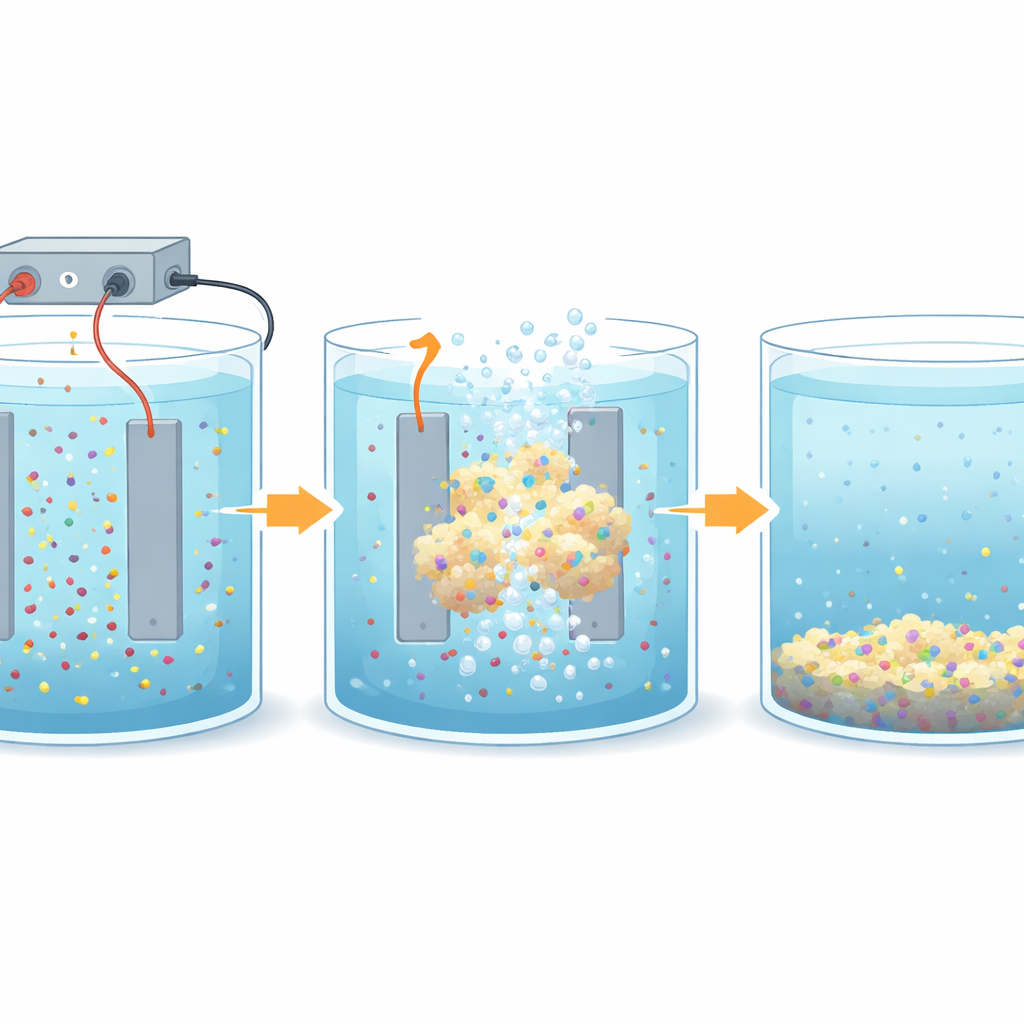
What this means for cleaner water
For non-specialists, the key message is that even well-run sewage plants still release microplastics, but an added, relatively low-tech electrical treatment can remove most of what slips through. By encouraging plastic specks to clump together and settle out, electrocoagulation turns a hard-to-catch mist of particles into larger masses that can be handled as sludge. The study suggests that installing this step after the usual biological treatment could significantly cut microplastic pollution heading toward rivers and seas, without overloading the system or disrupting the microbes that do the main cleaning. While full-scale trials are still needed, this combined approach offers a promising path to keep more plastic out of aquatic environments—and, ultimately, away from our food and drinking water.
Citation: El-Ezaby, K.H., Abou Samra, R.M., Hamzawy, A.H. et al. Comparative evaluation of activated sludge and electrocoagulation for microplastics removal from sewage. Sci Rep 16, 9675 (2026). https://doi.org/10.1038/s41598-026-41175-1
Keywords: microplastics, wastewater treatment, electrocoagulation, activated sludge, sewage pollution