Clear Sky Science · en
Thermodynamic and exergoeconomic analysis of a solar-assisted LiBr/H₂O ejector–absorption refrigeration system with triple-layer thermal storage
Why Cooler Buildings Need Smarter Sun Power
As hotter summers and rising living standards drive up the demand for air conditioning, especially in sunny regions, keeping people comfortable without overloading power grids has become a pressing challenge. This study explores a clever way to turn abundant sunlight into reliable cooling, using a refrigeration system that sips electricity but drinks in heat. By combining solar collectors, a layered hot‑water tank, and a specialized jet‑like device, the researchers show how to provide building cooling more efficiently and at lower cost than with a conventional solar absorption chiller.
A Different Way to Make Cold
Most air conditioners rely on electric compressors, which draw heavily on the grid and indirectly on fossil fuels. The system examined here works differently: it uses heat rather than electricity as its main driving force. A mixture of lithium bromide and water acts as the working fluid in an absorption refrigeration cycle that can be powered by hot water from solar collectors. The authors go a step further by adding a supersonic ejector—a component with no moving parts that uses a high‑speed jet of fluid to draw in and compress another flow. This ejector recovers energy that would otherwise be wasted, helping to cut down on the heat required to run the cycle. A triple‑layer thermal storage tank, fed by evacuated‑tube solar collectors, stores solar heat in neatly separated hot, warm, and cool zones so that the system can keep operating smoothly as sunshine changes throughout the day. 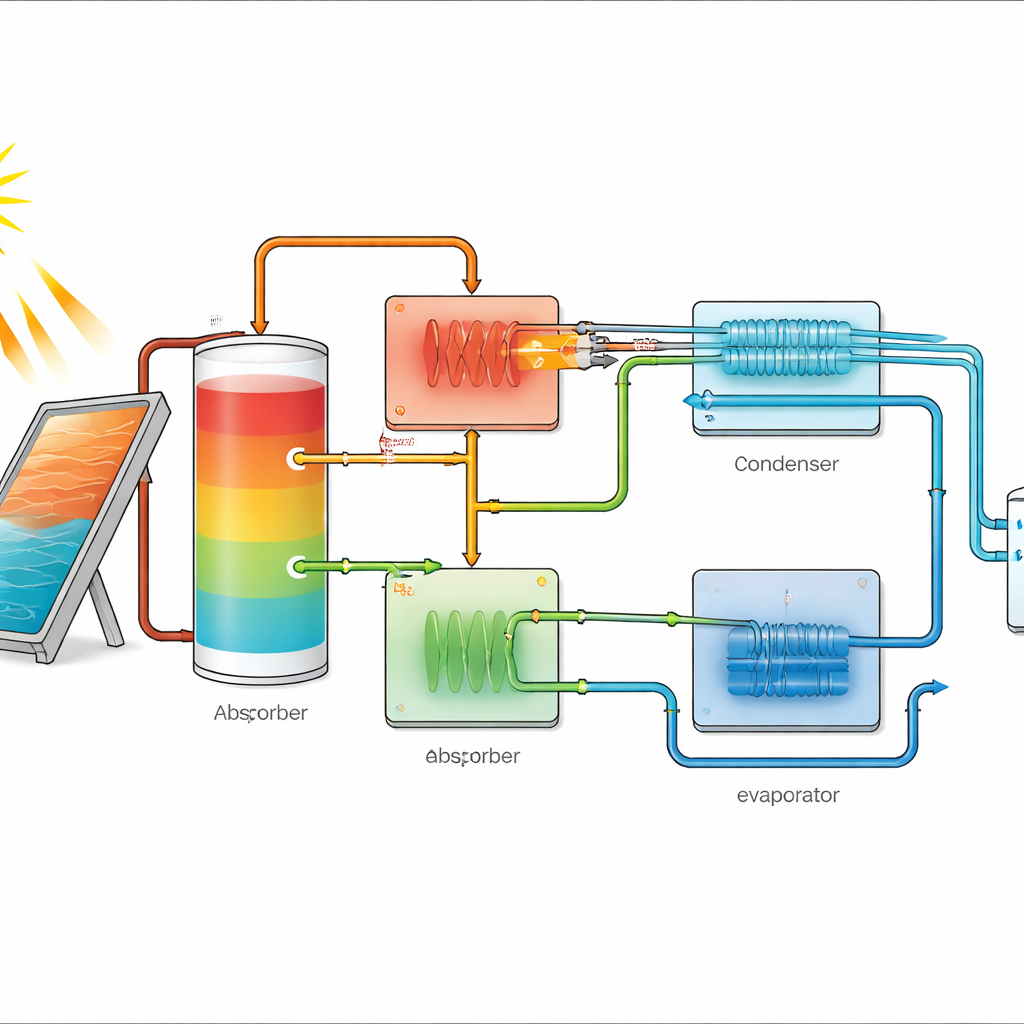
How the Sun, Storage, and Ejector Work Together
In the proposed setup, sunlight heats water in rooftop solar collectors, which then feeds a vertical storage tank divided into three temperature layers. The hottest water accumulates at the top, where it supplies steady heat to the generator of the absorption chiller; the middle layer acts as a buffer, and the coolest water settles at the bottom. This layering reduces temperature swings and makes better use of the solar resource. The lithium‑bromide solution absorbs and releases water vapor as it circulates between the generator, absorber, condenser, and evaporator, producing chilled water for building cooling. The ejector is inserted in place of a simple expansion valve so that, instead of letting pressure drop and energy dissipate, a high‑velocity stream helps pull in lower‑pressure vapor and partially recompress it, easing the workload on other components and improving overall efficiency.
Measuring Performance and Cost
To quantify the benefits, the researchers built a detailed computer model that tracks mass, energy, and energy quality throughout every part of the system. They used real hourly weather data from Kabul, Afghanistan, a city with strong summer sun and high cooling demand, to see how the system would behave on a typical clear midsummer day. Beyond evaluating ordinary efficiency measures such as the coefficient of performance (how much cooling is delivered per unit of heat input), they also examined exergy, which reflects how much of the input energy remains truly useful after losses, and they translated these technical insights into money terms. By assigning costs to equipment and to the quality of energy flowing through the system, they could judge not only how well the system cooled, but how economically it did so over its lifetime.
What the Numbers Reveal
The results show that the combination of solar collectors, stratified storage, and ejector meaningfully boosts performance compared with a simpler solar absorption chiller. Under strong midday sunshine of about 973 watts per square meter, an optimized setup reaches a coefficient of performance of 0.74 and a solar performance measure of 0.58. Adding the ejector increases the cooling efficiency by around 12 to 13 percent and improves the quality of energy use by about 11 percent, while reducing the overall investment cost by roughly 9 percent. The triple‑layer storage tank keeps a sharp temperature difference of more than 20 degrees Celsius between the hottest and coolest zones at midday, providing a stable heat source for the generator even as outdoor conditions fluctuate. Optimization studies further identify the generator temperature and the ejector’s suction behavior as key levers for balancing efficiency and cost. 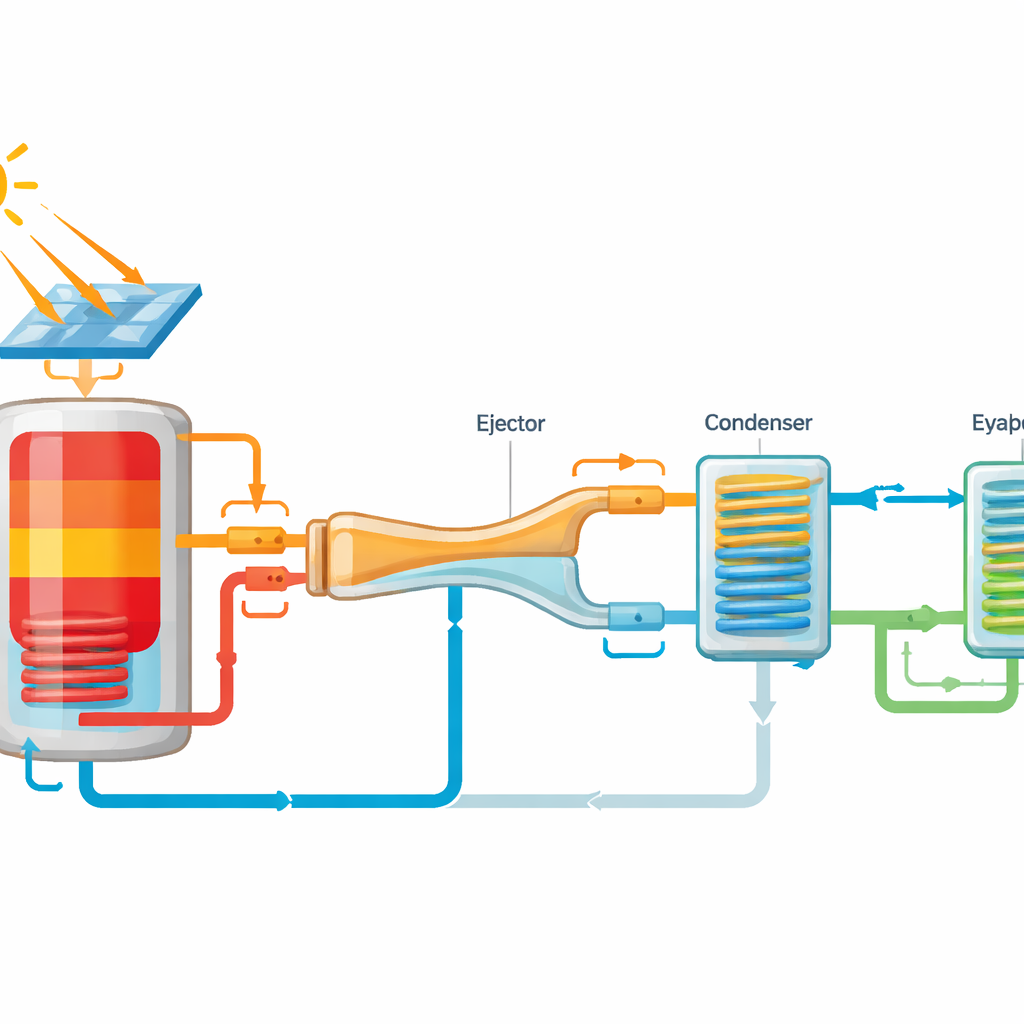
What This Means for Future Cooling
For non‑specialists, the main message is that careful redesign of how we move heat around in a cooling system can make solar‑driven air conditioning significantly more practical and affordable. By storing solar heat in a layered tank and recycling pressure drops through an ejector, this concept delivers more cooling from the same sunlight while trimming equipment and operating costs. If developed and implemented at scale, such systems could help sunny, power‑strained regions meet their growing cooling needs with fewer emissions and less reliance on conventional electricity‑hungry air conditioners.
Citation: Chammam, A., Abbood, R.S., Majid, S.H. et al. Thermodynamic and exergoeconomic analysis of a solar-assisted LiBr/H₂O ejector–absorption refrigeration system with triple-layer thermal storage. Sci Rep 16, 9435 (2026). https://doi.org/10.1038/s41598-026-41158-2
Keywords: solar cooling, absorption refrigeration, thermal energy storage, ejector technology, energy efficiency