Clear Sky Science · en
First comprehensive GC–MS profile of Echinops erinaceus with antimicrobial and cytotoxic activities and in-silico model
Desert plant with hidden healing power
Echinops erinaceus is a spiny wild plant growing in remote parts of Saudi Arabia, long used locally but almost unknown to the wider world. This study asks a question with broad appeal: can a little-studied desert herb yield new molecules that fight microbes and cancer cells, and can modern chemistry explain how they might work inside the body?
Looking inside a rare wild thistle
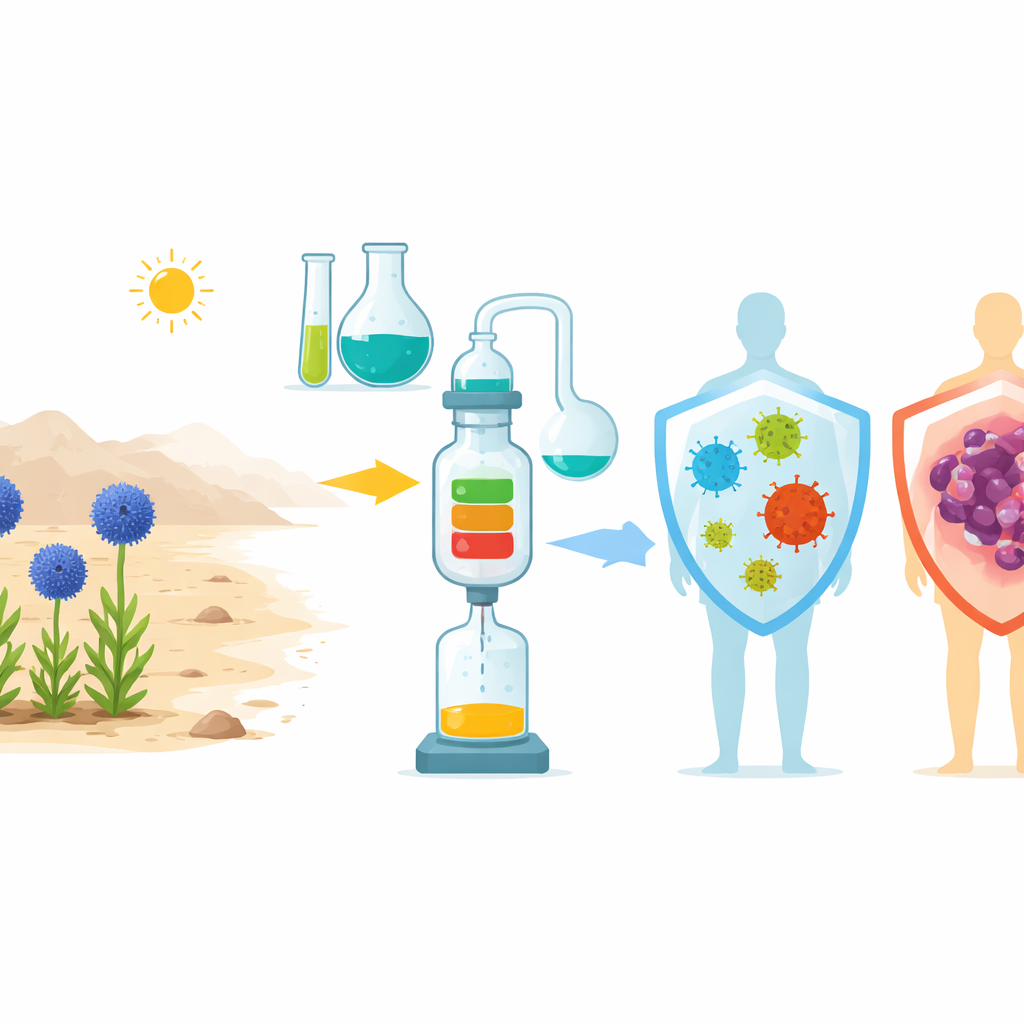
Researchers collected the aerial parts of Echinops erinaceus in 2017 and used a heated alcohol technique, called Soxhlet extraction, to pull out its oily components. They then separated these into different portions: total lipids, a “saponified” fraction rich in fatty acids and their derivatives, and an “unsaponified” fraction containing sterol- and resin‑like molecules. Gas chromatography–mass spectrometry, a method that sorts and weighs molecules, revealed at least 42 distinct substances, many of them long-chain fats and plant steroids known as triterpenes and phytosterols. One group of these compounds, led by lupeol and its acetate form, dominated the oily mixture, while another set of ethyl esters of common fatty acids was especially abundant in the saponified fraction.
Testing the plant against cancer cells
The team then challenged a broad panel of seven human cancer cell lines—including breast, colon, lung, liver, prostate, intestinal, and cervical cancers—with the different extracts. They found that the non‑polar oily fractions and a more water‑soluble butanol extract showed the strongest ability to slow or kill cancer cells in the dish. In particular, the unsaponified fraction was highly active against lung and colon cancer cells, while the saponified fraction was especially potent against colon cancer cells and moderately effective on several others. Further purification pinpointed some individual fatty acids and long‑chain molecules that produced modest anticancer effects, suggesting that both mixtures of compounds and specific ingredients contribute to the overall activity.
Fighting a wide range of microbes
Because Echinops plants are traditionally used for infections, the scientists also tested the 2017 extracts against 20 different microbes, including disease‑causing bacteria and fungi. The butanol and chloroform extracts stood out, inhibiting several troublesome fungi, such as Candida and Cryptococcus species, and a number of Gram‑negative bacteria that often resist treatment. The saponified fraction and some of its sub‑fractions also showed meaningful activity against certain bacterial strains. In contrast, the total oily extract alone was largely inactive, underscoring how separating the plant into targeted fractions can expose the most promising antimicrobial components.
Linking plant molecules to human targets
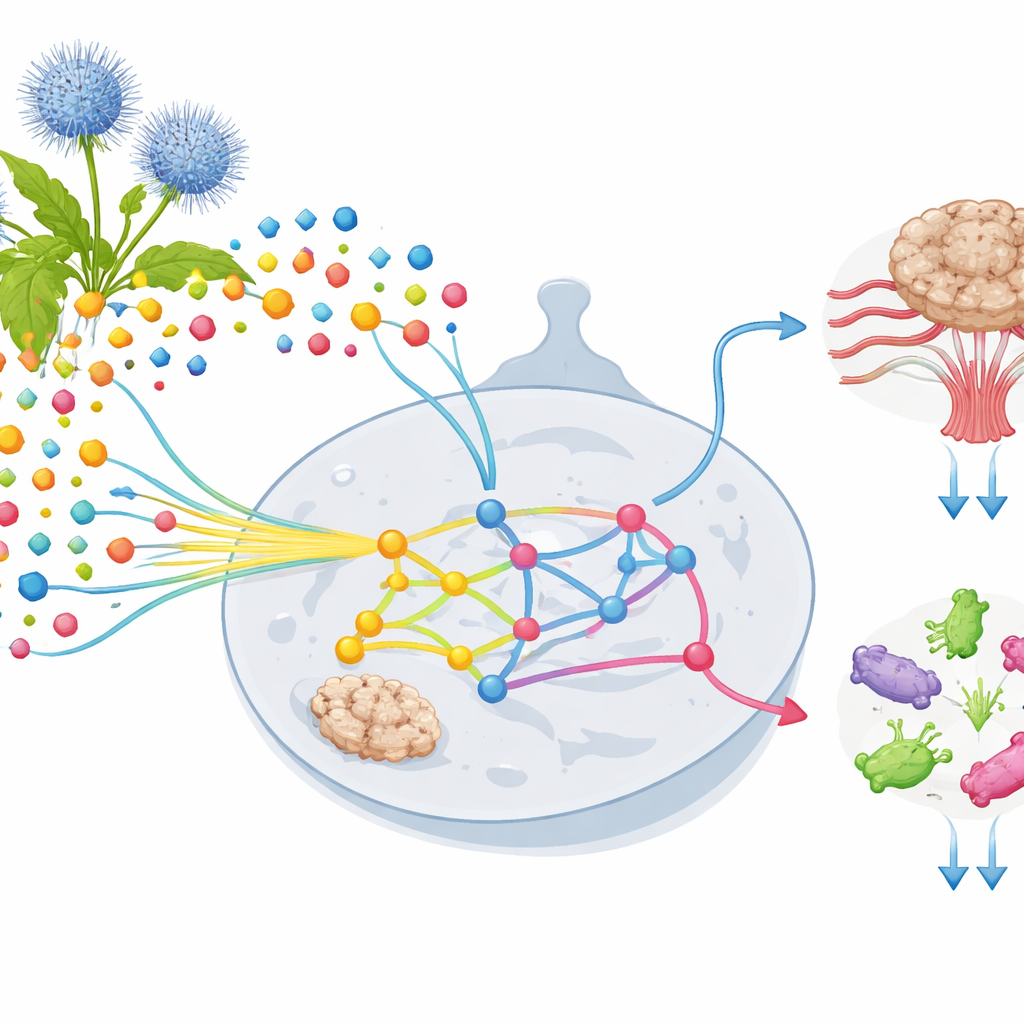
To connect these lab observations to possible actions in the body, the authors turned to computer‑based network pharmacology and molecular docking. They selected 27 major plant metabolites and, using online databases, predicted which human proteins each might influence. When these targets were overlaid with thousands of genes tied to cancer, 183 overlapping candidates emerged. Mapping how these proteins interact highlighted several central control points, in particular a signaling protein called ERK that helps govern cell growth, survival, and movement. Docking simulations suggested that four Echinops compounds—including a very long fatty acid and a triterpene acetate—could nestle tightly into ERK’s active region, potentially dampening its activity. Many of the predicted targets also clustered in a pathway known as “proteoglycans in cancer,” which influences how cancer cells grow, migrate, and invade tissue.
Why the extraction method matters
A striking feature of this work is the comparison with earlier studies on Echinops erinaceus that used a gentler, cold extraction method on plants collected in 2018. The hot Soxhlet approach applied here, using warm ethanol, drew out a somewhat different chemical profile—with more triterpenes and fatty esters—and these 2017 extracts showed stronger anticancer and antimicrobial actions than the earlier samples. This reinforces a crucial point for herbal medicines: not only the species, but also how and when it is extracted, can greatly change both its chemistry and its biological effects.
What this means for future medicines
Overall, the study paints Echinops erinaceus as a promising source of natural molecules that could help combat infections and certain cancers. In simple terms, the plant’s oily ingredients appear able to slow cancer cell growth and hinder several disease‑causing microbes, while computer models suggest that some of these molecules may calm overactive growth signals inside human cells. The authors emphasize that these are early, laboratory‑based findings; animal studies and clinical trials are still needed before any treatment could reach patients. Yet by carefully mapping both the chemistry and the likely molecular targets of this rare desert plant, the work lays a rational foundation for turning traditional knowledge into future therapeutics.
Citation: Sweilam, S.H., Awaad, A.S., Said, M.A. et al. First comprehensive GC–MS profile of Echinops erinaceus with antimicrobial and cytotoxic activities and in-silico model. Sci Rep 16, 9809 (2026). https://doi.org/10.1038/s41598-026-41154-6
Keywords: Echinops erinaceus, medicinal plants, natural anticancer agents, antimicrobial extracts, network pharmacology