Clear Sky Science · en
Adult age differences in the modulation of peripersonal space after tool use in virtual reality
Reaching Beyond Arm’s Length
Imagine putting on a virtual reality headset, picking up a digital stick, and reaching out to grab floating rings that are otherwise out of reach. This study asks a deceptively simple question: does using tools in virtual reality change how close or far things feel around our bodies—and does this work the same way for younger and older adults? The answer matters for designing VR training and rehabilitation tools that feel natural and work well for people of all ages.
The Space Just Around Us
Our brains keep a constantly updated map of the space right next to our bodies, often called “peripersonal space.” It is the zone where things are close enough to touch, grasp, or protect ourselves from. In everyday life this space is flexible: for instance, when we use a long stick or a computer mouse, the brain can start treating the space at the tip of the tool as if it were part of the body’s immediate surroundings. Scientists have shown this in lab studies with physical tools, but it has been unclear whether the same thing happens in virtual reality, where both the tools and even our own bodies may be digital.
Testing Virtual Reaching in Young and Old
To probe this, the researchers invited two age groups into a VR lab: younger adults aged 19–29 and older adults aged 65–84. While seated and wearing a VR headset, each person saw a life-sized avatar body from a first-person view, aligned with their real body. Before any tool use, participants completed a “visuo-tactile” task: a small green ball in VR moved toward their avatar’s right hand from different distances while a brief vibration was delivered to the back of their own right hand. They had to press a button as quickly as possible when they felt the vibration. By comparing responses with and without the approaching visual ball, the team measured how strongly the brain combined what was seen and what was felt at each distance—an indirect readout of how “near” that space felt to the body. 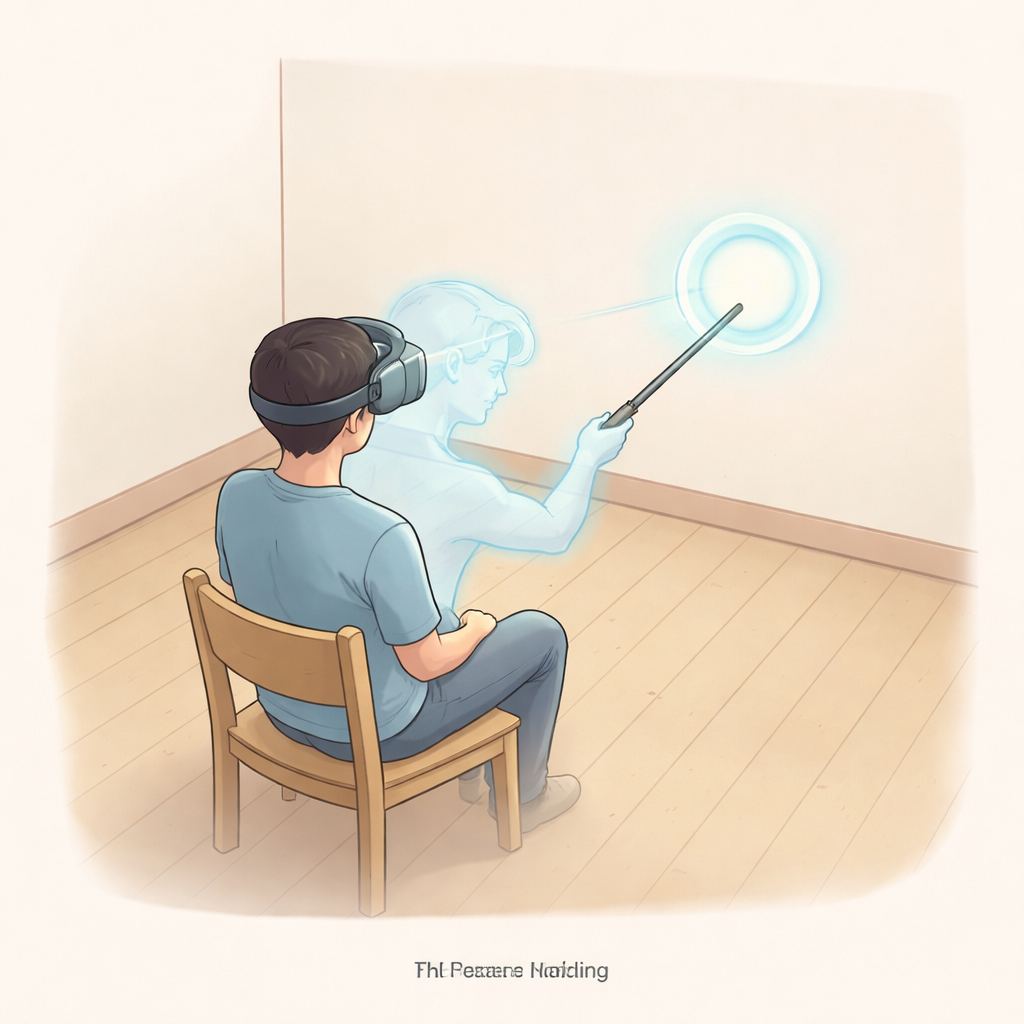
Practicing With a Virtual Tool
Next came the tool-use phase. Participants controlled a virtual stick with a hand-held VR controller. Their avatar’s right arm and the stick moved in sync with their real arm, thanks to animation software that inferred joint positions from the controller. Tasked with hooking a pink virtual ring 1.5 meters in front of them and then placing it into a box near their feet, they repeated this far-to-near movement 150 times. After this practice, they performed the visuo-tactile task again, and they also rated how strongly they felt that the avatar’s body was their own, both before and after tool use.
Different Brain Adjustments With Age
The younger adults showed a targeted adjustment: after using the virtual stick, their visual and touch signals were combined more strongly at and just beyond the tool-use distance (around 1.5 to 1.9 meters), but not at closer or farther locations. This pattern suggests that, for them, virtual tool use specifically expanded or reshaped the “near” space toward where the stick had been used. Older adults, in contrast, did not show such a distance-specific shift. Instead, they exhibited a more general boost in visual–touch integration across almost all distances within the VR scene, except the very farthest one. Both age groups felt more ownership over their avatar bodies after tool use, but only in older adults was a larger increase in avatar ownership linked to a larger overall boost in multisensory integration. 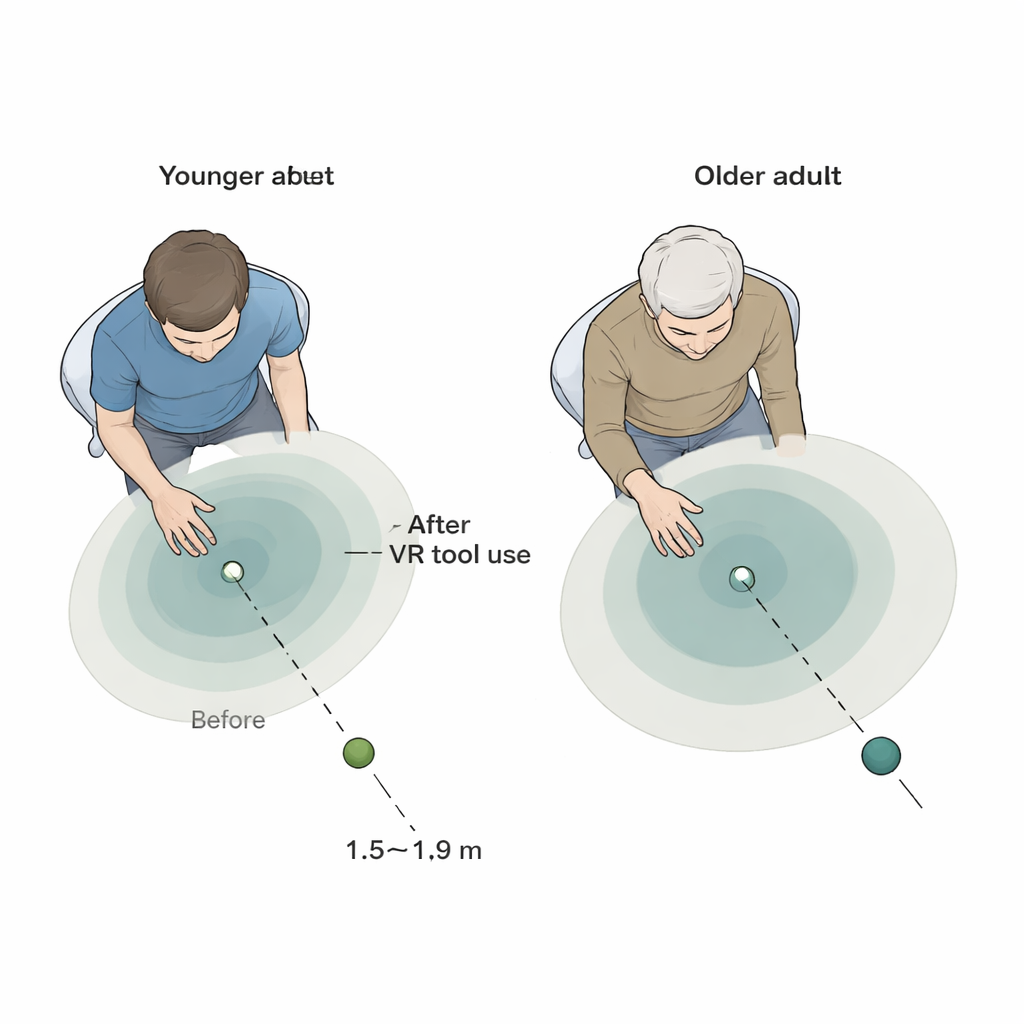
Why This Matters for VR in Everyday Life
For a layperson, the takeaway is that our sense of “what counts as near my body” can be reshaped even by digital tools in virtual worlds—but the way this reshaping happens changes with age. Younger adults seem to fine-tune the brain’s near space specifically toward where the virtual tool is used, as if the stick truly extends their reach. Older adults instead appear to strengthen their awareness of the whole virtual space around their avatar, especially when they feel that the avatar body really belongs to them. This suggests that VR-based training or rehabilitation might work best if it is tailored differently for younger and older users—for example, by emphasizing precise tool interactions for younger people and boosting body ownership and general immersion for older adults. Overall, the study shows that the brain’s map of the space around us remains flexible well into older age, and that virtual reality can tap into this flexibility to support more inclusive digital experiences.
Citation: O’Leary, D., Fan, Y., Krzywinski, J. et al. Adult age differences in the modulation of peripersonal space after tool use in virtual reality. Sci Rep 16, 7505 (2026). https://doi.org/10.1038/s41598-026-41116-y
Keywords: virtual reality, peripersonal space, tool use, aging, multisensory integration