Clear Sky Science · en
Temporal dynamics of the tomato rhizosphere microbiome in response to synthetic communities of plant growth-promoting rhizobacteria
Why tiny root-dwelling allies matter for our food
Tomatoes are one of the world’s most important vegetables, yet high yields often depend on heavy use of fertilizers and pesticides. This study explores a greener path: recruiting helpful soil bacteria that live around plant roots to boost growth and health. By building "synthetic communities" of friendly microbes from tomato’s own natural partners, the researchers asked whether small, well-designed bacterial teams could replace some chemicals and gently steer the underground life that supports crops.
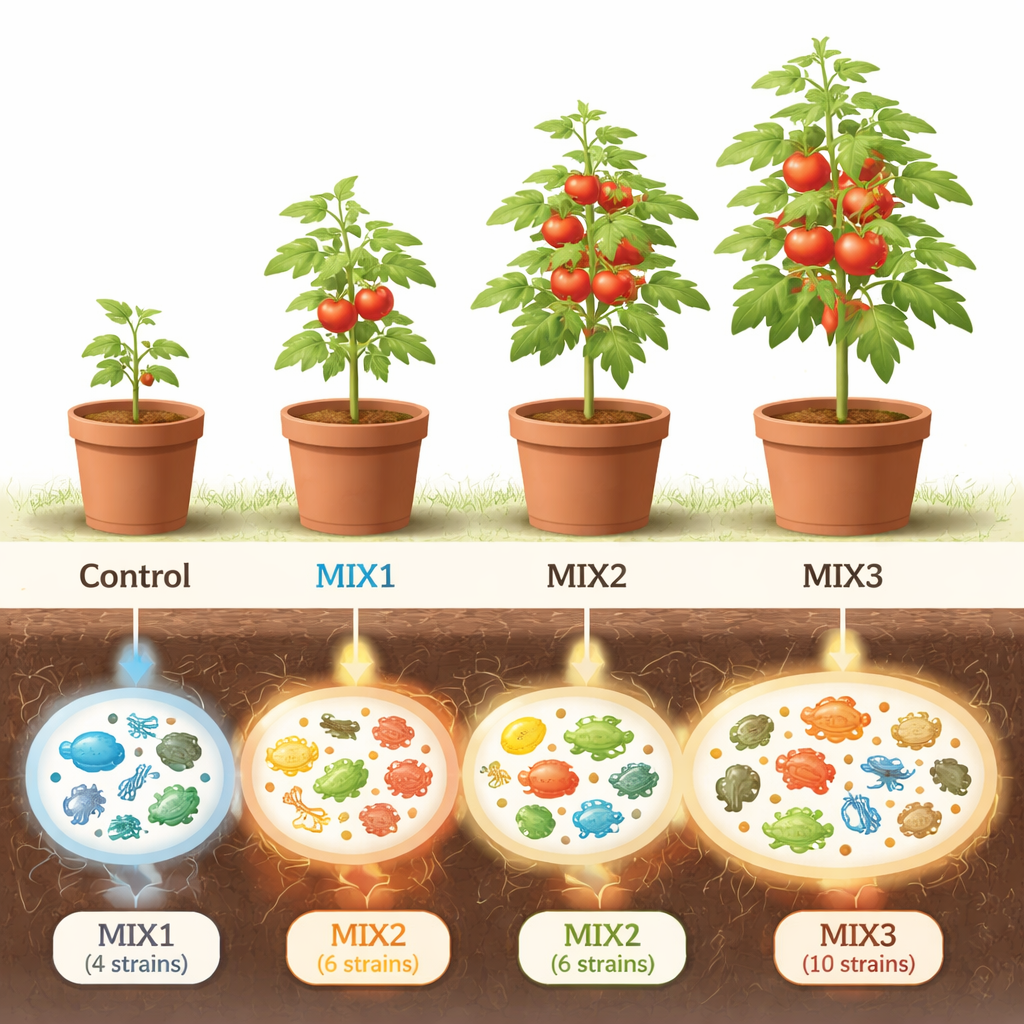
Building custom teams of helpful bacteria
The scientists started with ten bacterial strains originally found living inside tomato plants, members of the crop’s "core microbiome." These included well-known helpers like Bacillus and Pseudomonas, plus lesser-known genera such as Glutamicibacter, Leclercia, Chryseobacterium and Paenarthrobacter. From these, they assembled three synthetic communities, or SynComs, of increasing richness: MIX1 (4 strains), MIX2 (6 strains) and MIX3 (10 strains). All were mixed in equal proportions and applied to the soil of young tomato plants as a drench, mimicking a practical treatment farmers could use in nurseries or greenhouses.
Tomato plants grow taller with the right partners
When the SynComs were added to two tomato varieties—one bushy, one vine-like—all treatments increased plant height and biomass compared with water-only controls. The strongest effect appeared in the indeterminate variety ‘Proxy.’ After four weeks, plants treated with the six-strain MIX2 and the ten-strain MIX3 were up to 94% taller than untreated plants, and their shoots weighed significantly more, both fresh and dry. MIX1 also boosted growth, but less dramatically. A key difference between MIX1 and the other mixtures was the presence of Pseudomonas in MIX2 and MIX3, suggesting that pairing these species with Bacillus and the other strains creates particularly powerful growth-promoting combinations.
Shaping an invisible world around the roots
To see how these SynComs influenced the hidden community of microbes living around the roots (the rhizosphere), the team tracked bacteria and fungi over a month using DNA sequencing. Time itself turned out to be the main factor structuring these communities, as the young plants and their roots developed. Against this shifting background, the SynComs triggered distinct, time-dependent changes. One week after treatment, bacterial communities in treated plants—especially those given MIX2—showed strong, treatment-specific shifts, including enrichment of many rare bacterial groups linked to key nutrient cycles, such as sulphur- and nitrogen-transforming microbes like Desulfosporosinus, Sulfurovum and Azospirillum. By the second week, these effects began to fade; by the fourth week, responses in different SynComs had partly converged, and many of the initially stimulated rare taxa were now depleted compared with controls.
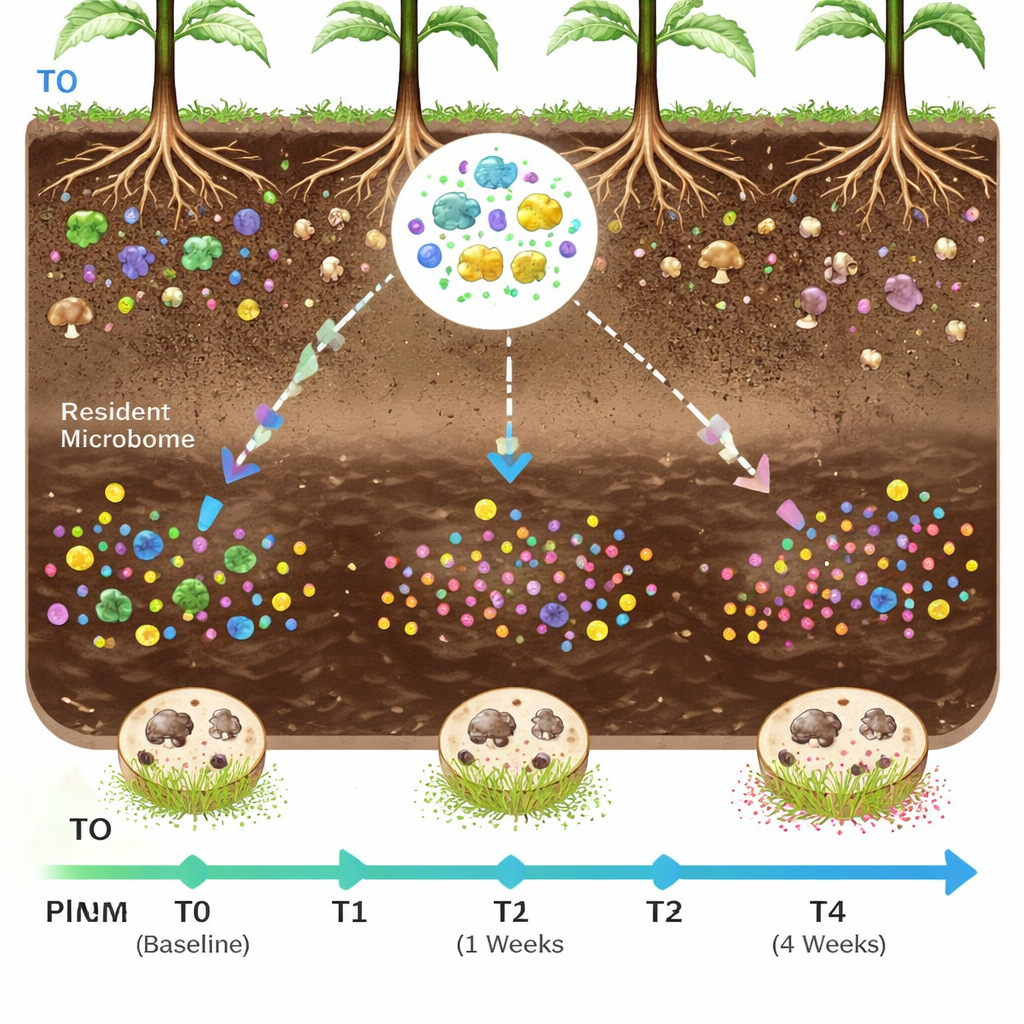
Quiet but meaningful ripples through the soil food web
The inoculated strains themselves did not remain dominant. Their genetic signatures declined steadily over time and sometimes became hard to detect, even though plant growth benefits persisted. This pattern suggests that the SynComs act more like a temporary spark than a permanent implant: an early push that rearranges interactions among resident microbes, particularly within the "rare biosphere"—the multitude of species present at very low abundance but capable of quick response to change. Computer-based predictions of microbial functions indicated that communities exposed to Pseudomonas-containing SynComs shifted toward a greater potential for breaking down complex or foreign compounds, while other metabolic pathways subtly rebalanced. Fungal communities were less dramatically affected, but the SynComs appeared to slow the decline of certain groups and support others, such as Basidiomycota and Mucoromycota, hinting at a gentle cross-kingdom influence.
What this means for future sustainable farming
In everyday terms, this work shows that small, carefully chosen teams of bacteria—sourced from plants themselves—can make tomatoes grow bigger while also nudging the surrounding soil life into new, potentially healthier configurations. Rather than taking over the root zone, these SynComs briefly stir up the community, especially its rare members that help drive nutrient and chemical cycles, and the plants reap the benefits even after the added microbes thin out. The findings support the idea that next-generation biofertilizers will come not from single "miracle" strains, but from tailored, host-matched microbial communities designed to work with native soil life, reduce chemical inputs and keep crop productivity high.
Citation: Nicotra, D., Mosca, A., Dimaria, G. et al. Temporal dynamics of the tomato rhizosphere microbiome in response to synthetic communities of plant growth-promoting rhizobacteria. Sci Rep 16, 7829 (2026). https://doi.org/10.1038/s41598-026-41114-0
Keywords: tomato microbiome, beneficial bacteria, soil health, plant probiotics, sustainable agriculture