Clear Sky Science · en
Evaluation of copper chloride crystallisation as a method for systems-level characterisation of phytopharmaceuticals – a pilot investigation
Why the shape of crystals could matter for herbal medicine
Herbal remedies are hugely popular, yet checking their quality is surprisingly hard. Most tests zoom in on just a few molecules, even though plant extracts are tangled mixtures of hundreds of substances that may work together. This study asks a simple but intriguing question: can we learn something about a plant medicine by watching how it makes crystals grow in a salt solution? If so, we might gain a more “whole-picture” way to look at complex herbal products.
A picture-based test for plant extracts
The researchers focused on a technique called copper chloride crystallisation. In this method, a plant extract is mixed with a solution of copper salt and allowed to dry in shallow glass dishes. As the liquid evaporates, delicate branching crystals spread across the surface, forming patterns that look a bit like ferns or river deltas. These patterns, captured as images, act like “fingerprints” of the sample. Instead of measuring single chemicals, the team used computer tools to describe the overall texture and structure of the crystal patterns—how rough or smooth they are, how complex the fine details look, and how long and numerous the crystal “needles” become. 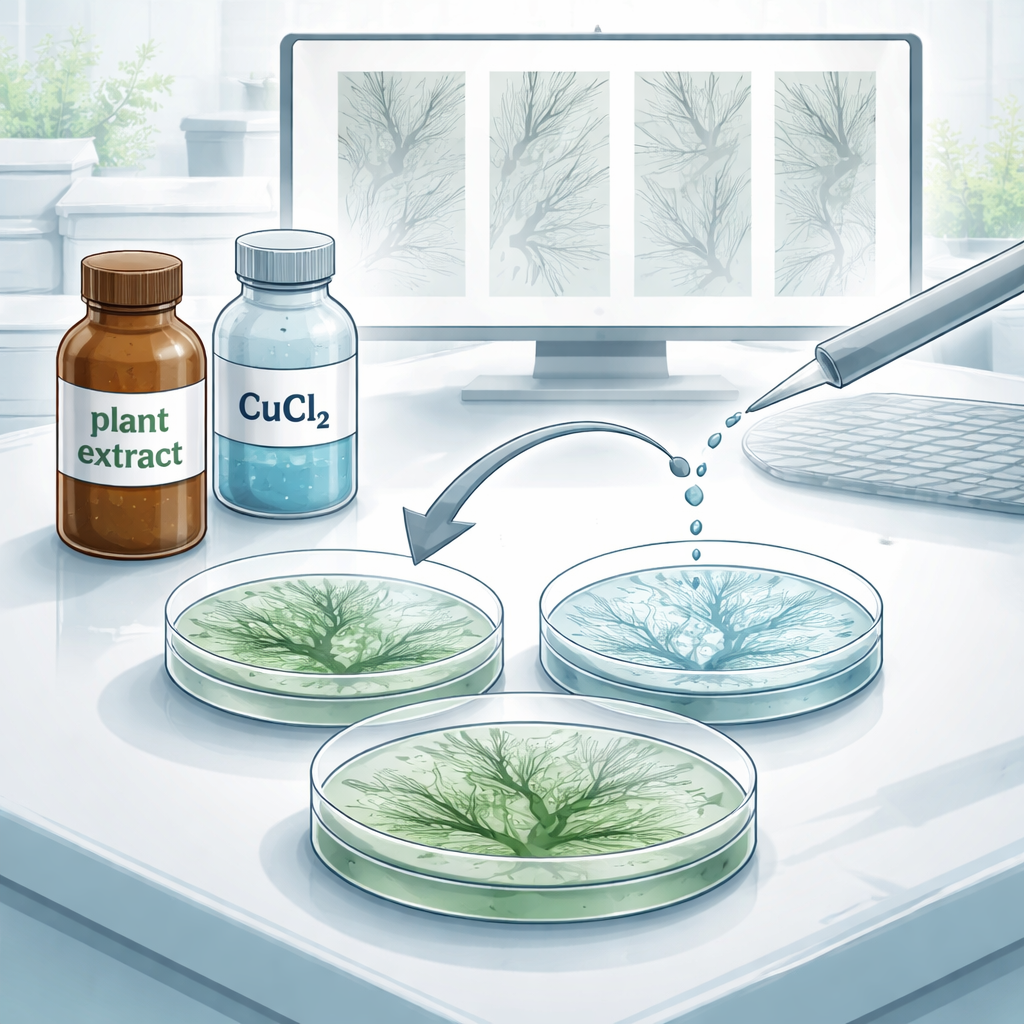
Mistletoe as a test case
To see how sensitive this crystal fingerprinting really is, the scientists chose European mistletoe, a plant widely used in complementary cancer care. They prepared a series of mistletoe extracts that differed in three increasingly subtle ways. First, they compared two subspecies of mistletoe that are already known to have clear chemical differences. Second, they looked at mistletoe from the same subspecies but growing on two different deciduous trees, apple and oak, where the chemical distinctions are more modest. Third, they compared two ways of blending the fermented plant juices: by hand in a simple glass container, or using a special high-speed machine developed within anthroposophic pharmacy and claimed to affect deeper, system-like properties of the remedy. All samples were processed in a tightly controlled crystallisation setup, and the resulting patterns were scanned and analysed by computer.
What the crystal patterns revealed
The team then asked how well seven image-based variables could tell these samples apart. For the broadest difference—between mistletoe subspecies—all seven variables showed clear and statistically strong separation of the crystal patterns, in line with the well-known chemical contrast between these plants. When the comparison was narrowed to mistletoe from apple versus oak trees, four variables still picked up reliable differences, although the signal was weaker and in some cases depended on which production batch was examined. Finally, for the finest distinction—the blending procedure—two structural measures related to the length and number of crystal needles were able to spot a small but real difference between hand-blended and machine-blended extracts. This is notable because previous chemical profiling failed to detect any distinction between these two processes, even though biological tests had hinted that the machine-treated extracts might act differently.
Checking the method’s stability
Of course, a method is only useful if it is stable and not fooled by everyday experimental noise. To test this, the researchers ran control experiments in which the same mistletoe extract was crystallised repeatedly in all positions of the chambers over several days. Under these conditions, the image variables did not show systematic differences related to subspecies, host tree, or process—because none existed. Some measures did drift slightly with experimental day, as might be expected in a real laboratory, but overall the setup appeared robust. Importantly, the two crystallisation chambers performed equivalently, suggesting the observed differences in the main study really stemmed from the samples rather than from quirks of the apparatus. 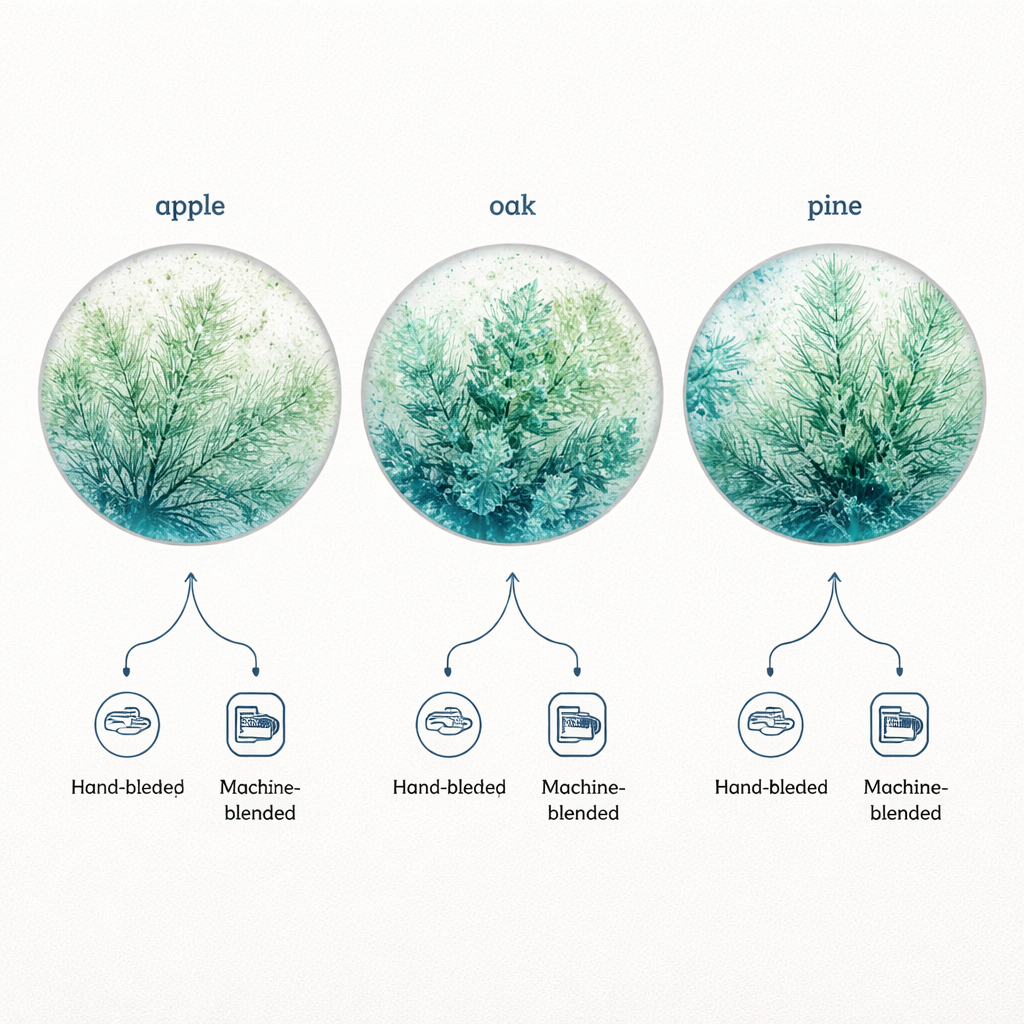
What this could mean for future herbal quality testing
For a lay reader, the key message is that the way crystals grow in a dish seems to “remember” more than just simple chemistry. From a single set of crystal images, the researchers could read out information about plant subspecies, growing conditions, and even a very subtle manufacturing step. This makes copper chloride crystallisation an intriguing candidate as a complementary quality test for complex herbal medicines, one that looks at the product as an integrated whole. The authors stress that this is an early, exploratory study: more work is needed to standardise the method, link the image features to specific product properties, and test it on other plants. Still, the findings suggest that pattern-based approaches might one day help regulators and manufacturers ensure that herbal medicines are not only chemically consistent but also stable, resilient, and effective as multifaceted natural products.
Citation: Guglielmetti, G., Doesburg, P., Scherr, C. et al. Evaluation of copper chloride crystallisation as a method for systems-level characterisation of phytopharmaceuticals – a pilot investigation. Sci Rep 16, 7506 (2026). https://doi.org/10.1038/s41598-026-41081-6
Keywords: herbal medicine quality, mistletoe extract, crystallisation patterns, phytopharmaceuticals, systems-level analysis