Clear Sky Science · en
Feather aerodynamics suggest importance of lift and flow predictability over drag minimization
Why feather details matter for flight
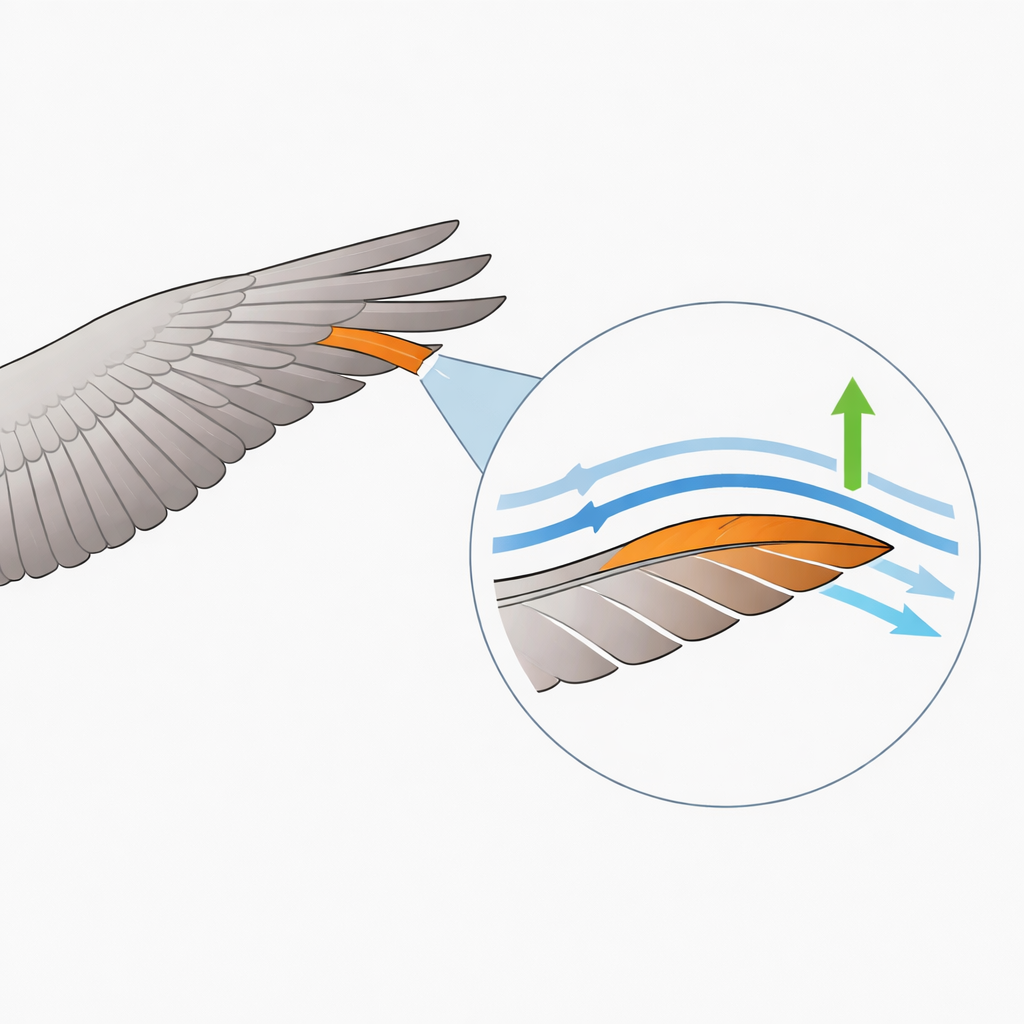
Birds’ wings look soft and simple from a distance, but up close they are built from many overlapping feathers with intricate structures. At the outer edge of the wing, some of these feathers spread apart and act almost like a row of tiny individual wings. This study asks a deceptively simple question with big consequences: how well does a single flight feather work as a wing, and what trade-offs has evolution made between flying efficiently, staying structurally strong, and keeping the forces on the bird’s body predictable?
A tiny wing at the edge of a jackdaw’s wing
The researchers focused on the ninth primary flight feather of a jackdaw, a crow-like bird that is a capable glider. At the outer, slotted part of the wing, this feather sits at the leading edge and can function as an independent miniature wing. Using a high-resolution X-ray CT scan, the team built a detailed 3D computer model of a short section of this feather, including the central shaft and the rows of barbs that form the feather’s vanes. They then used computational fluid dynamics—a numerical wind tunnel—to simulate how air flows over this slice of feather during gliding, at speeds and sizes that match real jackdaw flight.
Comparing real feather structure to a smooth wing shape
To understand what the feather’s complex microstructure actually does, the team created a second, simplified model: a smooth "equivalent aerofoil" that follows the effective outline of the feather but lacks the protruding shaft and barbs. This pair of models allowed them to ask which features help or hurt aerodynamic performance. They tested how lift (the upward force), drag (the resisting force), and the twisting torque around the shaft changed with angle of attack—the tilt of the feather into the wind. They also studied how vortices and regions of separated flow formed and shed from the feather, patterns that can make forces fluctuate over time.
Lift, drag, and the surprising role of roughness
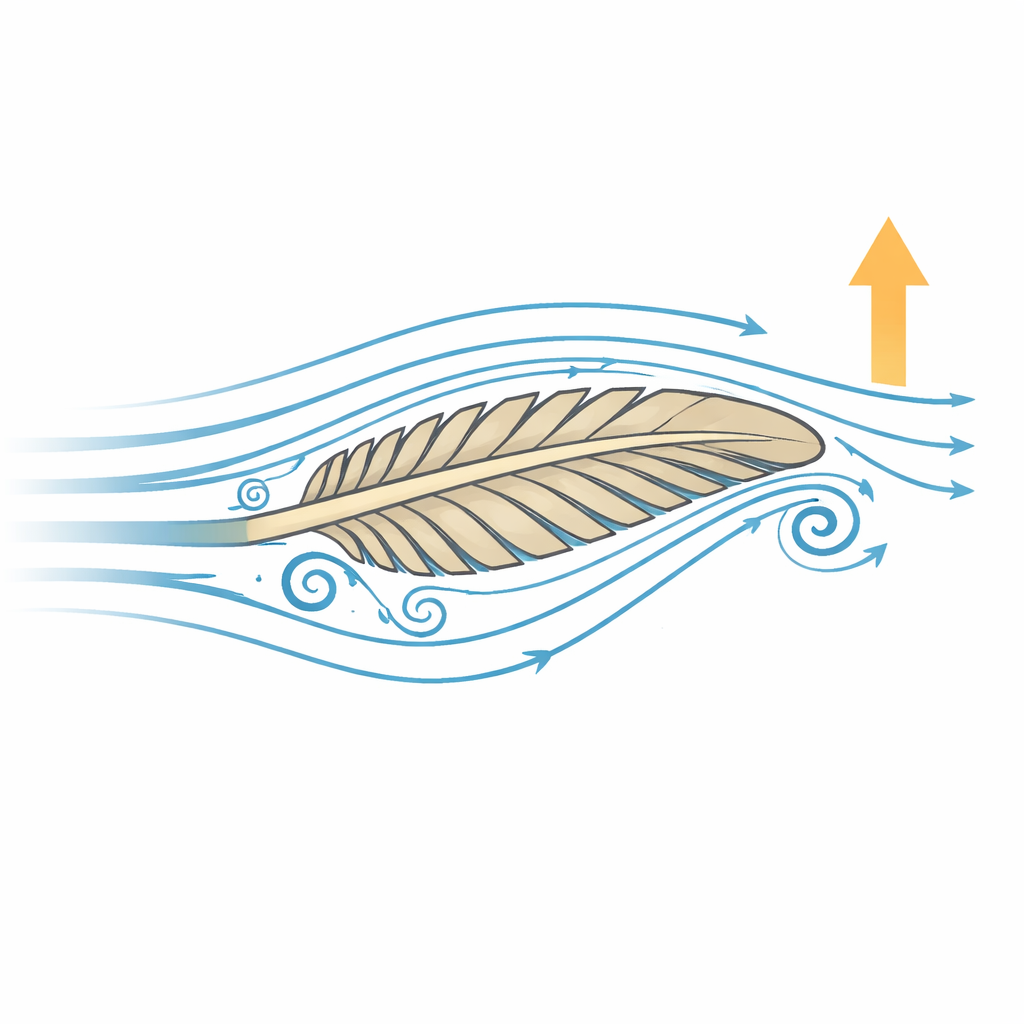
The feather section generated lift levels comparable to carefully designed man-made wing profiles and thin plates, even though it operates at much lower Reynolds numbers, where air behaves more viscously and is harder to manage aerodynamically. The central shaft and raised barbs did not significantly reduce lift, but they did increase drag compared with the smooth equivalent aerofoil. In other words, the detailed structure imposes a drag penalty while preserving, and in some angles slightly boosting, lift. Despite this, the feather’s ratio of lift to drag was at least as good as that of the smooth version, because the simplified profile lost more lift than it gained in reduced drag. The flow patterns around the feather resembled those around technical aerofoils in this size range, but with some notable differences, such as the absence of a classic laminar separation bubble and a distinctive way that flow separates and sheds vortices from near the shaft.
Stable forces and passive self-adjustment
Across a wide range of angles, the feather model produced lift with relatively low, steady fluctuations compared with many engineered wing profiles. At modest angles of attack, the flow stayed attached or shed vortices in a regular pattern, giving predictable forces over time. The simulations also showed that the aerodynamic torque around the shaft always tended to twist the feather nose-down. Real jackdaw feathers are built with an inherent nose-up twist along their length. Combining this built-in twist with the aerodynamic nose-down torque suggests a passive self-correcting mechanism: as the feather is pushed to higher angles, the torque increases in a way that helps detwist it back toward a mid-range angle where lift is strong, drag is acceptable, and force fluctuations remain small.
What this means for birds and small flying machines
The results paint a picture of feathers as products of evolutionary compromise. The shaft must be thick and strong enough to carry loads and withstand flapping, even though that shape inevitably adds drag. The raised barbs and complex surface do not minimize resistance to the absolute limit, but they appear to support good lift, predictable flow separation, and stable, low-noise force production. For a bird, these features likely aid control and reduce sudden jolts during flight, which may be more important than shaving off every bit of drag. For engineers designing micro air vehicles or tiny wind turbines that operate in the same challenging flow regime, the study suggests that copying feathers may be less about perfectly smooth, drag-minimizing surfaces and more about embracing structures that trade some efficiency for robustness and passive stability.
Citation: Alenius, F., Revstedt, J. & Johansson, L.C. Feather aerodynamics suggest importance of lift and flow predictability over drag minimization. Sci Rep 16, 8380 (2026). https://doi.org/10.1038/s41598-026-41064-7
Keywords: bird flight, feather aerodynamics, micro air vehicles, wing design, flow stability