Clear Sky Science · en
Distinct neural signatures of hippocampal population dynamics during locomotion-in-place
How the Brain Tracks Movement Without Going Anywhere
Even when you run on a treadmill and never leave the spot, your brain somehow keeps track of how fast and how far you have gone, and how long you have been moving. This study explores how a key brain region called the hippocampus—best known for memory and navigation—handles different kinds of motion, from steady, stimulus-driven running to fidgety, almost-still movements. Understanding these internal "motion codes" can shed light on how the brain builds our sense of space, time, and action, and how that might fail in aging or disease.
A Careful Look Inside the Moving Brain
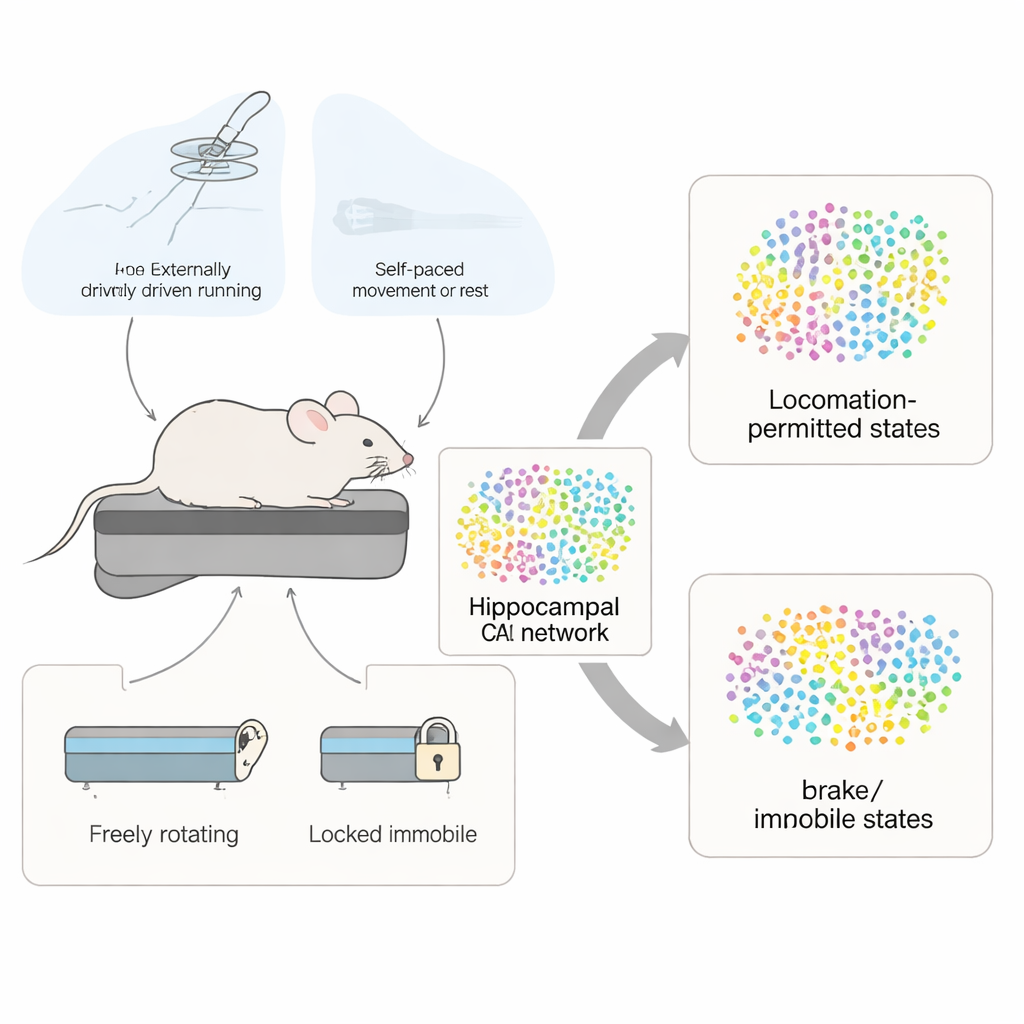
To watch many brain cells at once while keeping the situation tightly controlled, the researchers worked with mice whose heads were gently fixed in place above a simple, non-motorized conveyor belt. A mild stream of air to the back made the animals run; turning the air off allowed them to slow down or stop on their own. In some sessions the belt could rotate freely, letting the mice run in place with full steps. In others, a brake locked the belt so that only tiny paw movements were possible. Throughout, a microscope that detects flashes of calcium inside nerve cells recorded the activity of hundreds of hippocampal neurons, allowing the team to infer when each cell became more or less active.
Different Kinds of Running, Different Neural Casts
Behaviorally, the air jet created two clear movement states. During air-on periods on a free belt, mice quickly reached and maintained relatively high speeds, behaving much like someone keeping pace on a treadmill. When the air stopped, they continued moving for a while, then slipped into slower, more irregular, self-paced bouts. On a locked belt, the same air bursts produced only small, in-place motions, but these still varied between air-on and air-off phases. The researchers asked how strongly each hippocampal cell’s activity related to three simple quantities: how much time had passed, how much distance had been covered (or, under the brake, how much movement-in-place occurred), and how fast the animal was moving.
Sharp, Simple Codes After the Stimulus
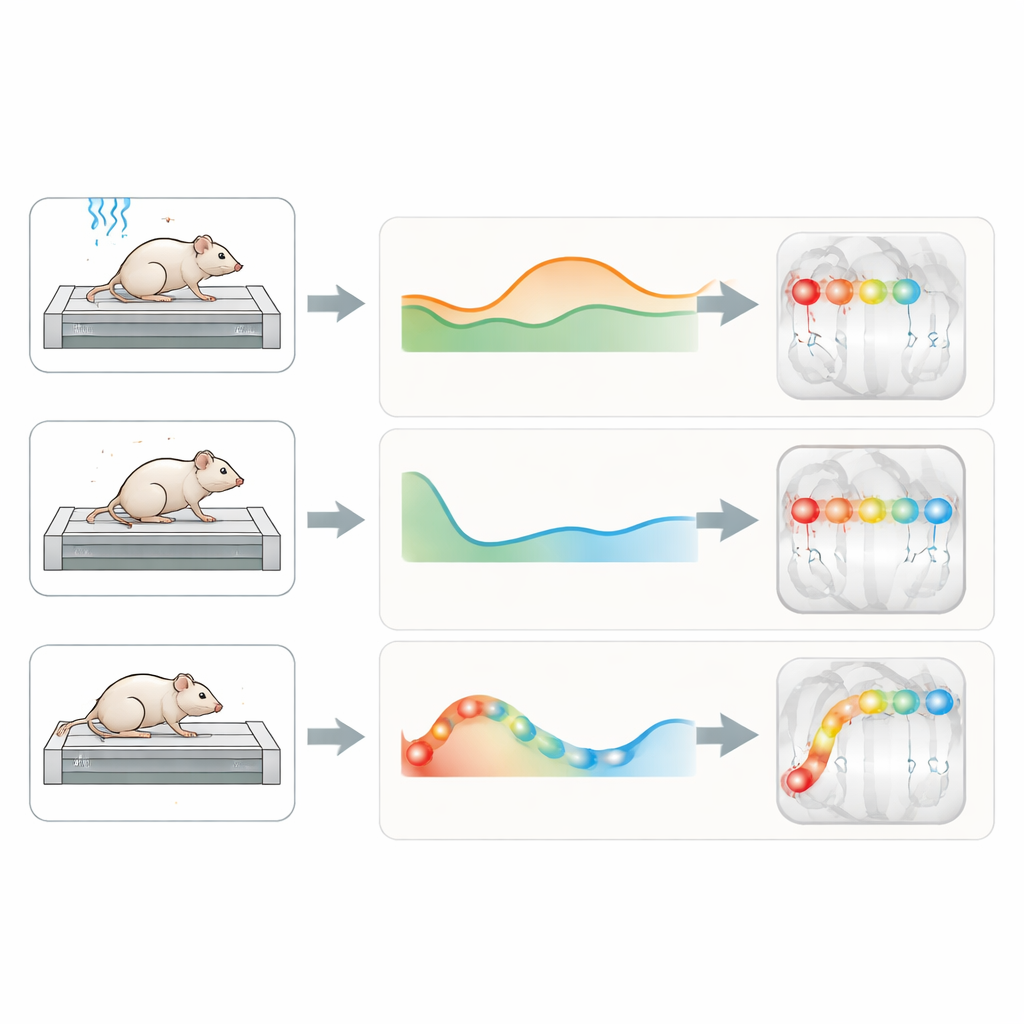
Across conditions, more cells were active and clearly tied to movement variables during the post-stimulus air-off periods, in which the animals moved on their own. When the team controlled for the fact that air-off phases simply lasted longer, they found that air-on running actually recruited a more reliable subset of cells—but over the full, longer air-off window, many additional neurons came into play. Within this active population, most cells turned out to be "specialists": their firing was linked mainly to a single feature—time, distance, or speed—rather than a complicated mixture of all three. This tendency toward simple, single-variable tuning was strongest during air-off, suggesting that once the driving stimulus ended, hippocampal networks shifted into a mode that highlights specific aspects of ongoing motion.
Speed Leads, Time and Distance Follow
When the researchers zoomed in on the timing of activity, a striking pattern emerged. Cells whose activity reflected speed tended to reach their peak firing earlier after the start or end of the air stream than cells that tracked time or distance. In other words, speed-related signals flared up quickly around the sensory event that launched or halted running, while time and distance signals built up later as the movement unfolded. Under forced immobility, cells were again mostly specialists, now tuned either to time or to subtle movement-in-place, with movement-in-place signals especially prominent after air was turned off. This points to a role for the hippocampus in monitoring even tiny, attempted motions when actual forward movement is blocked.
Stable Group Patterns Despite Changing Individuals
At the level of single cells, the cast of which neuron encoded what was surprisingly fluid: a cell that tracked speed in one configuration might instead track time, distance, or nothing at all in another. Yet when the authors looked at the population as a whole, they found orderly structure. Groups of cells active in the same phase—air-on or air-off—tended to resemble each other more than groups across phases, and patterns formed distinct clusters for free-running versus braked conditions. This suggests that the hippocampus maintains a stable "scaffold" of population organization while flexibly reassigning roles to individual neurons as movement context changes.
What This Means for Our Inner Sense of Motion
Put simply, the study shows that the hippocampus does not rely on a fixed set of cells to track movement. Instead, it dynamically reweights simple signals about speed, time, distance, and even tiny in-place motions depending on whether movement is externally driven or self-paced, and whether the body is free to move or held still. Speed signals come online first around important sensory events, while more precise timing and distance codes emerge as behavior unfolds. Despite this churn at the single-cell level, the overall pattern of activity remains well organized and tied to behavioral state. Such a flexible yet structured system may underlie our ability to form memories that weave together where we were, how we moved, and when things happened—even when we never actually left the spot.
Citation: Inayat, S., McAllister, B.B., Whishaw, I.Q. et al. Distinct neural signatures of hippocampal population dynamics during locomotion-in-place. Sci Rep 16, 10372 (2026). https://doi.org/10.1038/s41598-026-41049-6
Keywords: hippocampus, locomotion, neural coding, population dynamics, sensorimotor integration