Clear Sky Science · en
Bystander and emergency medical service responses to and outcomes of out-of-hospital cardiac arrest among domestic and non-domestic visitors in Japan
Why this matters to travelers and locals
When someone’s heart suddenly stops on a street, in a train station, or in a hotel lobby, seconds decide whether they live with a healthy brain, survive with disability, or die. This study asks a simple but urgent question for a country that welcomes millions of visitors each year: do people from elsewhere fare as well as locals when cardiac arrest strikes in public? Using nationwide data from Japan, the researchers show that visitors from abroad face a quieter but serious risk: they are less likely to receive quick help from people nearby and, as a result, less likely to recover well.
Looking at millions of emergencies
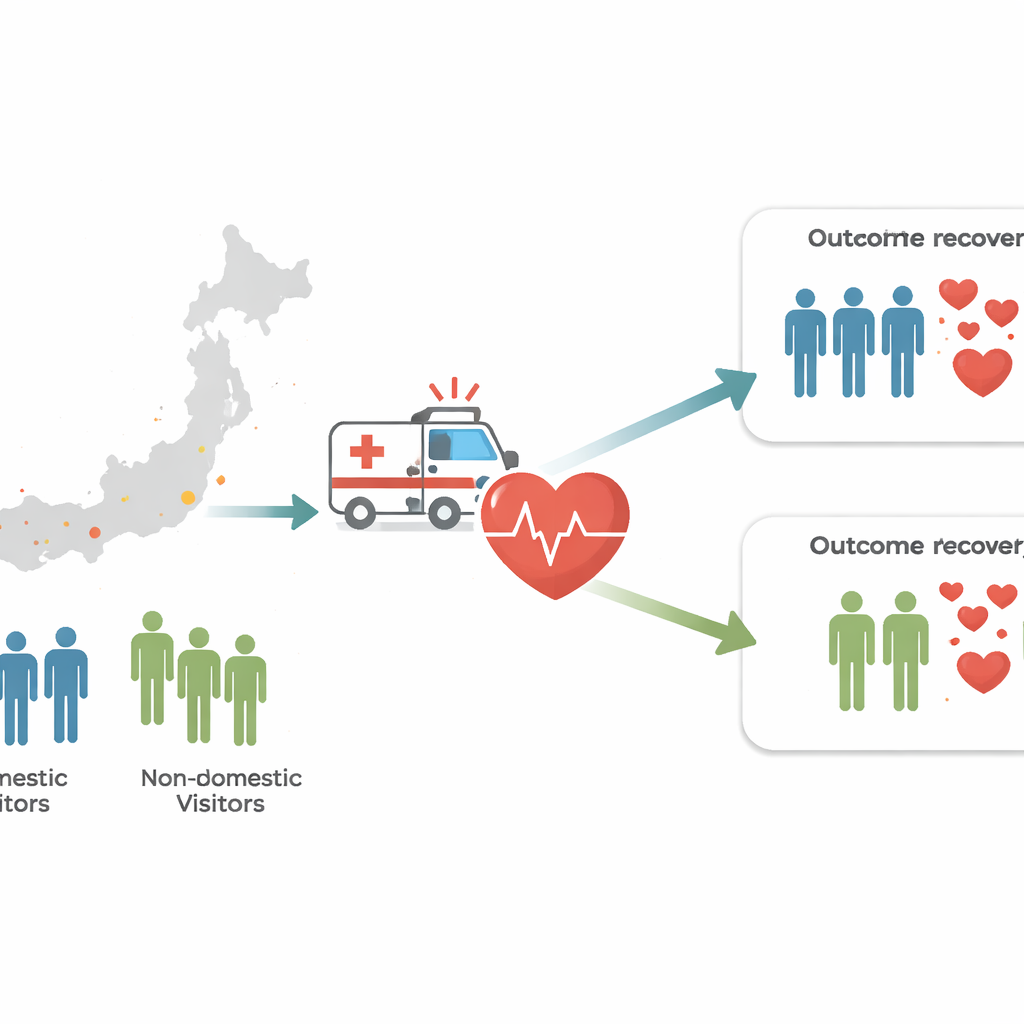
Japan keeps unusually detailed records of every ambulance call and every out-of-hospital cardiac arrest. The team combined two national databases covering 2018–2023, including more than 32 million emergency transports and over 770,000 cases where someone’s heart stopped outside a hospital. From these they pulled out nearly 57,000 cases involving visitors who were not residents of the area where they collapsed. They then divided this group into domestic visitors (people living somewhere in Japan but away from home) and non-domestic visitors (mainly foreign tourists and business travelers) and compared who they were, where they collapsed, how people around them responded, and what happened a month later.
Who is collapsing, and where
Non-domestic visitors tended to be younger and more often male than domestic visitors. Their emergencies clustered in Tokyo and other big-city hubs, and more often occurred in public places such as stations, streets, and tourist areas. Ambulances generally reached them slightly faster, reflecting dense urban coverage. Yet several warning signs appeared in the data. Cardiac arrests in non-domestic visitors were more likely to go unwitnessed, more likely to happen in private lodging or homes away from familiar social networks, and less likely to be caused by a sudden heart problem that responds well to electric shocks. All of these patterns are known to reduce the chances of a good recovery, even before considering how bystanders and emergency teams react.
When help from strangers makes the difference
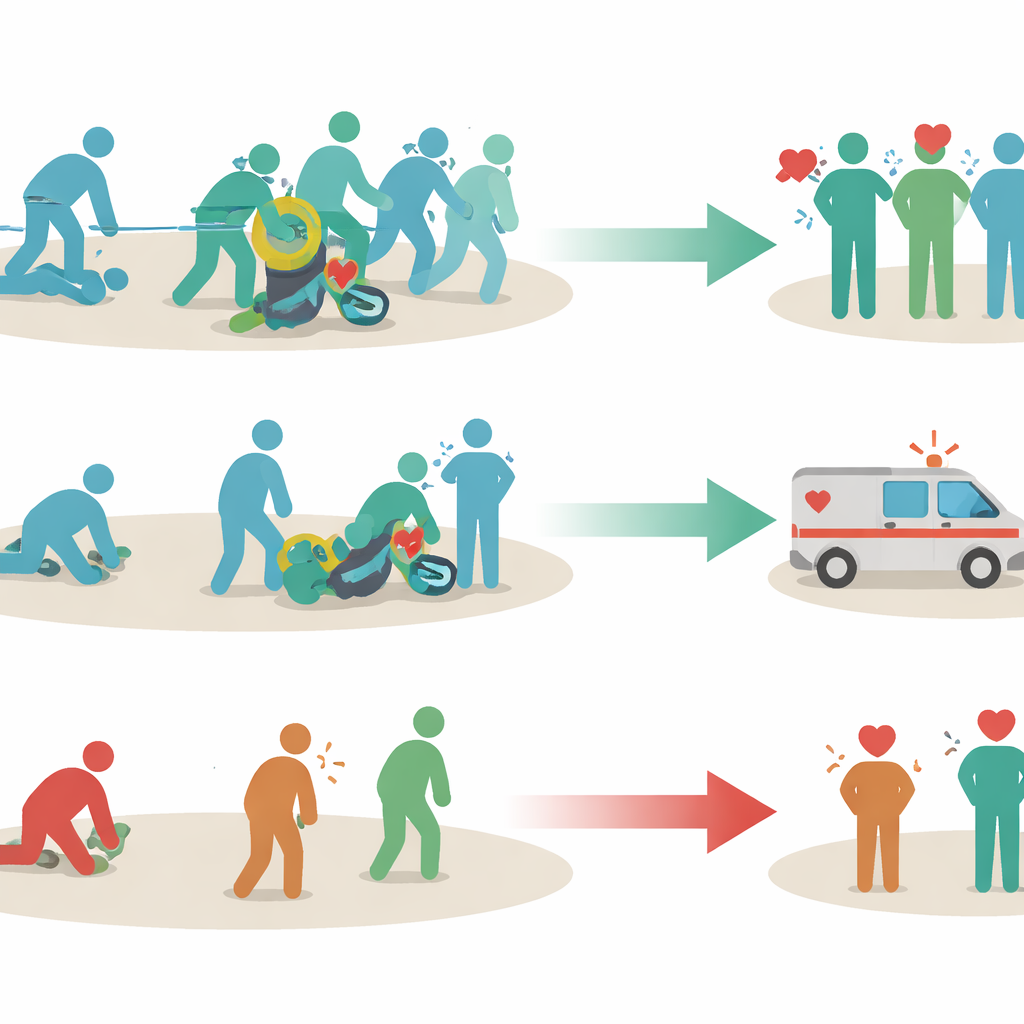
The strongest contrast between the two visitor groups was what happened in the crucial minutes before the ambulance arrived. For domestic visitors, more than half of cardiac arrests prompted chest compressions from bystanders; for non-domestic visitors, fewer than one in three did. Early use of public defibrillators was also rarer. As a result, non-domestic visitors were less likely to have a shockable heart rhythm when paramedics arrived and less likely to regain a pulse before reaching the hospital. One month later, 8.6% of domestic visitors were alive with good brain function, compared with only 4.5% of non-domestic visitors. Even after the researchers adjusted for age, sex, cause of arrest, location, response times, and other known influences, non-domestic visitors were about 40% less likely to have a favorable brain outcome.
Digging deeper into the gap
To test whether hidden differences might explain the gap, the team used advanced matching methods to create pairs of domestic and non-domestic visitors who looked almost identical on paper: same age, type of emergency, heart rhythm, location, and timing. Even in this more level comparison, non-domestic visitors still had clearly worse outcomes. The gap did not depend strongly on whether the cause was cardiac or non-cardiac, or whether the first recorded rhythm was shockable or not. During the COVID-19 pandemic, bystander CPR fell for everyone, but the drop was sharper for non-domestic visitors, suggesting that fear and confusion during crises may amplify existing disadvantages.
Barriers you cannot see, but can change
The study cannot measure every possible factor, such as underlying health, language skills, or the training and attitudes of bystanders. Still, the patterns point toward invisible barriers between visitors and those around them. Non-domestic visitors may hesitate to call for help, may not know the local emergency number, or may struggle to communicate their location. People nearby may be uncertain about how to assist someone who looks or sounds different, or worry about legal or cultural consequences. The authors argue that strengthening multilingual emergency information, training staff in tourist-heavy areas, and promoting simple CPR skills could narrow this survival gap. In plain terms, the study shows that a stranger’s life in a crowded city may depend on whether the people around them feel ready and willing to act, and that visitors from abroad still do not benefit from that help as much as locals do.
Citation: Omatsu, K., Ushimoto, T. & Inaba, H. Bystander and emergency medical service responses to and outcomes of out-of-hospital cardiac arrest among domestic and non-domestic visitors in Japan. Sci Rep 16, 8935 (2026). https://doi.org/10.1038/s41598-026-41033-0
Keywords: cardiac arrest, tourism health, bystander CPR, emergency care, Japan