Clear Sky Science · en
Mental and physical fatigue altered working memory consolidation and impaired gaze behavior and perceptual-cognitive skills using video-based and real-situation
Why Tired Eyes Matter in Fast Sports
Anyone who has tried to return a fast serve or react to a quick pass knows that sports are as much about sharp thinking as strong muscles. This study looks at how different kinds of tiredness—mental, physical, and a mix of both—change the way novice badminton players see the game, make split‑second choices, and remember what they’ve just processed. By tracking where players look and how quickly they react in both video drills and real matches, the researchers reveal why feeling mentally drained can be even more harmful than sore legs when the game speeds up.
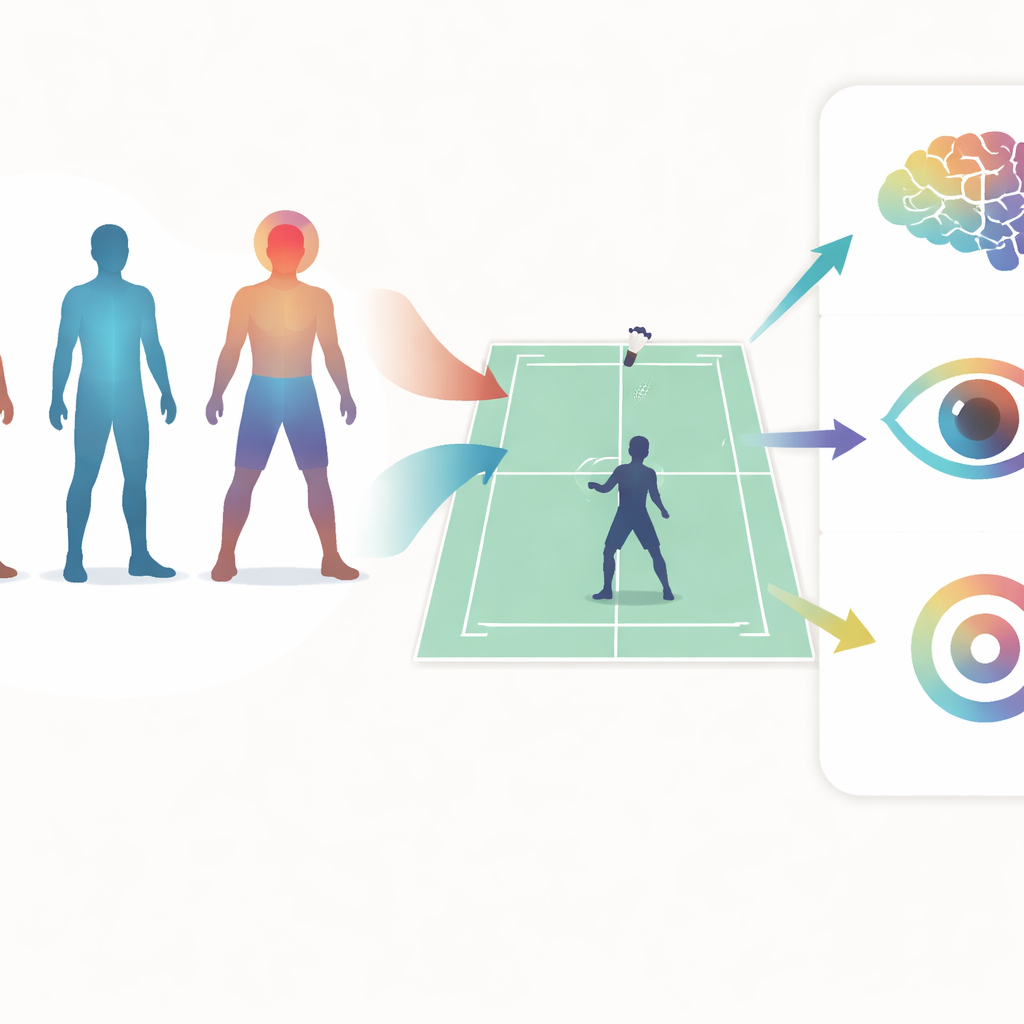
Three Types of Tiredness Put to the Test
The researchers recruited young women with no racquet‑sport experience and divided them into three groups. One group was made mentally tired using an hour‑long, attention‑heavy computer task. A second group was made physically tired through intense badminton‑style running drills. The third group experienced a half‑and‑half mix of both. Before, during, and after these fatigue sessions, each participant completed two kinds of badminton tasks: video clips that paused right as the shuttle was hit, and real rallies on a court. In both settings, they had to predict where the shuttle would go, decide on a response as quickly as possible, and performed a simple working‑memory test. Mobile eye‑tracking glasses recorded where and how long players fixed their gaze.
How Tiredness Scrambles Where We Look
Across all fatigue types, players’ gaze patterns became less efficient. As tiredness set in, the number of eye fixations increased, but each fixation became shorter. Instead of settling their gaze on a few key areas, players hopped their eyes around more, especially toward the shuttle itself and empty court spaces after the opponent’s stroke. Mental fatigue drove the biggest disruption, particularly in real match situations. When the researchers compared successful and unsuccessful strokes, they found that good shots were linked to fewer but longer fixations, with more time spent looking at the opponent’s upper body, a small “anticipation” zone between racket and shuttle, and certain boundary areas. In contrast, missed shots were tied to a scattered visual search, with attention drifting toward less useful spots.
Thinking Speed and Short‑Term Memory Take a Hit
Performance measures told a similar story. After becoming mentally tired, players were less accurate in predicting shuttle direction and took longer to decide on a response, both in videos and on the court. Physical fatigue also slowed decisions and reduced accuracy, but its impact was smaller. The mixed mental‑physical group performed in between. Real‑court play proved more demanding than screen‑based tasks: under the richer, more chaotic conditions of a live rally, anticipation accuracy dropped more and reaction times lengthened further, especially for mentally fatigued players. Working‑memory scores, measured with a simple visual task, also fell the most during mental fatigue, suggesting that holding and updating key information becomes harder when the brain is overtaxed.
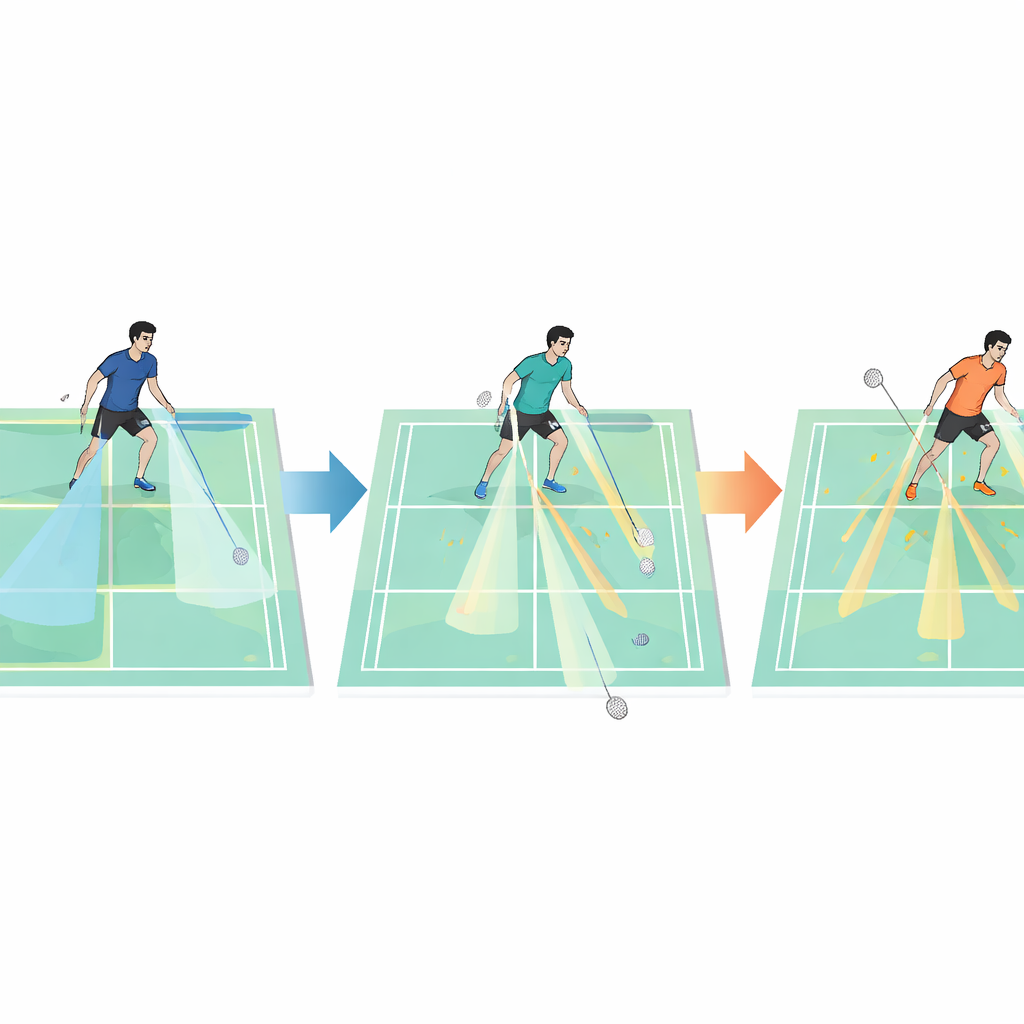
Video Drills Versus Real‑World Play
The study also highlights an important gap between training on screens and playing on court. While video clips allowed tighter control of what players saw, they could not fully reproduce the constant movement, changing distances, and body cues present in a real rally. Under fatigue, these extra demands in live play amplified the drop in anticipation, decision‑making, and gaze efficiency. Players in real situations showed lower accuracy, slower responses, and different gaze patterns than in the video tasks, emphasizing that laboratory‑style drills may miss crucial aspects of how vision and decision‑making work in true game contexts.
What This Means for Players and Coaches
The study concludes that mental fatigue is especially damaging for sports that depend on rapid visual reading of opponents and quick decisions, such as badminton. When the mind is overworked, players’ eyes wander more, dwell less on key cues, and their working memory and choices suffer—particularly in real match conditions. For coaches and athletes, this suggests that managing mental load before training and competition may be just as important as managing physical workload. Avoiding heavy cognitive tasks, designing practices that mimic real‑game vision and decision demands, and recognizing early signs of mental exhaustion could help players keep their eyes—and their judgments—sharp when it matters most.
Citation: Farahani, F.K., Dehkordi, P.S., Khalaji, M. et al. Mental and physical fatigue altered working memory consolidation and impaired gaze behavior and perceptual-cognitive skills using video-based and real-situation. Sci Rep 16, 10180 (2026). https://doi.org/10.1038/s41598-026-40994-6
Keywords: mental fatigue, badminton, gaze behavior, working memory, decision making