Clear Sky Science · en
Array antenna with series-fed configuration providing high radiation performances for automotive radar in IoT applications
Smarter car radar for safer streets
Modern cars are quickly becoming rolling computers, packed with sensors that help them see the road and avoid danger. Among these sensors, radar is especially important because it can measure distance and speed reliably, even in rain, fog, or darkness. This article describes a new kind of compact radar antenna designed for the 24‑gigahertz band, tailored for cars that are constantly connected to the internet of things (IoT). By combining clever hardware design with artificial intelligence–driven optimization, the researchers achieve sharper, stronger radar beams in very little space—an attractive recipe for safer, smarter vehicles.

Why cars need better “eyes”
Today’s driver assistance systems—such as adaptive cruise control, blind‑spot warning, and parking aids—depend on radar to monitor what is happening around the vehicle. These radars must detect objects tens of meters away, distinguish between nearby cars and pedestrians, and still fit discreetly into bumpers and body panels. The 24‑gigahertz frequency band is popular because it offers reliable performance across different weather conditions and is well suited to short‑ and mid‑range sensing in busy city traffic. However, designing antennas for this band is challenging: engineers must squeeze high gain (strong, focused signals), wide useful bandwidth, and low energy loss into a small, low‑cost structure that can be mass‑produced like a printed circuit board.
Compact antenna design in a small footprint
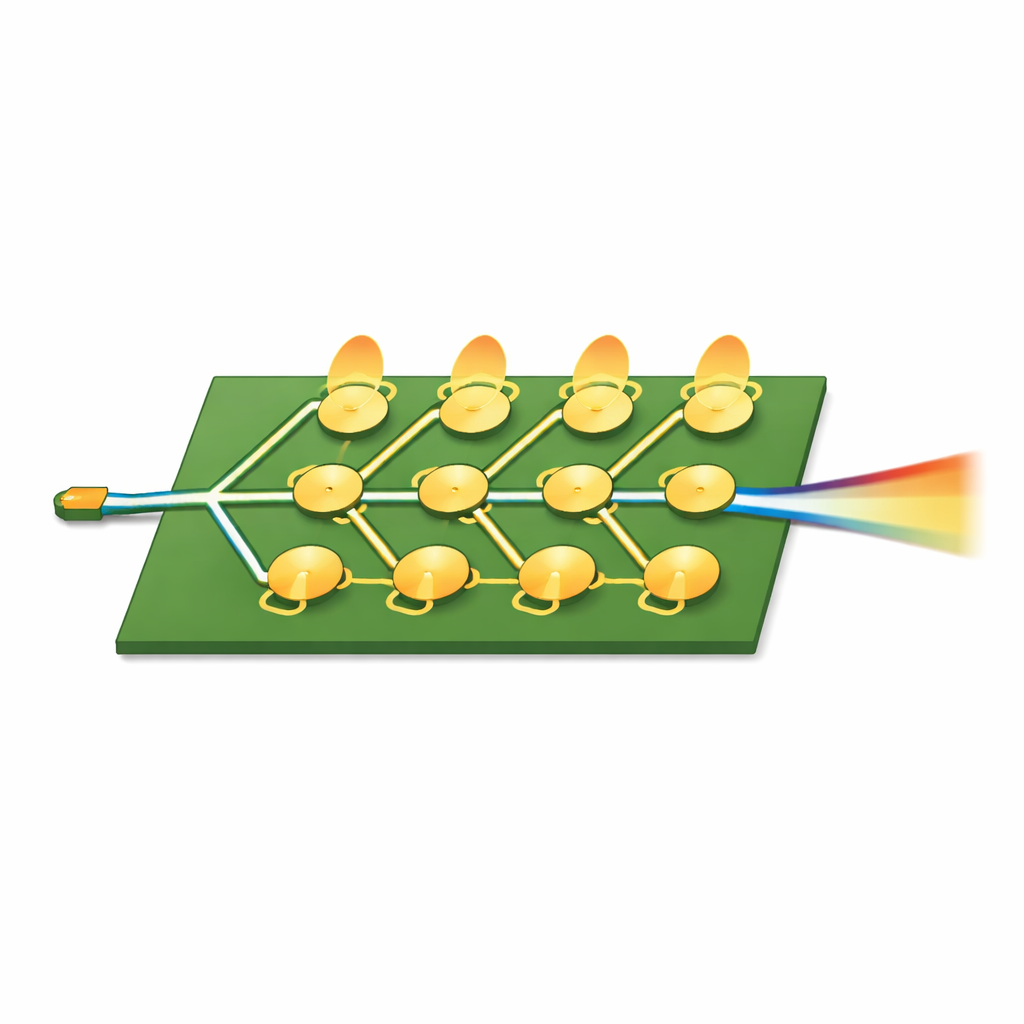
The authors present two closely related antenna designs that meet these demands using flat, circular metal patches etched on a microwave circuit board. One design has two rows of five patches (2 × 5), and the other has four rows of five patches (4 × 5). A custom “power divider” splits the incoming radar signal into equal portions and feeds each patch through slim metal lines that run beside, rather than directly into, the patches. This nearby coupling avoids fragile vertical connections and improves bandwidth, while a carefully chosen spacing between patches helps their individual signals add up into a strong, narrow beam. The result is a fan‑shaped beam for wide coverage in one design and a more pencil‑like beam for longer‑range, high‑resolution sensing in the other.
Using artificial intelligence to fine‑tune the hardware
Instead of adjusting dimensions by trial and error, the team relies on an artificial intelligence–assisted optimization method called PSADEA. This algorithm tests different combinations of key design parameters—such as the gaps between feed lines and patches, patch sizes, and line lengths—using fast mathematical “surrogate” models backed by full electromagnetic simulations. PSADEA searches for shapes that simultaneously deliver low signal reflections, high gain, and a suitably narrow beam. Compared with more traditional algorithms like genetic strategies or particle‑based search, PSADEA reaches better designs with far fewer heavy simulations, saving substantial computing time while still exploring many possibilities.
Measured performance on the test range
Prototypes of both arrays were built on a low‑loss Rogers circuit material and measured in an anechoic chamber that mimics free space. Across the 23–25‑gigahertz band used by many automotive radars, both antennas show very low signal reflection, meaning most of the power is converted into radiation rather than bouncing back toward the electronics. The smaller 2 × 5 array reaches about 16 decibels of gain, while the 4 × 5 array reaches around 19.5 decibels, with simulated radiation efficiencies above 95 percent. Their beams match simulations closely: the 2 × 5 design forms a wide fan in one plane, ideal for covering large side or rear areas, whereas the 4 × 5 design produces a tighter beam in both directions, better suited for looking far ahead. When compared with other published antennas, these arrays achieve unusually high “aperture efficiency,” meaning they squeeze more useful beam strength out of each square centimeter of hardware.
What this means for future connected vehicles
For non‑specialists, the main message is that the authors have shown how to build very efficient, highly focused radar antennas in a small, flat form factor using tools and materials compatible with mass‑produced electronics. By letting an AI‑based optimizer guide the detailed geometry, they obtain designs that outperform many existing solutions while keeping costs and size under control. These fixed‑beam antennas are especially well matched to common driver‑assistance tasks such as blind‑spot detection, rear cross‑traffic alerts, parking aids, and mid‑range forward sensing. As cars become more deeply linked into IoT networks—sharing radar data with other vehicles and infrastructure—such compact, high‑performance antennas will be a key building block for safer, more aware transportation systems.
Citation: Zakeri, H., Parvaneh, M., Moradi, G. et al. Array antenna with series-fed configuration providing high radiation performances for automotive radar in IoT applications. Sci Rep 16, 11116 (2026). https://doi.org/10.1038/s41598-026-40981-x
Keywords: automotive radar, antenna array, 24 GHz, Internet of Things, AI optimization