Clear Sky Science · en
Proactive fault prediction in marine diesel engines using multivariate machine learning
Why ship engines and smart prediction matter
Most of the goods we buy—from phones to food—cross the oceans on ships powered by large diesel engines. When one of these engines fails unexpectedly, it can halt deliveries, cost millions in emergency repairs, and waste fuel while spewing extra pollution. This study explores how a new mix of sensors and machine learning can watch an engine’s vital signs and warn crews about problems days or hours before anything actually breaks, helping ships run more safely, cheaply, and cleanly. 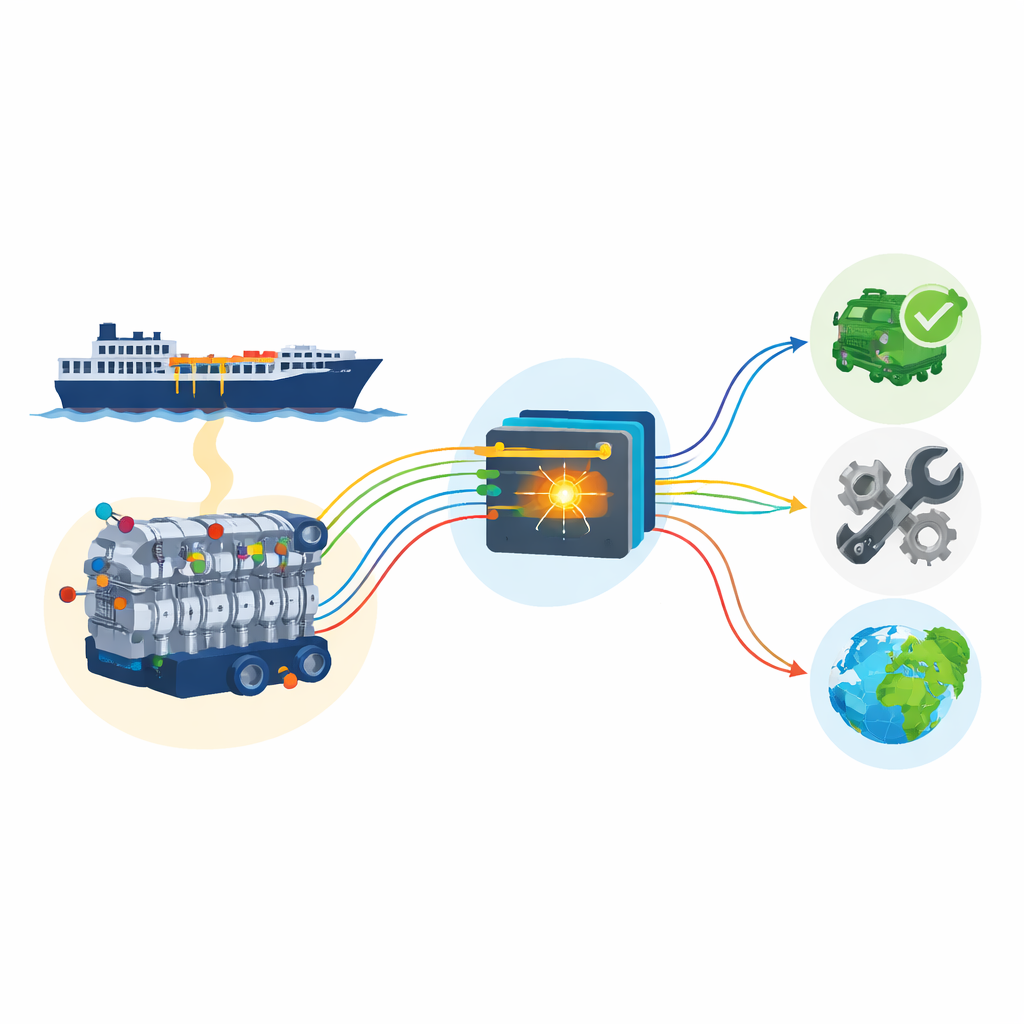
From break-and-fix to fixing before it breaks
Traditional ship maintenance often waits for something to go wrong, or follows fixed schedules that may be too early or too late. The authors argue for a different mindset: proactive maintenance that looks at live data to spot hints of trouble in advance. Better care for engines is not just about avoiding delays. It also cuts fuel use and emissions at a time when the shipping industry is under pressure to reduce its climate footprint. With more than 100,000 merchant ships in service worldwide, even small gains in reliability and efficiency can have a large impact on global trade and greenhouse gas emissions.
Building a small-scale stand-in for a real ship
To test their ideas safely and systematically, the team set up a four-cylinder diesel engine in a lab as a stand-in for a ship’s main engine. They equipped it with temperature sensors on each cylinder, thermometers on the cooling water in and out, three-direction vibration sensors on the engine block, and instruments to track speed, voltage, current, and power. Then they deliberately introduced realistic problems—partial blockages in the air intake, exhaust line, cooling water, and lubrication oil system, as well as low oil levels—at different severities. Over 21,000 data records were collected as the engine went through heat-up, normal load, faulted operation, and cool-down, creating a rich “movie” of how a healthy engine gradually drifts into various kinds of trouble.
Teaching algorithms to forecast and recognize trouble
The heart of the work is a two-part machine learning system. First, a forecasting model based on a type of neural network called ConvLSTM is trained to predict how all 13 measured signals—temperatures, vibrations, speed, and electrical output—will evolve over the next few steps. This model does not just see each number in isolation; it learns how changes in one measurement ripple into others over time. Compared with more conventional approaches such as decision trees, standard neural networks, and basic recurrent networks, the ConvLSTM made noticeably more accurate predictions, cutting one key error measure by about 15% and outperforming rivals on most tests. 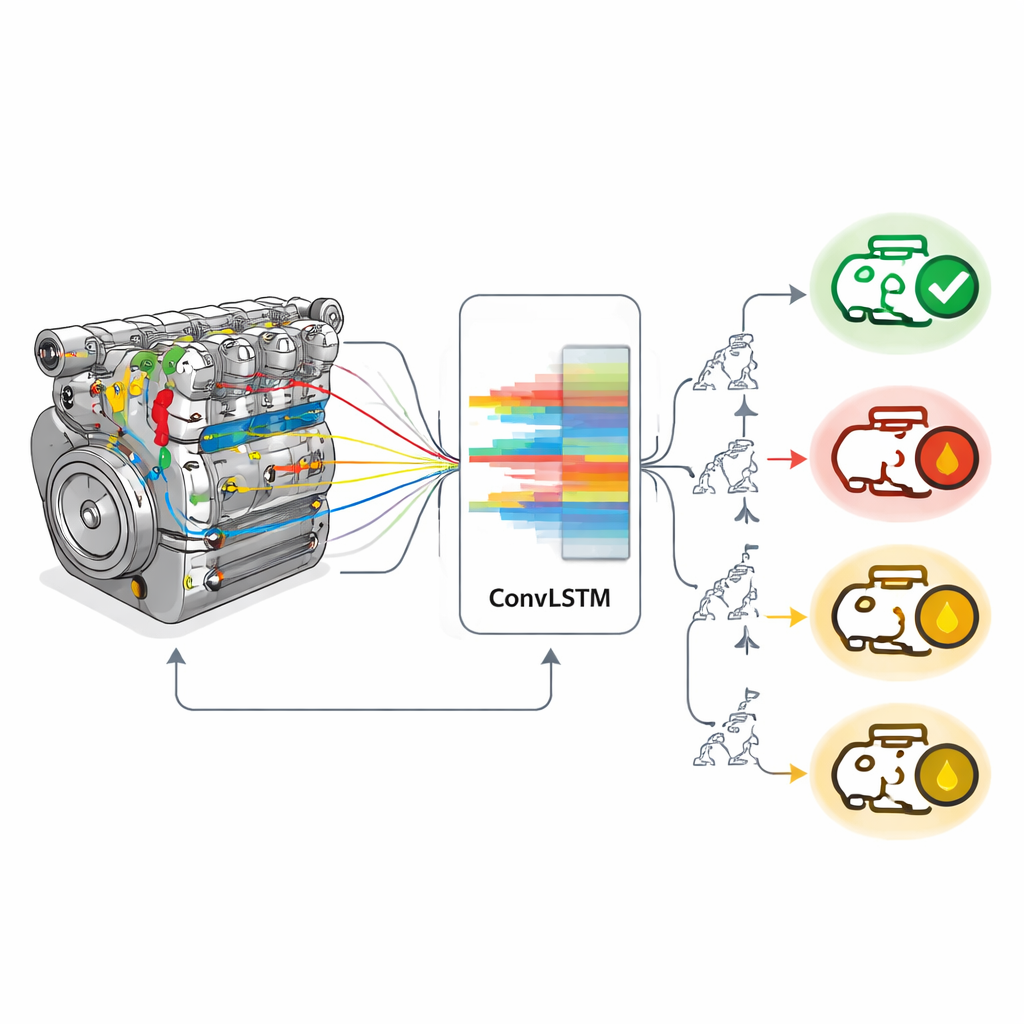
Turning predictions into clear fault warnings
The second part of the system takes those predicted engine signals and asks a simpler question: what kind of state does this pattern represent? Here the authors used a random forest classifier, which combines the decisions of many small decision “trees.” Trained on the same multichannel data, it learns to distinguish among 13 different operating and fault modes, from normal load and cool-down to several levels of air, water, and oil problems. In testing, this classifier correctly identified the right mode more than 82% of the time. Most mistakes occurred between neighboring severities of the same fault type—for example, between medium and high air blockage—rather than confusing healthy operation with serious faults, which is encouraging for practical use.
What this means for ships at sea
Seen together, the forecasting and classification steps act like an intelligent early-warning layer. Continuous sensor readings from an engine room feed into the ConvLSTM, which projects where temperatures, vibrations, and loads are heading. The random forest then interprets those projections as specific emerging faults and their likely severity, giving crews a chance to adjust operation or plan maintenance before damage occurs. While this study was carried out on a single engine in controlled conditions, and more work is needed to cover additional fault types and real-world variability, it points toward “smart ships” whose engines can effectively say, in advance, “I’m about to have a problem here”—saving money, reducing downtime, and cutting unnecessary fuel burn and emissions.
Citation: Michel, M., Mehanna, A., Saleh, S.N. et al. Proactive fault prediction in marine diesel engines using multivariate machine learning. Sci Rep 16, 9678 (2026). https://doi.org/10.1038/s41598-026-40979-5
Keywords: marine diesel engines, predictive maintenance, machine learning, condition monitoring, shipping emissions