Clear Sky Science · en
TumorSageNet CNN hybrid architecture enables accurate detection of mango leaf pathologies
Why spotting sick leaves matters
Mangoes are a staple fruit and source of income for millions of farmers, especially in countries like Bangladesh. Yet tiny spots on mango leaves can signal diseases that quietly slash harvests and threaten food security. This paper explores how modern artificial intelligence can turn ordinary photos of mango leaves into an early warning system, helping farmers protect their orchards before damage becomes irreversible. 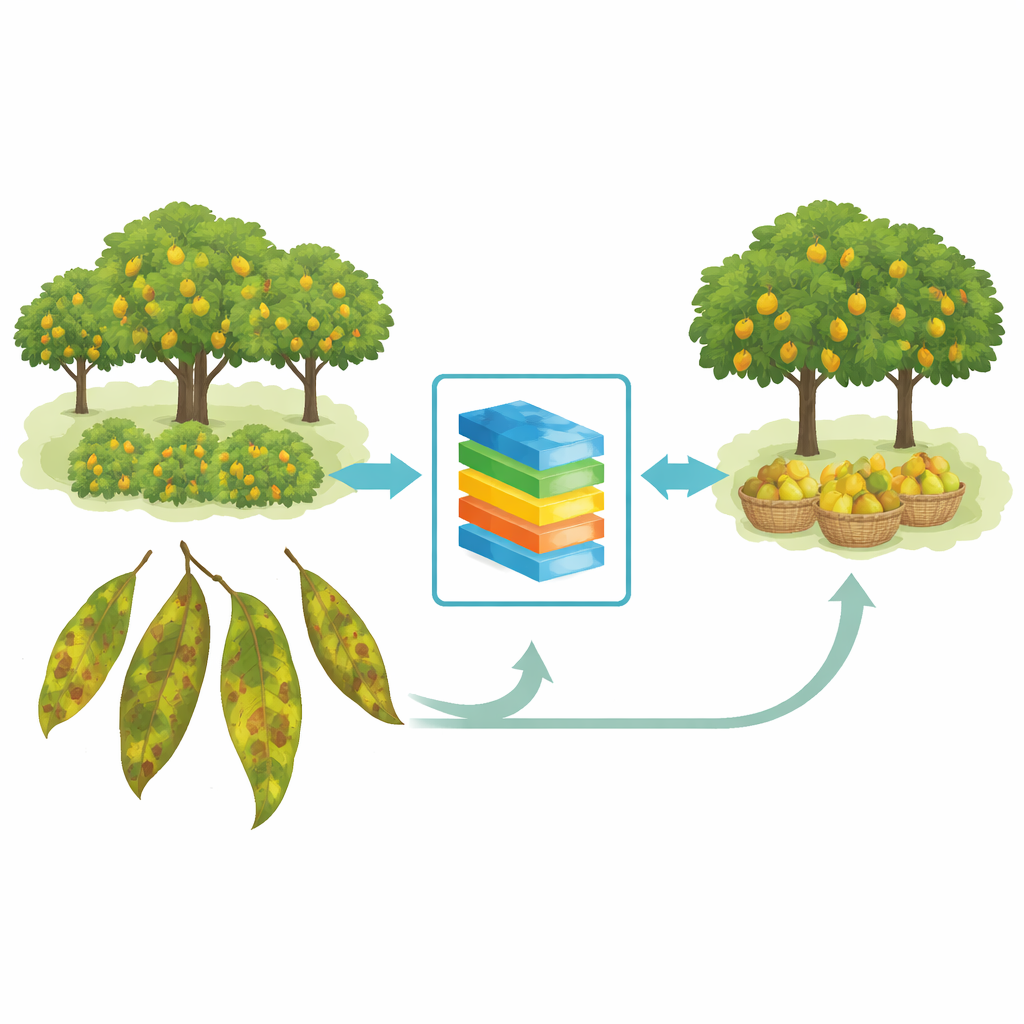
From field photos to smart diagnosis
The researchers focused on a simple but powerful idea: if a person can look at a leaf and see signs of disease, a computer can be trained to do the same—only faster, more consistently, and at large scale. They collected 800 high‑resolution images of mango leaves from orchards in the Rajshahi region of Bangladesh, covering six common problems such as Anthracnose, Die Back, and Powdery Mildew, along with healthy leaves. Experts carefully labeled each image so that the computer models would have trustworthy examples of what each condition looks like. The images were then resized and split into training, validation, and test sets to mimic real‑world use, where a model must correctly classify leaves it has never seen before.
Making the most of every pixel
Real farming conditions are messy: leaves appear at odd angles, under harsh sun or deep shade, and against cluttered backgrounds. To prepare the models for this complexity, the team used data augmentation, which artificially creates variety by flipping, rotating, and zooming images so the system does not latch onto narrow visual cues. They also transformed each image into several different color representations that highlight subtle differences in brightness and pigment changes. This helps bring out pale spots, dark patches, or powdery coatings that might be faint in the original photo but are crucial for early detection.
Building a new smart vision model
On top of this carefully prepared image set, the authors designed two main types of computer models. The first is a custom convolutional neural network—a layered pattern‑recognition system tuned specifically to the shapes and textures of mango leaves. The second is a more elaborate hybrid design called TumorSageNet, which starts with a powerful pre‑trained image network (EfficientNet‑B7), adds special attention layers that focus on the most telling regions of a leaf, and then passes these patterns through a sequence‑reading layer (known as LSTM) that learns how different patches of a leaf relate to each other. Both models were compared against well‑known image networks like AlexNet and VGG, as well as simpler approaches such as K‑Nearest Neighbors. 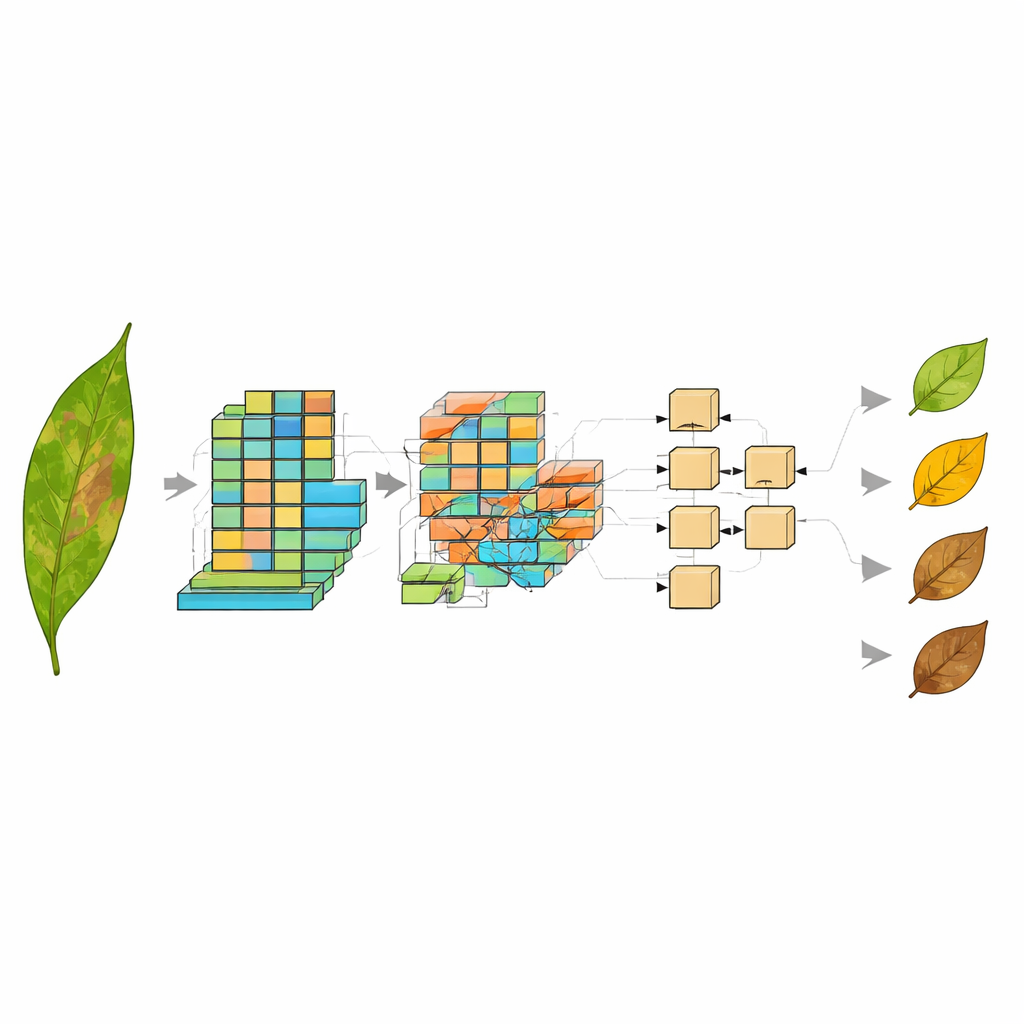
Seeing how the AI "thinks"
Accuracy alone is not enough if farmers and agronomists cannot trust the system. To open this black box, the researchers used a technique called Grad‑CAM, which overlays a colored heatmap on each input image to show where the model is concentrating its attention. When the system labels a leaf as having Anthracnose, for example, the heatmap highlights the dark, dead tissue that human experts also consider important. This visual alignment between human reasoning and machine focus helps verify that the model is responding to real disease symptoms rather than random background details, and it could guide more precise spraying or pruning at the orchard level.
What the results mean for farmers
On the test images, the custom network reached perfect scores for accuracy, precision, recall, and F1‑score, and the hybrid TumorSageNet model performed almost as well. While these results are striking, the authors acknowledge that the dataset is still modest and drawn from a single region, so wider trials are needed before claiming universal reliability. Even so, the study shows that with well‑designed models, thoughtful image preparation, and clear visual explanations, AI can become a practical partner in plant health monitoring. In everyday terms, this work points toward phone‑based tools that let farmers snap a photo of a suspicious leaf and receive an instant, understandable assessment—helping to save crops, stabilize incomes, and ease pressure on the global food supply.
Citation: Ghosh, H., Rahat, I.S., Hossain, M.Z. et al. TumorSageNet CNN hybrid architecture enables accurate detection of mango leaf pathologies. Sci Rep 16, 11033 (2026). https://doi.org/10.1038/s41598-026-40944-2
Keywords: mango leaf disease, plant disease detection, deep learning, precision agriculture, computer vision