Clear Sky Science · en
Seed endophytic bacteria from invasive Lactuca serriola increase soil available phosphorus under phosphorus deficiency
Hidden Helpers in Invasive Weeds
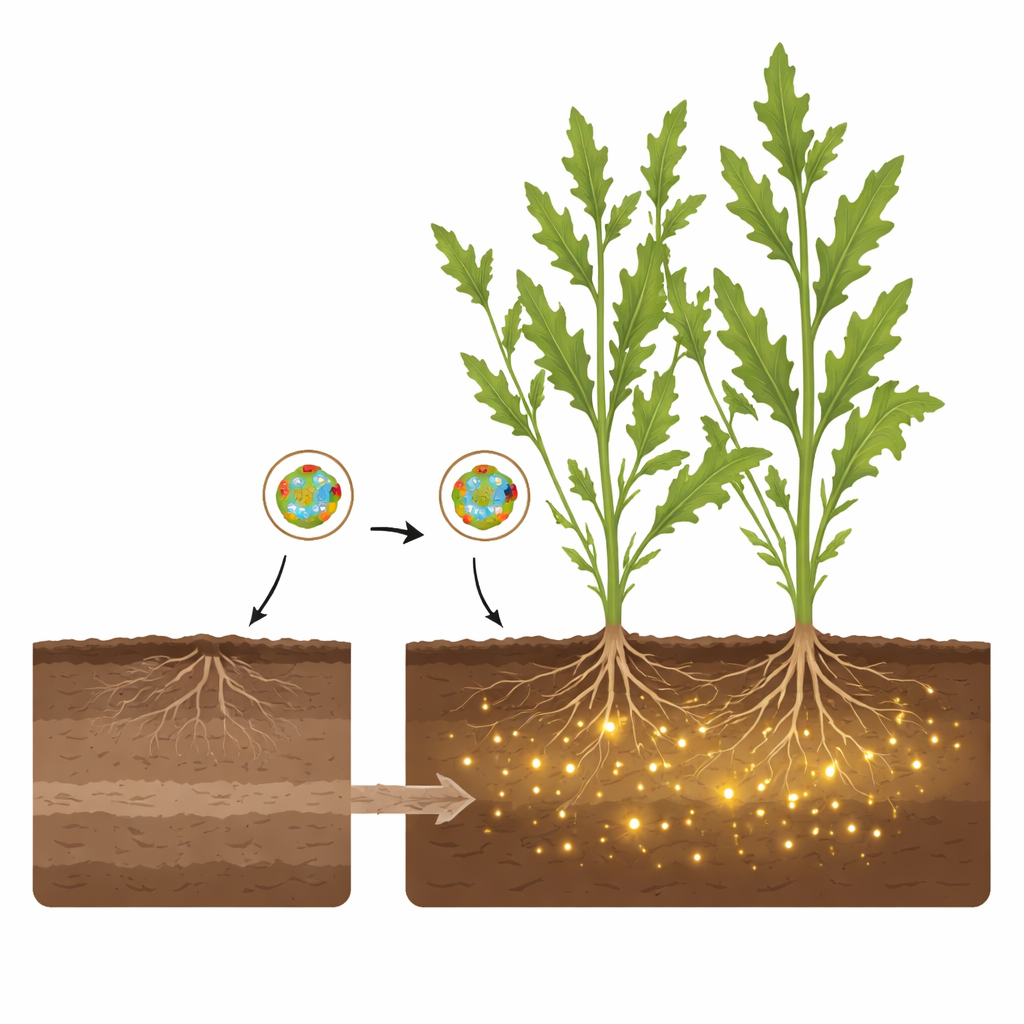
Many farmers and ecologists worry about invasive weeds because they crowd out native plants and change how ecosystems work. This study reveals an unexpected twist: a common invasive wild lettuce, Lactuca serriola, carries helpful bacteria inside its seeds that can unlock hard-to-reach phosphorus in poor soils. Because phosphorus is a key ingredient for plant growth and is often in short supply around the world, understanding how these tiny partners change soil fertility could reshape how we think about both weeds and future bio-based fertilizers.
Tiny Partners Traveling Inside Seeds
Plants are not alone when they spread into new places. Along with their seeds, they carry microscopic passengers called seed endophytic bacteria, which live tucked safely inside seed tissues. Unlike microbes that must arrive later from the surrounding soil, these bacteria start life with the young roots, making it easier for them to colonize the area right around the plant. Earlier work showed that such seed bacteria can help wild lettuce withstand drought. Here, the researchers asked a new question: can these same hitchhiking microbes help the plant gain access to phosphorus, an essential nutrient that is often locked away in forms that roots cannot easily use?
Building Microbial Teams in the Lab
From seeds of invasive wild lettuce collected at two sites in South Korea, the team had previously isolated a diverse set of bacteria from many different genera. In this study, they focused on how well these bacteria could free phosphorus from an insoluble mineral in laboratory tests. First, they measured each strain alone. Then they assembled “synthetic communities”: mixtures where all strains were combined, and companion mixtures in which each strain was left out in turn. By comparing how much dissolved phosphorus each mixture produced, they could spot cases where certain strains performed better together than alone, revealing cooperative, or “synergistic,” effects as well as combinations that interfered with each other.
From Test Tubes to Soil Pots
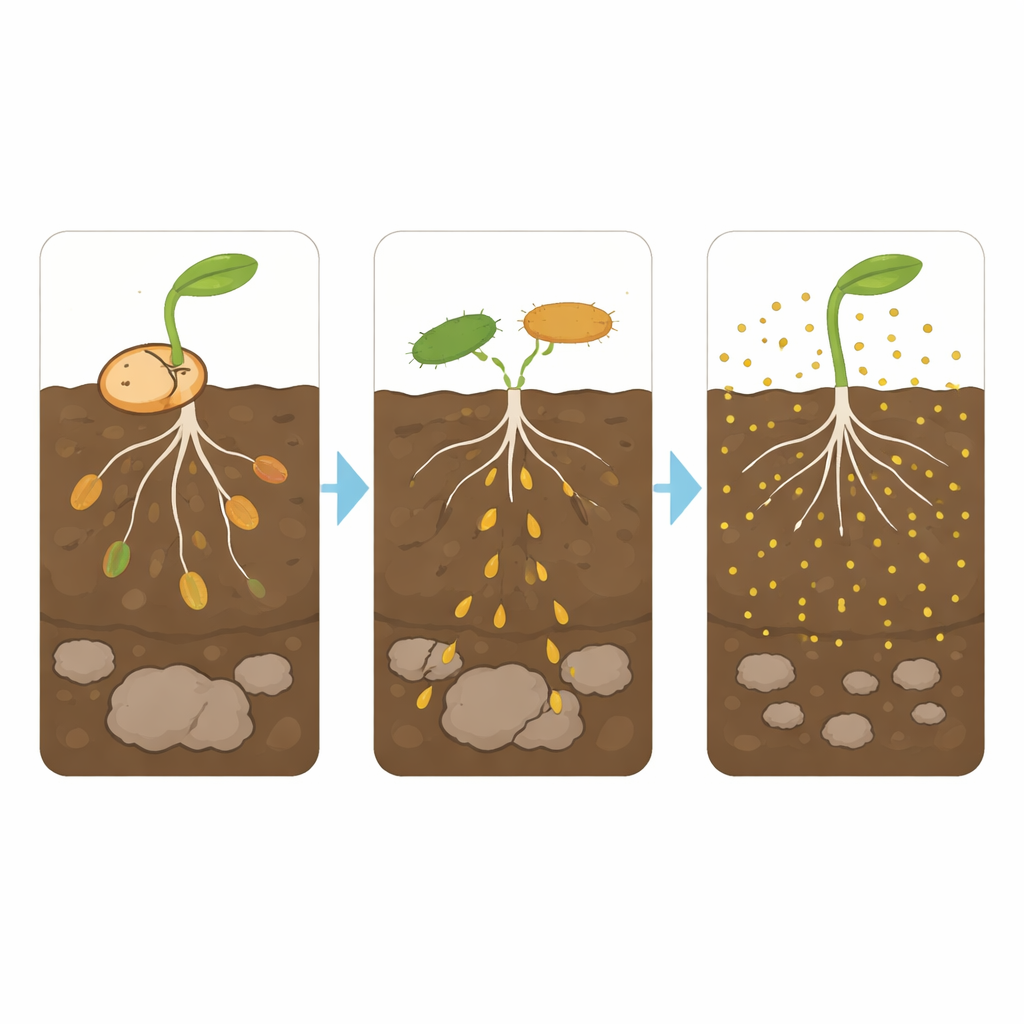
To see whether these promising bacteria also change soil conditions around living plants, the researchers coated surface-sterilized wild lettuce seeds with either single strains or carefully chosen pairs of strains that had shown strong performance in the lab. They then grew the plants in a simple, sterile soil mix that contained only a hard-to-dissolve calcium phosphate as the phosphorus source and fed them a nutrient solution lacking added phosphorus, mimicking a phosphorus-poor environment. Over several weeks, they tracked plant growth, the balance of root versus shoot biomass, leaf phosphorus levels, soil available phosphorus, soil organic carbon, and pH.
Soil Becomes Richer While Plants Stay Modest
The plants themselves did not grow dramatically bigger when given bacteria: shoot and root weights stayed similar across treatments. However, the soil beneath them told a different story. Almost all bacterial treatments raised the amount of plant-available phosphorus in the soil compared with uninoculated controls under phosphorus deficiency. Some two-strain combinations were especially powerful, boosting available phosphorus to levels higher than either strain could achieve alone, a clear sign of synergy. Interestingly, soil phosphorus was negatively linked to both soil organic carbon and to the ratio of root mass to shoot mass. In other words, as soils became richer in available phosphorus, plants invested relatively less in roots, and carbon left behind in the soil tended to decline, possibly because microbes were burning that carbon fuel as they worked to free up phosphorus.
Rethinking the Role of Invasive Plants
This research suggests that invasive plants like wild lettuce may alter soil fertility not only through their leaves and roots but also through the invisible partners hidden inside their seeds. Seed-borne bacterial teams can make more phosphorus available in poor soils, and some strain pairings are much more effective than others. For a general reader, the key takeaway is that “bad” weeds may owe part of their success to “good” microbes that help them tap into locked nutrient reserves. At the same time, these bacterial consortia could one day be harnessed as biological tools to improve phosphorus use in agriculture, reducing reliance on mined fertilizers while revealing just how tightly plant invasions and soil microbes are intertwined.
Citation: Kim, TM., Jeong, S., Choi, B. et al. Seed endophytic bacteria from invasive Lactuca serriola increase soil available phosphorus under phosphorus deficiency. Sci Rep 16, 8748 (2026). https://doi.org/10.1038/s41598-026-40933-5
Keywords: phosphorus cycling, seed endophytes, invasive plants, soil microbes, plant–microbe interactions