Clear Sky Science · en
Multilevel threshold image segmentation based on a novel mechanism enhanced coati optimization algorithm
Sharper Pictures from Smarter Digital Slicing
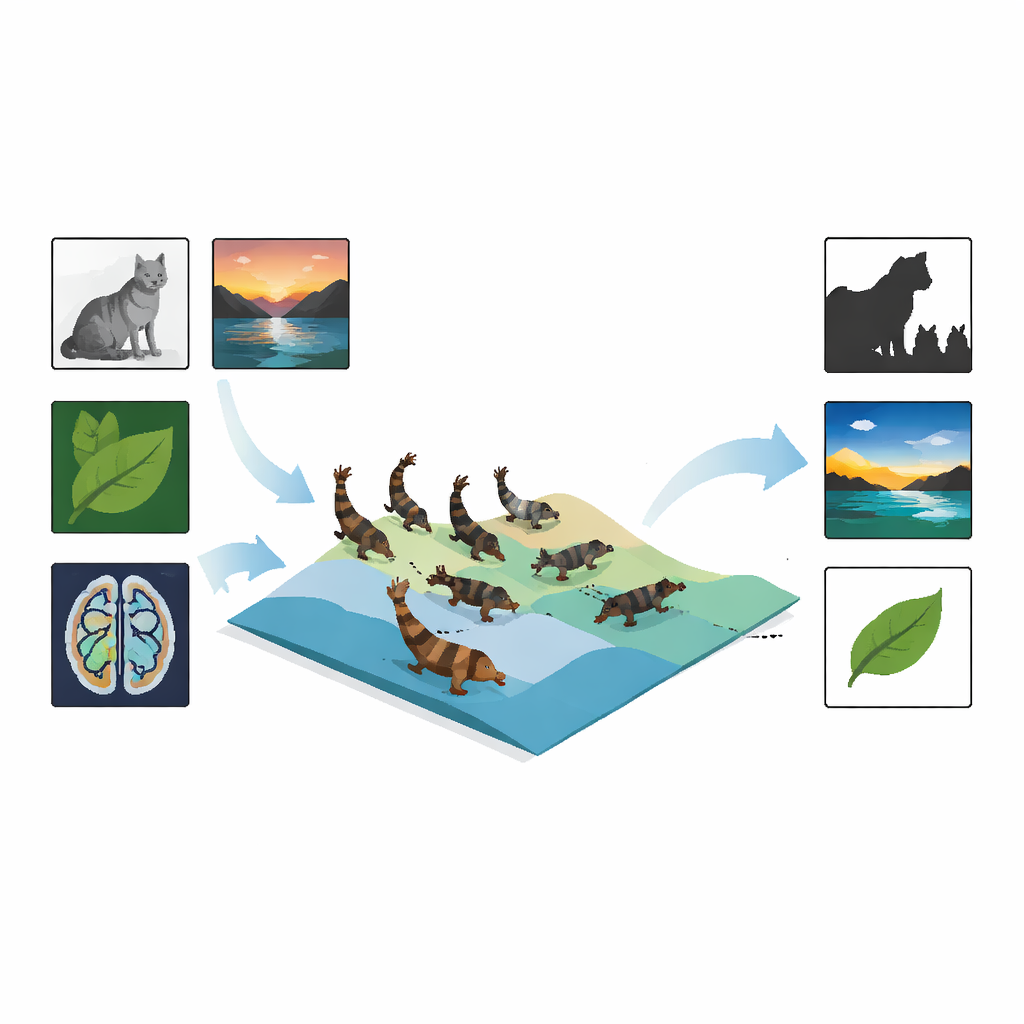
Every digital image, from satellite photos to medical scans, is really a grid of numbers. To analyze these pictures, computers often need to slice them into meaningful regions—like separating tumor from healthy tissue, or road from background. This paper introduces a new way to make that slicing both sharper and faster, even for very complex images, by teaching a virtual "swarm" of problem-solvers to cooperate more intelligently.
Why Cutting Images into Pieces Is So Hard
Before a computer can understand a picture, it must divide it into regions that belong together—a process called segmentation. One of the simplest and most widely used approaches is thresholding: choose one or more cutoff values on the image’s brightness scale, and assign each pixel to a region based on where its value falls. With just one threshold, this is easy. But modern tasks often need many thresholds at once to separate several tissues in a scan, or multiple land types in a satellite view. The mathematical search for the best combination of thresholds grows explosively as their number increases, quickly turning into a problem too large to solve by straightforward calculation.
Letting Virtual Animals Hunt for Better Answers
To cope with these thorny searches, scientists increasingly turn to meta-heuristic algorithms: digital swarms that roam the solution space, nudging candidate answers in promising directions. The work here builds on a recent method inspired by coatis—social mammals that hunt in groups. In the original coati optimization algorithm, some virtual coatis climb toward prey while others wait and pounce, mimicking global exploration and local fine-tuning. This strategy works well in many settings, but it can still get stuck in so-so solutions, especially when the number of thresholds is high or when the images and quality measures are diverse.
Teaching the Swarm to Explore and Focus
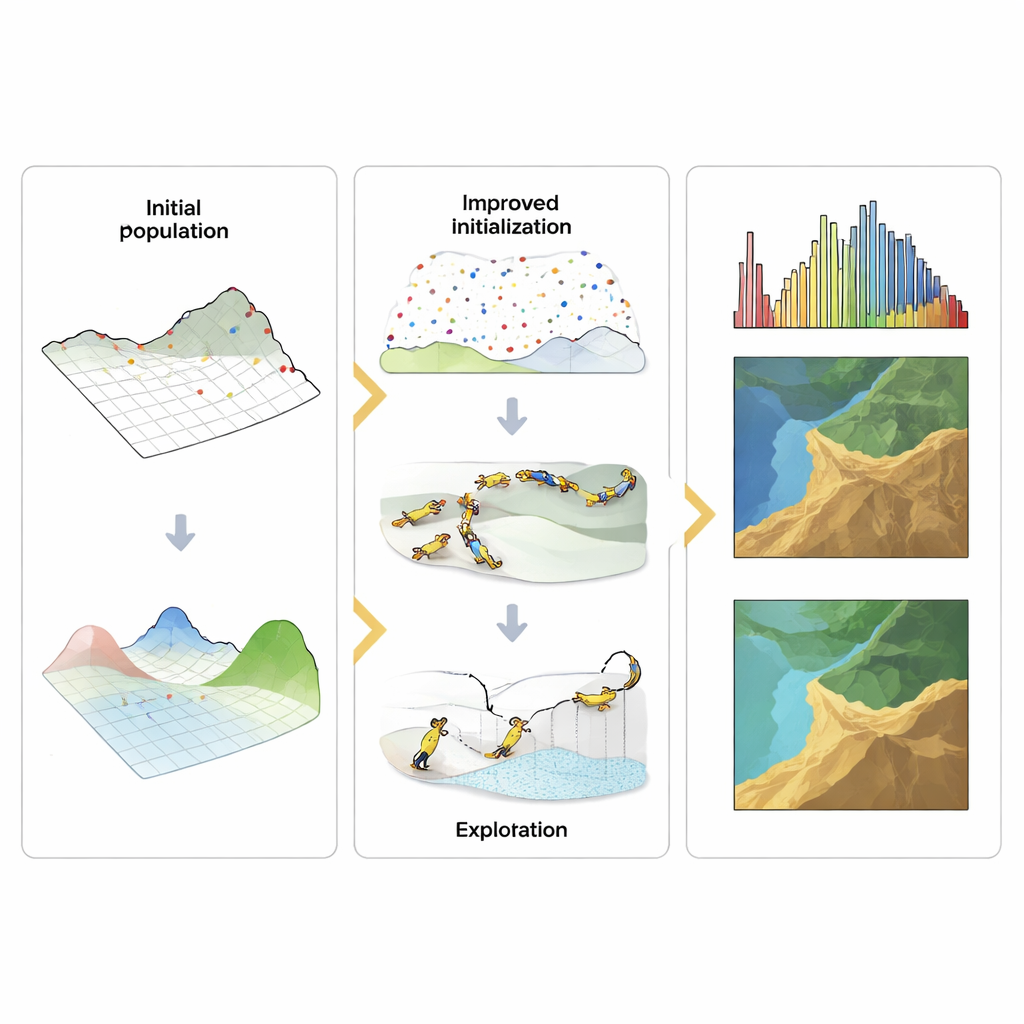
The authors design an enhanced version, called ENCOA, that upgrades the coati swarm at several levels. First, they improve how candidate solutions are initialized, using a carefully tuned chaotic pattern and a lens-like mirroring trick to spread the starting points more evenly across the search space. Next, they borrow ideas from another marine-inspired algorithm to create an adaptive search mechanism (ASSM). This mechanism gradually shifts the swarm’s behavior from broad roaming early on to more cautious refinement later, helping it avoid getting trapped in local dead ends. Finally, they introduce a hierarchical “vertical-horizontal” search: elite solutions are adjusted one dimension at a time for precise correction, while the rest of the swarm cross-mixes pieces of solutions to keep diversity high.
Proving the Method on Tests, Engineering, and Real Images
To check whether these tweaks really matter, the team first turns ENCOA loose on a standard suite of difficult mathematical test functions. Across most of these challenges, the new method converges faster and reaches more accurate answers than both the original coati algorithm and 11 other well-known swarm-based methods. They then apply ENCOA to four classic engineering design problems, such as optimizing the weight of a gearbox, where it again finds lighter or cheaper designs than competing techniques under the same constraints. Finally, they tackle the main goal: segmenting six grayscale and four color benchmark images, including natural scenes and medical-style pictures. Using two different quality criteria—one based on how distinct the regions are, the other on how much information is preserved—ENCOA consistently produces segmentations that score higher on standard image-similarity measures, particularly when many thresholds (up to 32) are required.
Clearer Boundaries for Real-World Pictures
In everyday terms, this research shows how a better-designed digital swarm can cut images into cleaner, more meaningful pieces without slowing to a crawl as problems get harder. By carefully balancing wild exploration with targeted refinement, ENCOA finds threshold settings that preserve details and reduce noise across a broad range of images and objectives. The authors suggest that these gains could carry over to demanding areas such as medical imaging, where sharper automated segmentations can help clinicians see subtle structures more clearly and support more reliable diagnoses.
Citation: Liu, J., Yang, S., Liu, W. et al. Multilevel threshold image segmentation based on a novel mechanism enhanced coati optimization algorithm. Sci Rep 16, 10338 (2026). https://doi.org/10.1038/s41598-026-40921-9
Keywords: image segmentation, optimization algorithms, swarm intelligence, medical imaging, digital image analysis