Clear Sky Science · en
Modeling mechanical properties of rubberized concrete using gene expression programming (GEP) and random forest: a comparative study
Turning Old Tires into Stronger, Greener Buildings
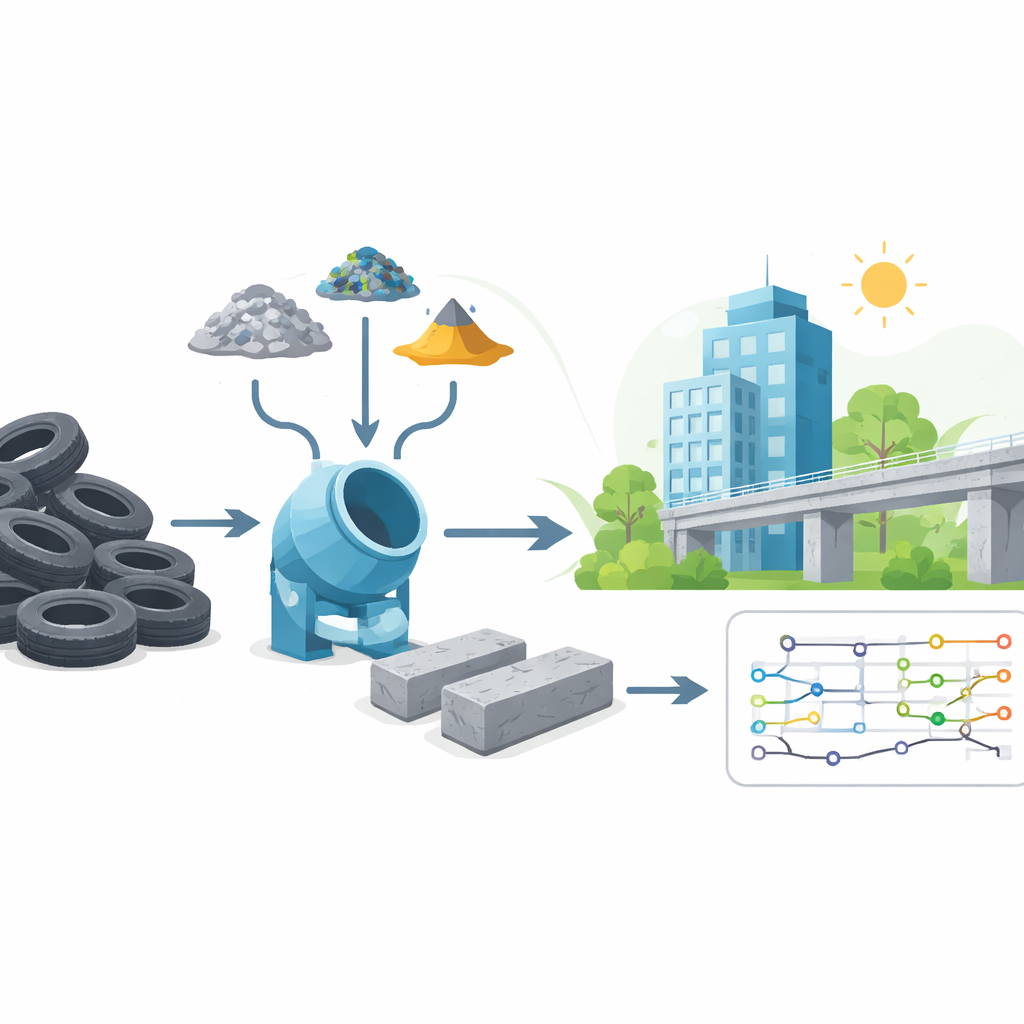
Every year, billions of tires reach the end of their life and often end up in landfills or illegal dumps, where they pose fire and pollution risks. At the same time, the construction industry consumes vast amounts of sand, gravel, and energy, contributing heavily to climate change. This study explores a way to tackle both problems at once: grinding up waste tires and using the rubber in concrete, then using advanced computer tools to predict how strong this new "rubberized" concrete will be without having to run endless lab tests.
Why Mix Rubber into Concrete?
Concrete is the backbone of modern infrastructure, but producing its ingredients, especially cement and natural aggregates, is energy-intensive and depletes natural resources. By replacing part of the sand and gravel with pieces of waste tire rubber, engineers can reduce the need for virgin materials and keep discarded tires out of landfills. Rubber particles can also give concrete useful features: they can absorb shocks, dampen noise, and improve resistance to wear and temperature changes. However, adding rubber usually weakens concrete’s ability to resist cracking and pulling apart. Measuring exactly how much strength is lost or gained for every change in recipe traditionally requires many time-consuming and expensive experiments.
Letting Computers Learn from Past Experiments
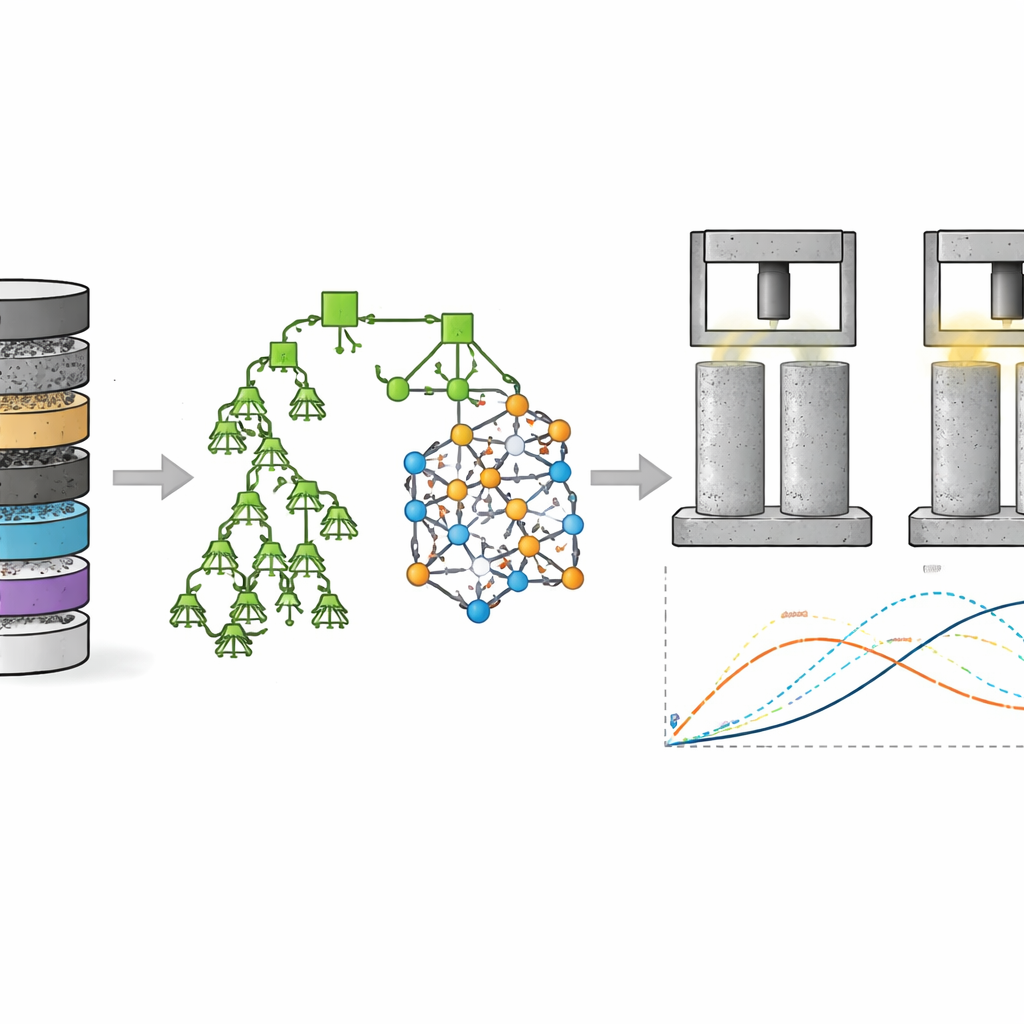
To avoid testing every possible mix by hand, the researchers turned to machine learning—computer methods that find patterns in data. They gathered 112 sets of experimental results from studies around the world, all involving rubberized concrete. Each data point described a unique recipe, including amounts of coarse and fine aggregates, chipped and crumb rubber, chemical additives called superplasticizers, the water–cement ratio, and the age of the concrete. For each recipe, two key properties were recorded: flexural strength (how well a beam resists bending) and split tensile strength (how well it resists being pulled apart). With this combined database, the team trained two different machine learning models side by side to see which could best predict these strengths.
Two Different Ways for a Computer to "Think"
The first method, gene expression programming, works a bit like evolution in nature. It starts with many random mathematical formulas and gradually improves them by mimicking mutation and recombination, eventually producing human-readable equations linking mix ingredients to strength. The second method, random forest, builds a large collection of decision trees—simple rule-based models—and lets them "vote" on the predicted strength. While random forest behaves more like a black box, it is often very accurate. Both models were carefully tuned and evaluated using standard statistics that compare predicted strengths with the values measured in the lab for mixes the models had never seen before.
What the Models Learned About Rubber Concrete
Both approaches captured the overall behavior of rubberized concrete, but random forest was more accurate. For unseen test data, it reproduced flexural and tensile strengths with correlation values close to perfect agreement, noticeably better than gene expression programming. Error analyses showed that most predictions were within a modest margin of the real values, with only a few outliers. To open the black box, the team used a tool called SHAP, which assigns each ingredient a share of responsibility for each prediction. This revealed that traditional aggregates and the water–cement ratio strongly influence bending strength, while the amount and type of rubber, along with superplasticizer and water content, play key roles in how well the concrete resists being pulled apart. In general, more rubber and more water tended to reduce strength, while well-balanced aggregates and additives could recover some performance.
What This Means for Future Construction
For non-specialists, the main takeaway is that we can realistically design greener concretes that recycle old tires without flying blind. The study shows that smart computer models, especially random forests, can reliably predict how changes in a rubberized concrete recipe will affect its cracking and bending behavior, using only a handful of easily measured inputs. That means engineers can cut down on expensive trial-and-error testing, speed up the adoption of waste-based materials, and more confidently specify mixes that balance environmental benefits with safety and durability. In the long run, such tools could help turn mountains of discarded tires into safe bridges, pavements, and buildings, shrinking both waste piles and the carbon footprint of construction.
Citation: Sheraz, M., Talha, M., Alam, M. et al. Modeling mechanical properties of rubberized concrete using gene expression programming (GEP) and random forest: a comparative study. Sci Rep 16, 8714 (2026). https://doi.org/10.1038/s41598-026-40897-6
Keywords: rubberized concrete, waste tire recycling, machine learning in construction, random forest modeling, sustainable materials