Clear Sky Science · en
Visual preference for previously familiar faces in Chimpanzees (Pan troglodytes)
Why chimpanzee friendships still matter years later
Most of us can recognize an old friend’s face even after decades apart. This study asks a similar question about our close evolutionary cousins: do chimpanzees keep paying special visual attention to the faces of former groupmates, long after they have gone? By tracking exactly where chimps look on a screen, the researchers show that memories of past social partners continue to shape what these animals notice, revealing how deep and long-lasting their social bonds may be.
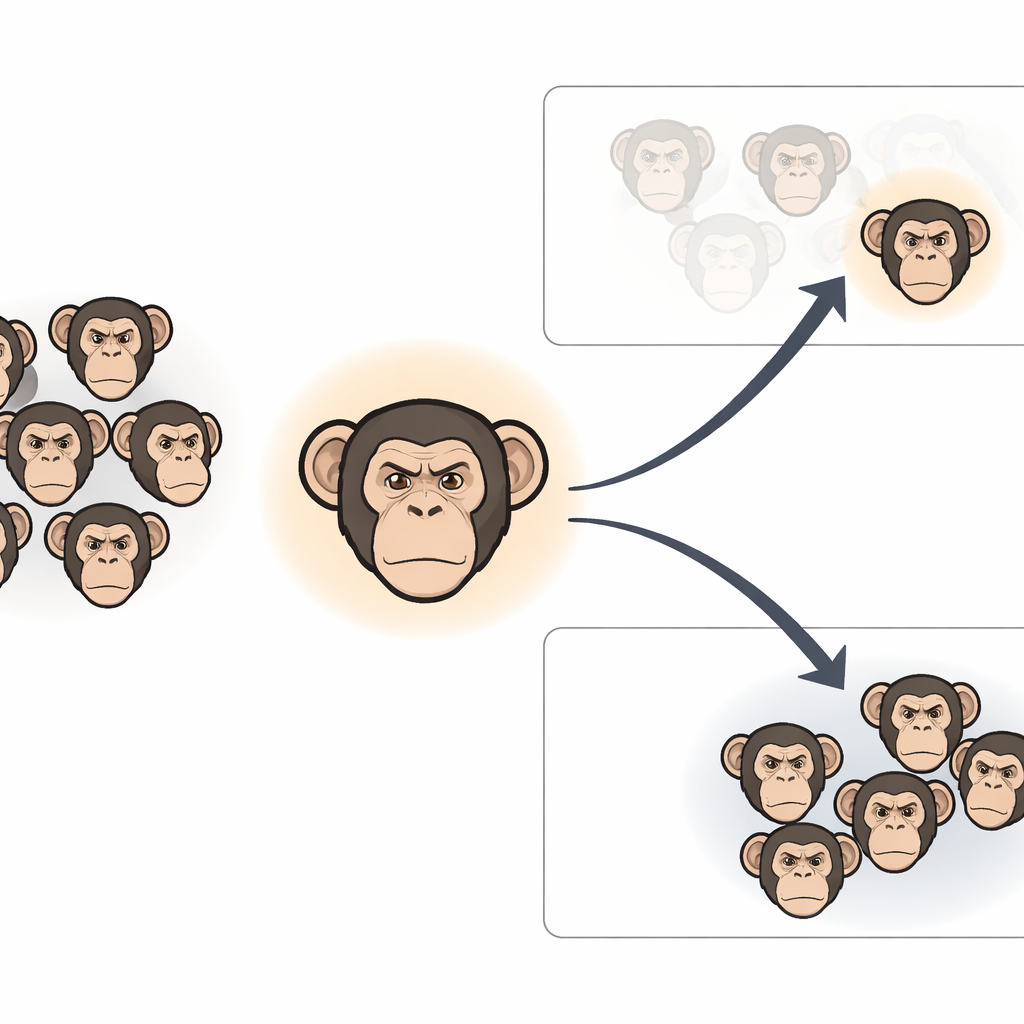
Looking into chimps’ eyes to see what they care about
To explore these hidden preferences, six adult chimpanzees at Kyoto University watched pairs of face photographs on a monitor. Each pair always contained one familiar chimp and one stranger. Crucially, the familiar faces came in two types. Some were current groupmates, animals the viewer still lived with every day. Others were former groupmates who had died or been separated years before, and whom the participants had not seen for a long time. While the chimps sat voluntarily in a test booth, an eye‑tracking system measured how long they looked at each face within a trial lasting only a few seconds.
Past companions draw the strongest gaze
When the familiar face belonged to a previous groupmate, the chimps showed a clear bias: they spent noticeably more time looking at the familiar face than at the stranger in the pair. This pattern appeared consistently across the animals, even though some had been separated from these individuals for more than a decade. The result suggests that memories of old companions remain vivid enough to guide visual attention long after daily contact ends, pointing to remarkably durable social memory in chimpanzees.
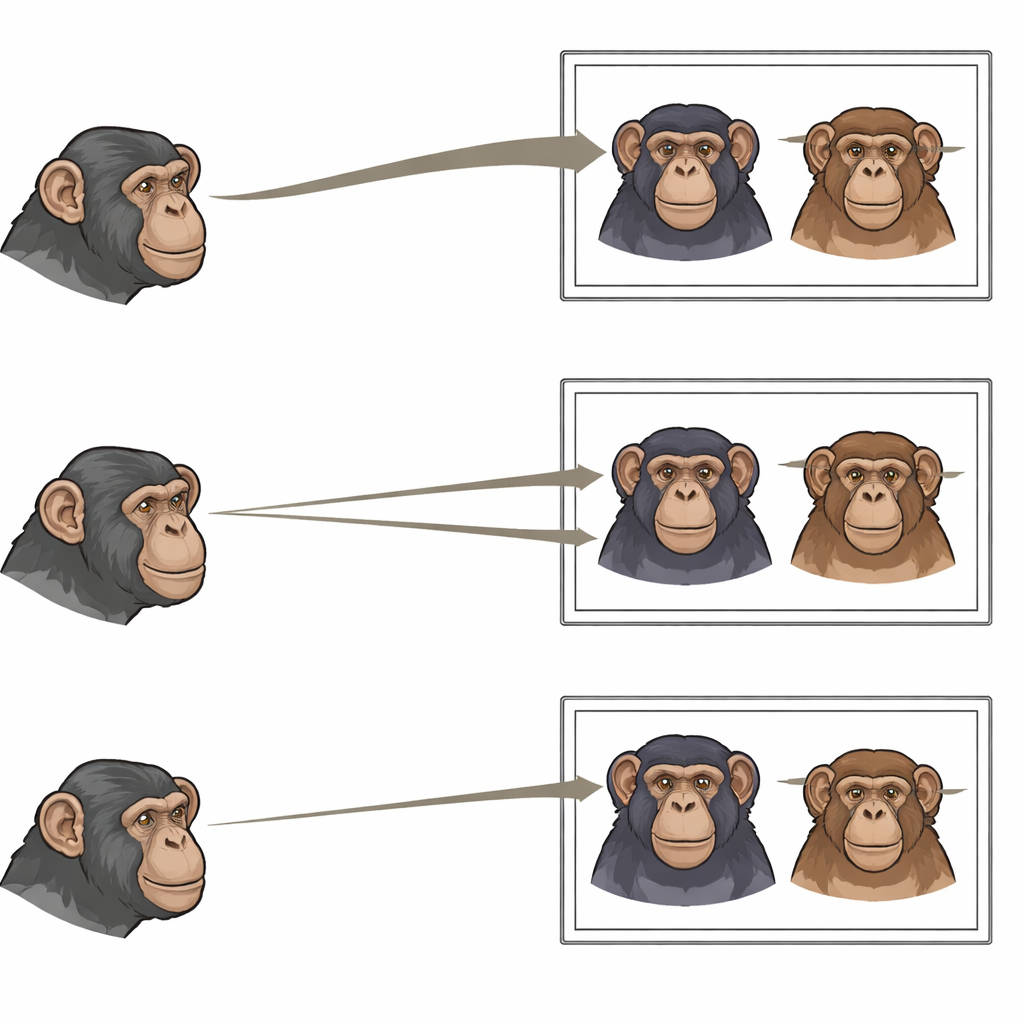
Present companions are not always the most interesting
The story was different for faces of current groupmates. When a present companion’s face was paired with a stranger, the chimps did not show a reliable preference for either face overall. On average, their looking time was closer to an even split. When the researchers examined how long each chimp had lived with each present groupmate, an intriguing pattern emerged: the longer two chimps had cohabited, the less extra attention the viewer gave to that familiar face. In other words, very long‑term housemates did not capture gaze more strongly than newcomers; if anything, the reverse tended to be true.
What time together really means
These findings hint that “time spent together” does not translate in a simple way into “more visual interest.” For old groupmates who are no longer around, long‑ago contact seems to leave a lasting trace that keeps their faces special. For current companions, however, extended cohabitation may make their faces more routine, so they no longer stand out from strangers in brief viewing tests. The work also suggests that other factors—such as sex, social rank, and the quality of past interactions—may interact with familiarity, helping to explain why previous studies sometimes found stronger interest in either familiar or novel faces depending on who was pictured.
What this reveals about chimpanzee minds
Put simply, this study shows that chimpanzees do not just remember who they used to live with; those memories continue to shape where they look. Former groupmates’ faces attract more attention than strangers’, even after many years apart, whereas current companions do not consistently get that same boost. For a lay reader, the takeaway is that chimpanzees, like humans, carry a long social history in their minds, and that history quietly influences what they notice in their surroundings. Their visual preferences are not fixed instincts but flexible habits shaped by time, relationships, and the ever‑changing makeup of their social world.
Citation: Ode, A., Adachi, I. & Imura, T. Visual preference for previously familiar faces in Chimpanzees (Pan troglodytes). Sci Rep 16, 8646 (2026). https://doi.org/10.1038/s41598-026-40862-3
Keywords: chimpanzees, face recognition, social memory, eye tracking, primate social behavior