Clear Sky Science · en
Modelling the cleanup of the North Pacific Garbage Patch based on 3 years of operational experience
Why a Distant Trash Patch Matters to Us
Far from any shoreline, currents in the North Pacific have gathered huge amounts of floating plastic into what is known as the North Pacific Garbage Patch. Although it lies far offshore, this slowly growing mass of debris harms sea life, spreads toxic chemicals, and threatens the ocean services humanity depends on, from fisheries to climate regulation. This paper asks a very practical question: using real-world test data, is it technically and economically realistic to clean up most of this floating plastic within a decade?
A Giant Cleanup Experiment at Sea
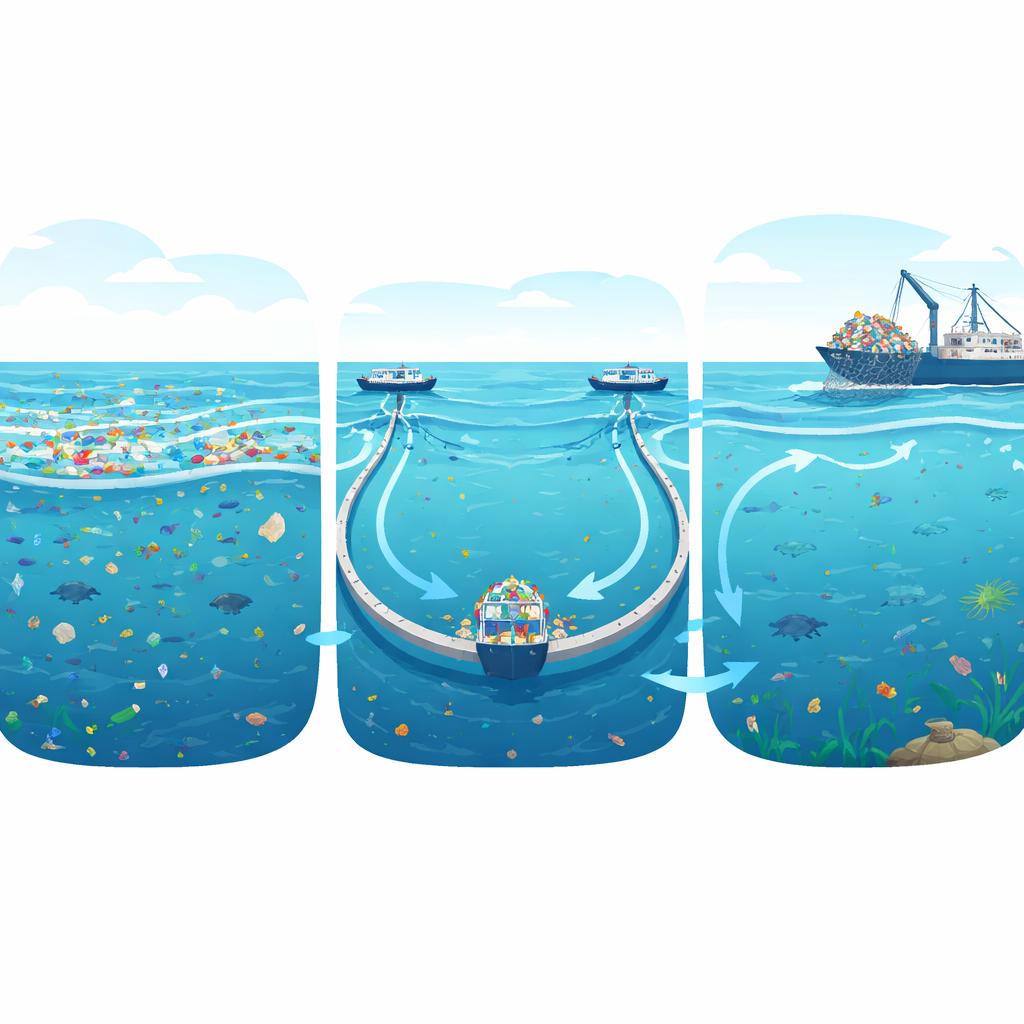
To explore this, the authors build on three years of large-scale trials by The Ocean Cleanup, a nonprofit developing technology to collect floating plastic in the open ocean. Their system is a long U-shaped floating barrier towed slowly by two ships, guiding debris into a central netted "retention zone" that can be hauled on deck and emptied. Between 2018 and late 2024, these systems removed over half a million kilograms of plastic from the North Pacific Garbage Patch, providing rare, detailed measurements of how much plastic was actually present and how efficiently it could be captured.
Measuring How Much Plastic Is Really Out There
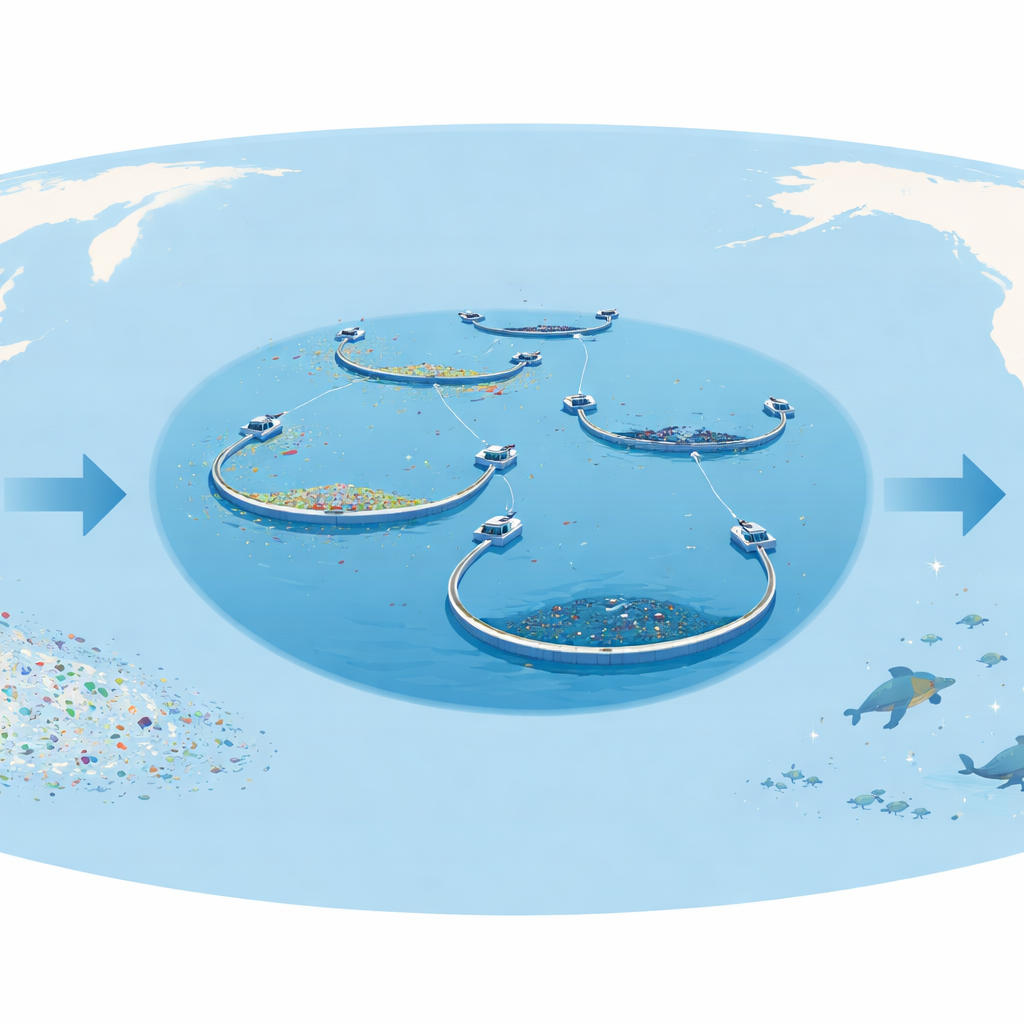
Because no one can weigh the entire garbage patch directly, the team combines their catch data with a computer model that tracks virtual plastic particles drifting on real ocean currents. They calibrate the model using 72 well-documented cleanup periods, where they know both the swept area and the recovered dry mass of plastic. They also perform tests with tagged plastic pieces released in front of the system to estimate how many items that enter the swept area are actually retained, and how wind and waves affect this "retention efficiency." By tuning the model until it reproduces the observed catch rates, they estimate that the patch currently holds on the order of tens of thousands of tonnes of floating plastic larger than a few millimeters, spread over roughly 1.6 million square kilometers.
Simulating a Fleet to Work the Patch
Armed with this calibrated picture, the authors simulate what would happen if a fleet of 10 to 20 systems similar to their latest design operated between 2027 and 2037. The virtual systems move through a detailed ocean circulation field, towing wide spans at realistic speeds and working most of the time, as in the real missions. Crucially, the study tests different ways of steering the fleet: simply wandering within the garbage patch; actively chasing local "hotspots" of high plastic concentration; or following computer-optimized routes that maximize encounters with dense debris streaks. It also varies how quickly plastic in the region is still growing, and how efficient the cleanup gear becomes if its design is improved.
How Much Can Realistically Be Removed?
The model suggests steering strategy is the single biggest performance lever. If the systems wander randomly, they might remove only about one-third to one-half of the plastic larger than half a centimeter over ten years. If they are guided toward hotspots, the removal fraction rises sharply. With an optimized routing approach and improved retention efficiency (around 70%, compared with about 40% measured so far), a fleet of 10–20 systems could remove more than 80% of the floating plastic mass in the core of the patch within a decade, extracting up to roughly 180,000 tonnes. However, the cleanup is far less effective on smaller fragments just above the size that can slip through the nets, which continue to form as larger pieces slowly break apart. The authors therefore also track how plastic degrades into tiny microplastics, which the current systems are not designed to capture.
Costs, Trade-Offs, and the Need to Turn Off the Tap
To assess whether such a cleanup is economically plausible, the study builds a detailed cost model around the necessary support vessels, fuel, crew, and maintenance. For the most efficient scenarios, reaching the 80% removal target would cost on the order of €1.8 billion; with today’s performance and less sophisticated steering, the price could climb to several billion euros more. Yet when compared with estimates of how much economic value is at risk from plastic damage to marine ecosystems in this region over the next century, these cleanup costs represent well under 1%. At the same time, the authors stress that cleanup alone cannot solve the problem: if plastic inflows from land and sea-based activities are not sharply reduced, the system eventually reaches a plateau where new debris arrives faster than it can be removed.
What This Means for the Future Ocean
In plain terms, the study concludes that cleaning up most of the floating plastic in the North Pacific Garbage Patch is both technically achievable and, in a broad sense, affordable—provided the systems are steered smartly and their design continues to improve. Removing around 80% of the larger debris would likely ease pressure on sea turtles, seabirds, fish, and other wildlife, and help protect the ocean’s role in climate regulation and food production. However, lasting success requires a twin approach: large-scale offshore cleanup to deal with the long-lived legacy plastic already offshore, and strong global measures to cut the flow of new plastic into the sea. Without both, the garbage patch—and the damage it causes—will persist for generations.
Citation: Sainte-Rose, B., Lebreton, L., Pham, Y. et al. Modelling the cleanup of the North Pacific Garbage Patch based on 3 years of operational experience. Sci Rep 16, 8050 (2026). https://doi.org/10.1038/s41598-026-40859-y
Keywords: marine plastic pollution, North Pacific Garbage Patch, ocean cleanup technology, floating debris modelling, ecosystem services