Clear Sky Science · en
Enhancing rabies epidemic modeling with neural networks and fractional calculus
Why this study matters
Rabies is almost always deadly once symptoms appear, yet it remains common in many parts of the world, especially where free-roaming dogs live close to people. Health agencies need computer models to anticipate outbreaks and test control strategies on a screen instead of in the field. This paper explores a new way to model rabies that remembers what happened in the past and uses modern neural networks to make fast, accurate predictions of how the virus moves between dogs and humans.
A closer look at dog and human risk
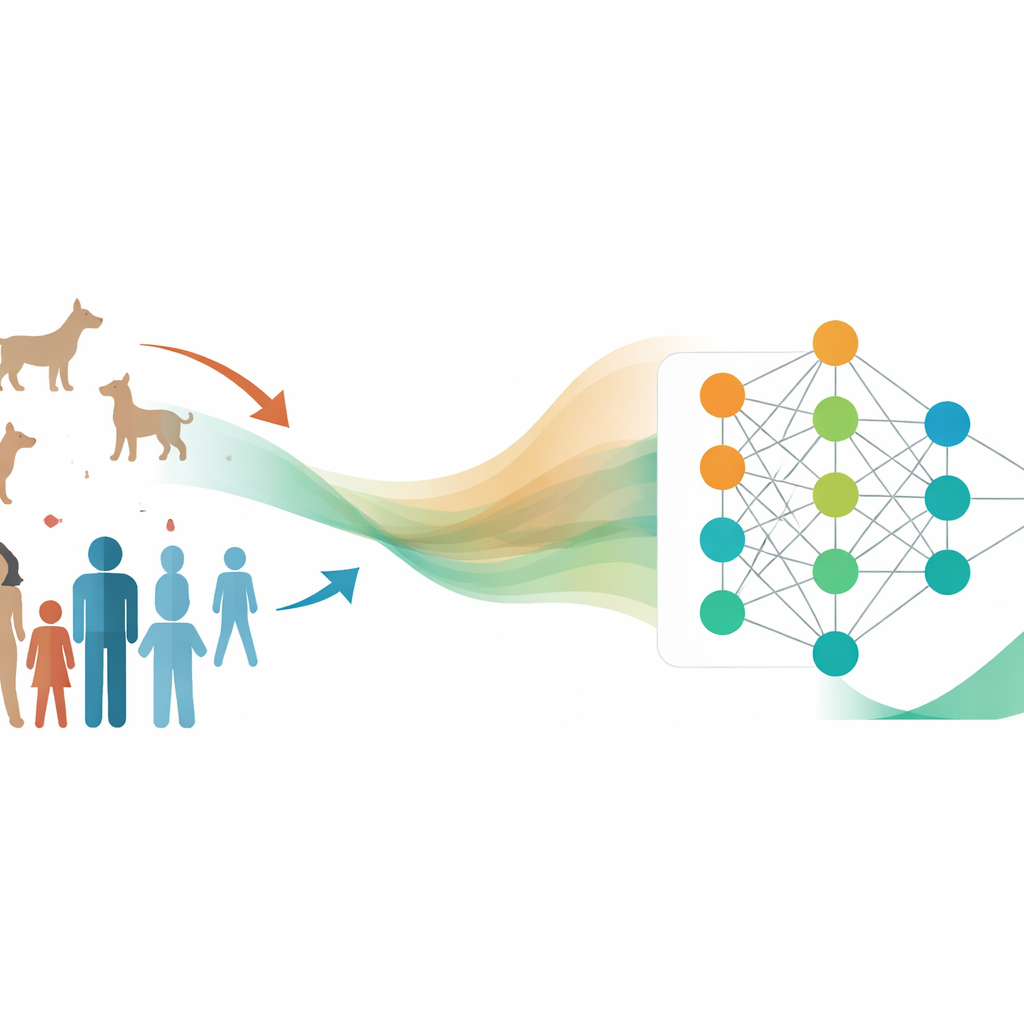
The authors focus on the main route by which people get rabies: bites from infected dogs. They divide both the dog and human populations into four groups each: those at risk but healthy, those recently exposed, those actively infectious, and those protected by vaccination or recovery. By tracking how individuals move between these groups over time, the model can describe how an outbreak starts, how large it becomes, and how long it lasts. It also includes key processes such as births, natural deaths, vaccination, and the gradual loss of immunity in both species.
Adding memory to disease spread
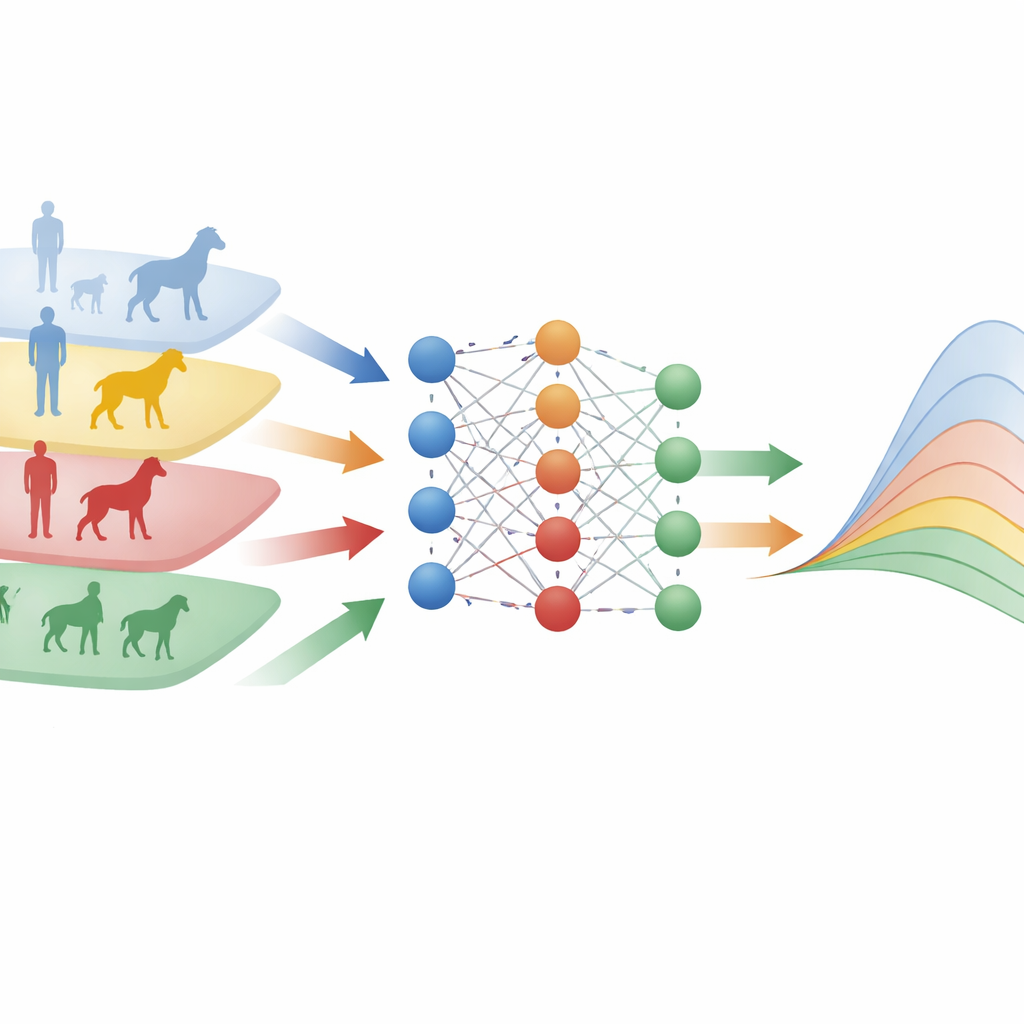
Classical outbreak models treat the future as depending only on what is happening right now. Rabies, however, is notorious for its long and variable pause between a bite and the onset of symptoms. To capture this, the authors build their equations using a type of "fractional" time derivative that allows the system to remember past events. In practical terms, this memory smooths the curves of infection: it can delay when cases peak, lower or raise the height of that peak, and alter how long the virus lingers in the population. By scanning through different levels of memory, the study shows that moderate memory best reflects the slow, drawn‑out course of rabies infection seen in real life.
Teaching a neural network to mimic the model
Because memory-based equations are expensive to solve repeatedly, the team trains a deep neural network to act as a fast stand‑in. They first generate highly accurate time series of all eight dog and human groups using a trusted numerical method. These data then serve as examples for the neural network, which learns to map time onto the levels of each group. The network is trained with a specialized optimization routine, the Levenberg–Marquardt method, which converges quickly for smooth problems like this one. The result is a compact neural surrogate that reproduces the full model’s behavior with extremely small errors, while being far quicker to evaluate.
What the model reveals about control
Beyond numerical performance, the authors use their framework to probe which features matter most for controlling rabies. They show that the parameters describing dog‑to‑dog transmission and the length of the incubation period in dogs have the largest impact on whether the virus can maintain itself in the population. In contrast, changes in human‑side factors play a smaller role in overall dynamics. This reinforces the long-standing public‑health message that dog-focused interventions—such as mass vaccination, limiting contact between dogs, and rapid removal of infectious animals—are central to reducing human deaths.
Big picture takeaway
In simple terms, this work shows that a rabies model that remembers past exposures and is distilled into a neural network can both reflect the biology of the disease and run quickly enough for scenario testing. The study suggests that moderate memory effects give the most realistic outbreak patterns and confirms that targeting dog transmission is the most effective route to protect people. More broadly, the approach provides a template for building fast, data‑friendly tools for other infectious diseases where long incubation times and lingering effects shape how epidemics unfold.
Citation: Shafqat, R., Imran, Al-Quran, A. et al. Enhancing rabies epidemic modeling with neural networks and fractional calculus. Sci Rep 16, 10409 (2026). https://doi.org/10.1038/s41598-026-40853-4
Keywords: rabies, infectious disease modeling, neural networks, fractional calculus, dog vaccination