Clear Sky Science · en
Mitigation of inductive coupling effects on buried pipelines using gradient control conductors of overhead line configuration and hippopotamus optimization algorithm
Why power lines can quietly threaten buried pipes
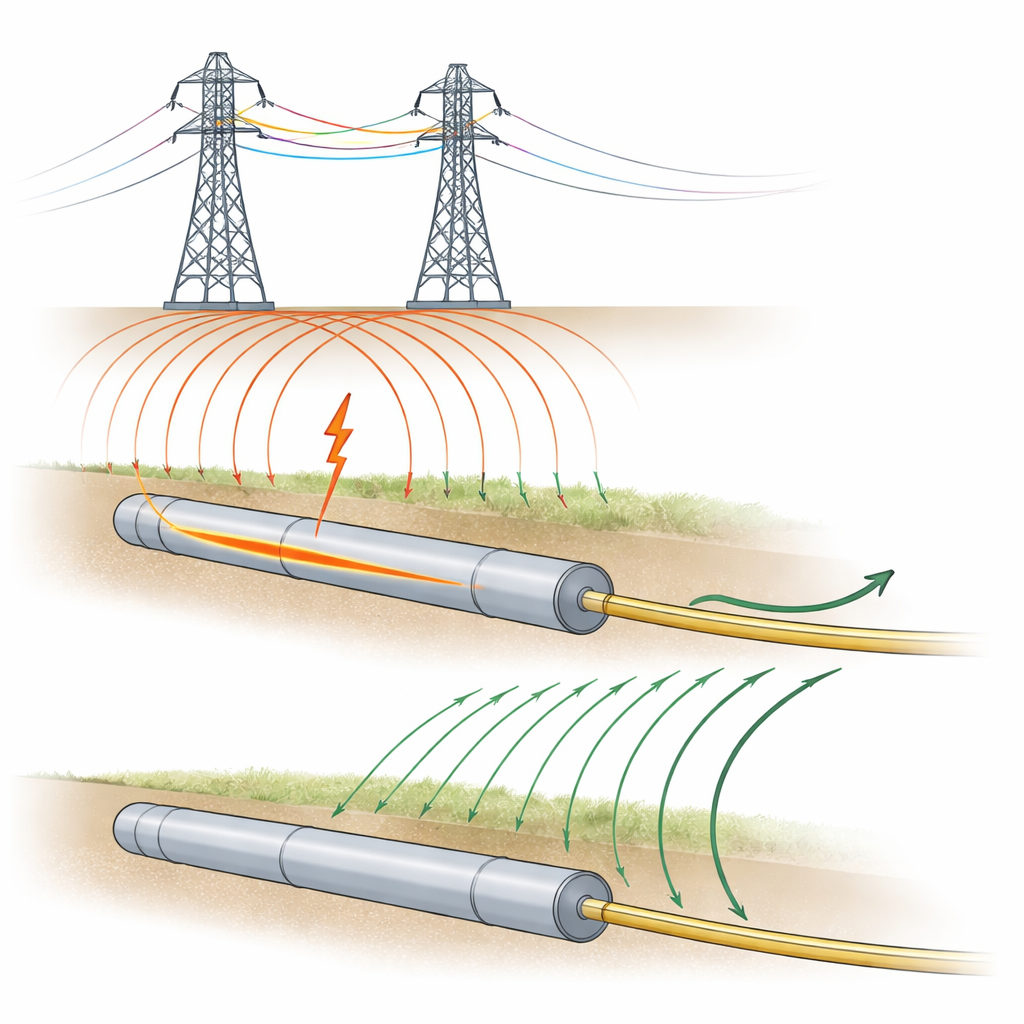
Across the world, high‑voltage power lines and underground pipelines often share the same narrow strips of land. This saves space and money—but it can create a hidden hazard. The electric currents flowing in massive transmission lines generate magnetic fields that can induce voltages in nearby metal pipes. Those invisible voltages can shock workers and slowly eat away at the steel. This study explores how serious that problem can be and tests smart ways to keep both people and pipelines safe.
Hidden currents beneath our feet
Buried steel pipelines carry oil, gas, and chemicals over hundreds of kilometers, while overhead lines carry electricity at hundreds of thousands of volts. When these two systems run side by side, the alternating current in the power line acts a bit like the primary coil of a transformer, and the pipeline becomes the secondary coil. The changing magnetic field from the line induces an electric voltage along the pipe and a current flowing between the pipe and the surrounding soil. International safety bodies such as NACE have set a recommended upper limit of about 15 volts on such induced voltages to avoid electric shock and excessive corrosion, but many real routes can exceed this level.
Measuring the risk to people and steel
The authors build a detailed mathematical model, based on classical electromagnetic laws and standard circuit theory, to estimate the magnetic field from a 400 kilovolt line in northern Algeria and the resulting voltage on a 40‑kilometer buried pipeline running nearby. They then translate those voltages into two concrete risks. First, they estimate how much current would pass through a person touching the pipe while standing on the ground, comparing it with medical data on heart fibrillation and shock survival times. Second, they calculate how the same interference drives corrosion by pushing charge across tiny defects in the pipe’s protective coating. The results are sobering: at a typical lateral separation of 40 meters, the induced voltage reaches about 43 volts—nearly three times the NACE limit—producing shock currents and corrosion current densities in a range where both serious injury and rapid metal loss become plausible.
Using a simple wire to tame dangerous voltages
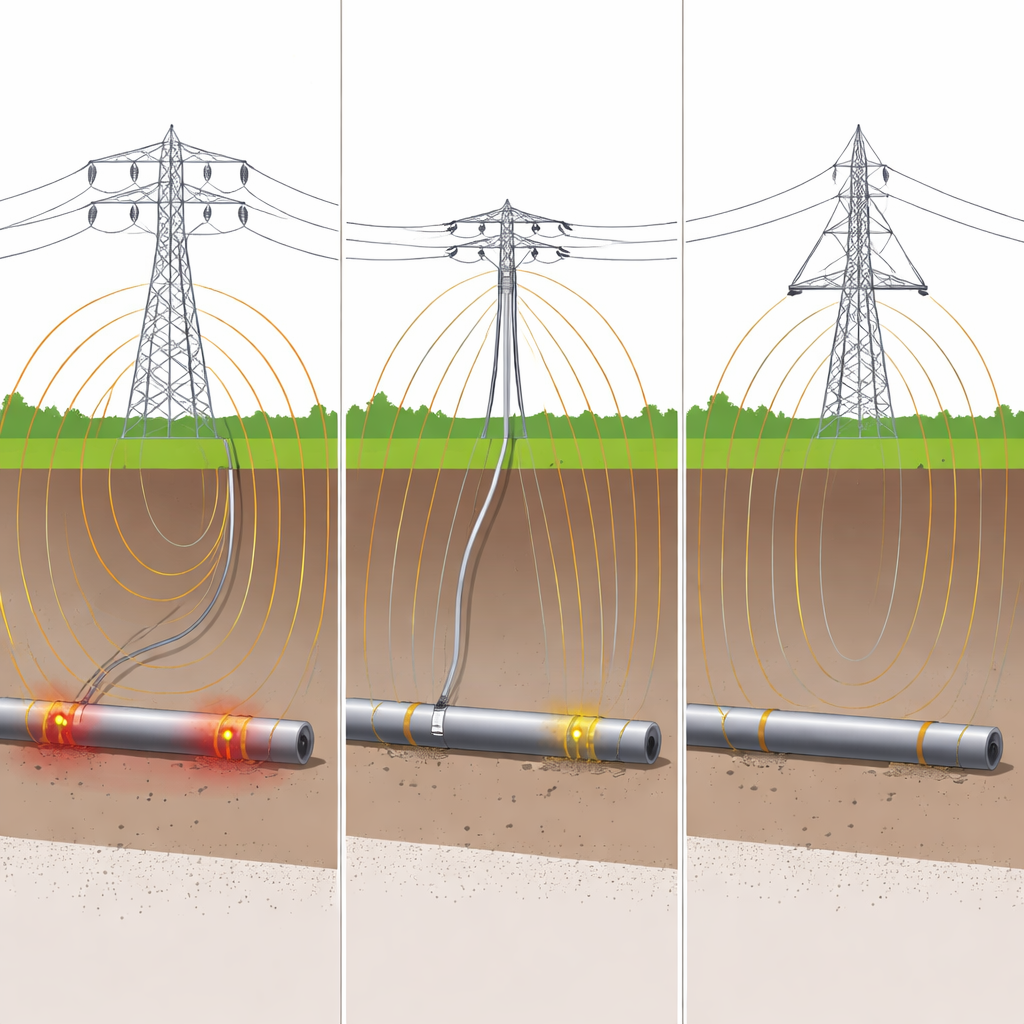
To bring the system back into a safe range, the team investigates a mitigation method already used in industry but not always carefully optimized. They add a long bare copper conductor—called a gradient control conductor—buried close and parallel to the pipeline and connected to it through special devices that block direct current but allow alternating current to pass. In effect, this extra conductor provides an easier path for the induced currents and smooths out voltage differences along the pipeline. Simulations show that, once installed, the peak induced voltage along the pipeline drops from about 43 volts to a value close to the 15‑volt safety target. In turn, the predicted electric shock current through a person and the corrosion‑driving current density both fall sharply below their critical limits.
Letting an algorithm rearrange the sky hardware
The researchers then ask a more ambitious question: can we also redesign the layout of the overhead conductors themselves to further suppress interference? Manually exploring all possible arrangements would be impractical, so they turn to a recent nature‑inspired search technique called the Hippopotamus Optimization algorithm, which mimics how hippos explore and defend territory. They let this algorithm vary the horizontal spacing and heights of the three phase conductors and the ground wire, with the goal of minimizing the maximum induced voltage on the pipeline. The best solution it finds places the phase conductors in a triangular configuration with the ground wire above the center. This geometry partially cancels the magnetic fields from each phase at the pipeline’s location. Under this optimized layout, the maximum induced voltage plunges to roughly 2–3 volts—well below any concern for shock or corrosion.
Making shared corridors safer for decades
In plain terms, the study shows that running powerful transmission lines next to buried pipelines can create enough induced voltage to endanger workers and greatly speed up rust, even when everything is operating normally. But it also demonstrates that two relatively straightforward measures—a nearby mitigation conductor and a carefully chosen arrangement of overhead wires—can cut those unwanted voltages by an order of magnitude. With these tools, designers of new energy corridors, and operators of existing ones, can protect both people and metal infrastructure while still reaping the economic benefits of shared routes.
Citation: Hachani, K., Bachir, B., Rabah, D. et al. Mitigation of inductive coupling effects on buried pipelines using gradient control conductors of overhead line configuration and hippopotamus optimization algorithm. Sci Rep 16, 7947 (2026). https://doi.org/10.1038/s41598-026-40852-5
Keywords: pipeline corrosion, power line interference, electrical safety, AC mitigation, metaheuristic optimization