Clear Sky Science · en
iGraphCTC: an inter-connected graph convolutional network for comprehensive clinical trial collaborations
Why smarter trial partnerships matter
When a new treatment for diabetes or stroke is tested, success doesn’t depend only on the drug—it also depends on who runs the trial and how they work together. Choosing the right mix of hospitals, universities, and companies is surprisingly hard and expensive. This study presents iGraphCTC, a data-driven tool that helps researchers and pharmaceutical firms find the most promising partners for chronic disease trials, potentially speeding up studies and getting effective therapies to patients sooner.
Seeing research as a web of connections
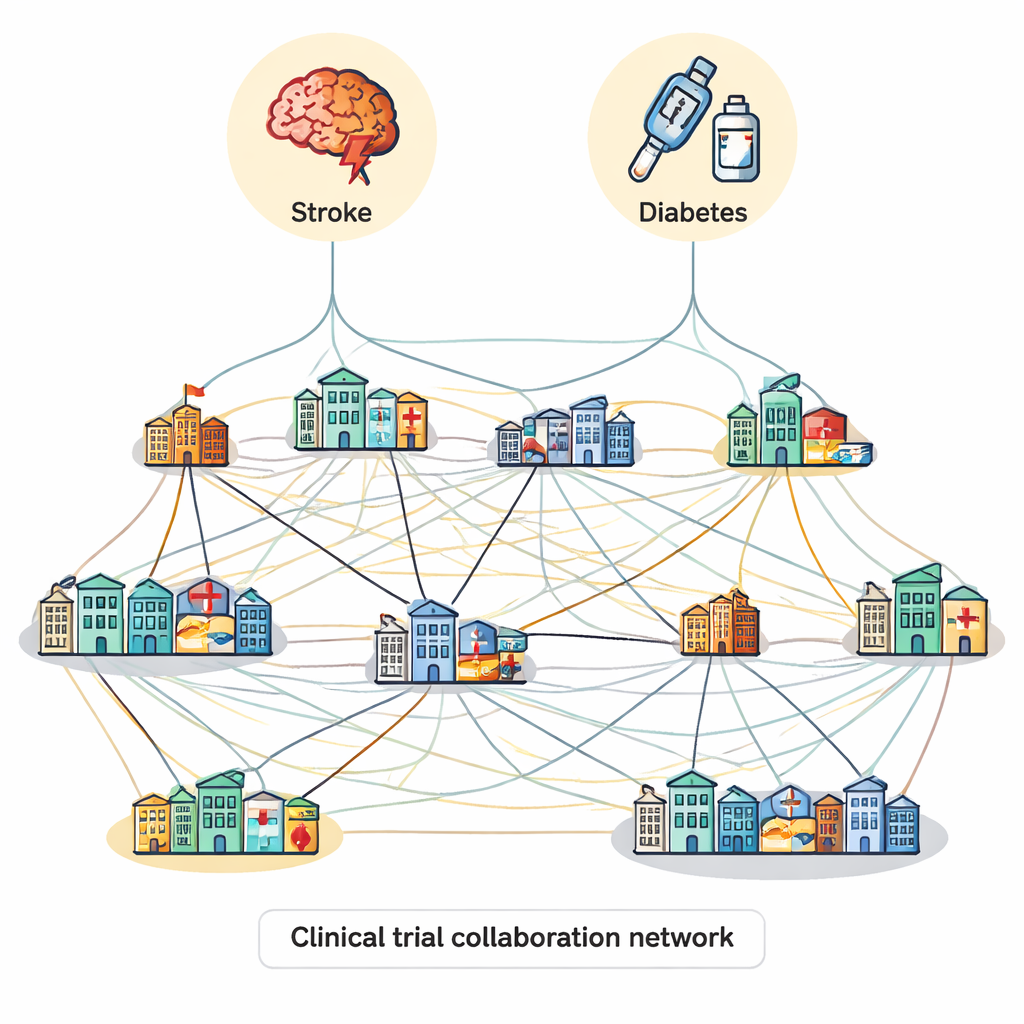
Instead of looking at clinical trials one by one, the authors view the whole landscape as a giant collaboration network. Each organization—whether a hospital, university, or pharmaceutical company—is treated as a “node” in a web, and a shared clinical trial between two organizations becomes a “link” connecting them. By studying this web for thousands of diabetes and stroke trials registered on ClinicalTrials.gov, the team can see who tends to work together, which groups act as hubs that connect many partners, and how these patterns differ across diseases and countries.
Turning trial data into a collaboration map
To build this map, the researchers gathered information such as who sponsored each trial, which institutions collaborated, what conditions were studied, which treatments were tested, and where the trials took place. They then cleaned and standardized this information—for example, unifying different spellings of the same institution and converting hospital names to their parent university when appropriate. The result was a large, carefully curated dataset containing over 60,000 trials and thousands of unique affiliations, ready to be analyzed as a weighted network where thicker links indicate more frequent collaboration.
From raw network to smart recommendations
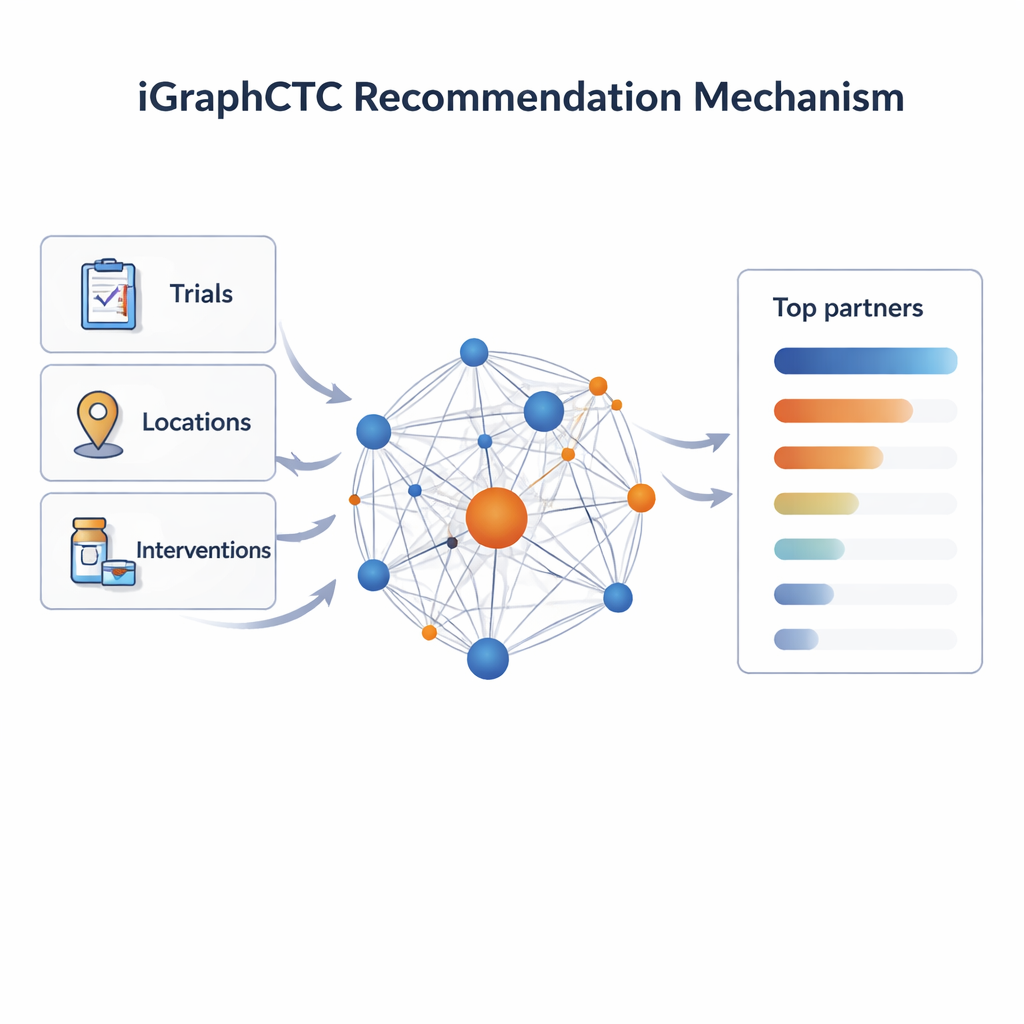
iGraphCTC goes a step beyond simply drawing this network. It uses a type of artificial intelligence called a graph neural network to learn patterns in how institutions collaborate and to predict which partnerships would work well in the future. Crucially, the system does not rely only on past co-authorship or shared trials. It also weaves in extra information about where institutions are located and what kinds of interventions—such as drugs, devices, or behavioral programs—they work on. These details are transformed into numerical “embeddings” that capture similarity in focus and context, helping the model suggest good partners even for institutions with limited collaboration history.
Testing the system against existing methods
To see whether iGraphCTC actually improves decision-making, the authors compared it with several established machine-learning and network-based models that are already used for recommendation tasks. They trained each model on older clinical trial data and then asked it to predict new collaborations that appeared in a later time period. Across multiple measures of accuracy, including how often the true best partners showed up in the top few recommendations, iGraphCTC consistently outperformed the alternatives. In diabetes trials, for example, it improved a key accuracy score by up to about 17 percentage points compared with strong baseline models; for stroke, it delivered similarly notable gains.
What this means for patients and policymakers
For non-specialists, the takeaway is straightforward: iGraphCTC helps match the right institutions to the right trials, using both who they’ve worked with and what kind of work they actually do. This can reduce wasted effort on poor-fit partnerships, cut administrative delays, and make it easier for under-resourced regions to join global studies. While the method still depends on good underlying data and will need testing in other disease areas, it shows how viewing clinical research as a connected network—and analyzing it with modern AI—can make the long, complex path from lab to patient more efficient and more equitable.
Citation: Jang, J., Ahn, H. & Park, E. iGraphCTC: an inter-connected graph convolutional network for comprehensive clinical trial collaborations. Sci Rep 16, 7939 (2026). https://doi.org/10.1038/s41598-026-40836-5
Keywords: clinical trial collaboration, graph neural networks, chronic disease research, research networks, AI recommendations