Clear Sky Science · en
High resolution temperature forecasting using functional time series decomposition and advanced predictive models
Why better temperature forecasts matter to everyday life
Air temperature shapes almost everything around us: the electricity we use, the food we grow, the comfort and safety of people during heatwaves or cold snaps. As weather grows more variable, city planners, farmers, doctors, and power-grid operators all need reliable short-term temperature forecasts—down to the hour. This study presents a new way to turn dense streams of temperature readings into smoother, more accurate daily forecasts, potentially improving how we plan for heat, cold, and energy demand.
From jagged numbers to smooth daily curves
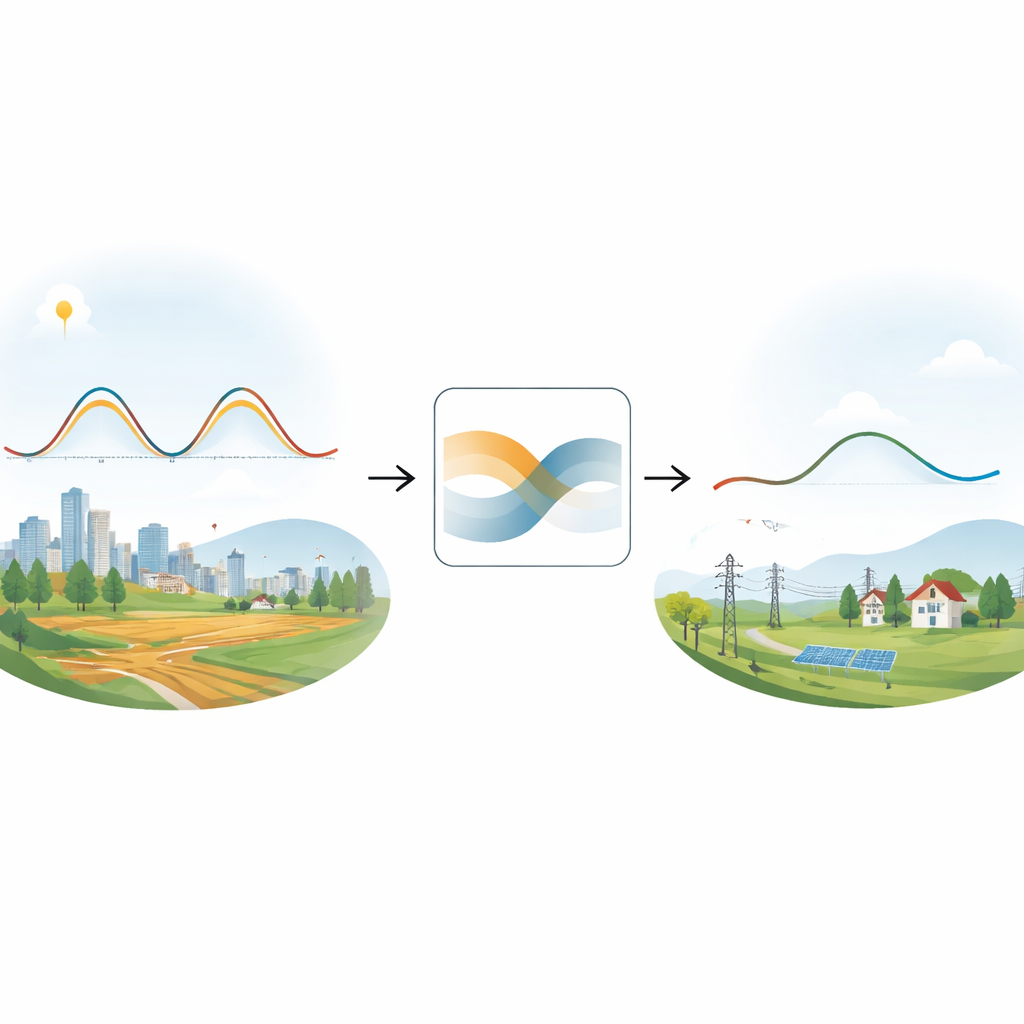
Most weather stations record temperature every hour, producing long lists of numbers. Traditional forecasting tools treat each number separately, like beads on a string. The authors instead treat each day’s 24 hourly readings as one smooth curve that rises and falls over the day. This curve-based view captures the familiar daily rhythm of cool nights and warm afternoons, as well as longer seasonal swings across months and years. By representing temperature as continuous curves rather than isolated points, the method can better track underlying patterns hidden in what otherwise looks like noisy data.
Separating regular patterns from surprises
To make sense of these curves, the study first splits the temperature signal into two parts. One part captures predictable structure: the long-term warming or cooling trend, the annual seasons, and weekly habits such as workdays versus weekends. This smooth backbone is estimated using flexible mathematical tools that gently follow the data without overreacting to short-lived bumps. The second part captures the remaining, more random day-to-day fluctuations—the weather surprises that still matter for tomorrow’s forecast. By stripping out the regular cycles, the model can focus its attention on predicting these shorter-term changes more precisely.

Letting whole days “talk” to each other
Instead of predicting the next hour from just the previous hour, the core model in this paper—called a functional autoregressive model—lets whole daily curves influence one another over time. In simple terms, yesterday’s entire temperature profile helps shape today’s, and today’s helps shape tomorrow’s. The method compresses each smooth curve into a small set of essential shapes, then learns how these shapes evolve from day to day. This allows the model to respect the continuity of the temperature signal, capturing how cool mornings tend to lead into warm afternoons and how similar weather patterns repeat across days while still allowing for natural variation.
Beating standard and AI-based rivals
The researchers tested their approach on seven years of hourly temperature data from Tabuk, a city in Saudi Arabia, using the first six years to train the model and the last year to test it in realistic, rolling “day-ahead” forecasts. They compared their curve-based method with classic statistical models widely used in forecasting, as well as popular artificial intelligence approaches based on neural networks. Across the board—whether looking hour by hour, month by month, or over the entire year—the functional model produced the smallest forecast errors and the most stable performance, particularly during the tricky early-morning and late-evening hours when temperatures can change quickly.
What this means for people and planning
For a non-specialist, the message is straightforward: by viewing temperature not as disconnected numbers but as smooth daily stories, we can predict tomorrow’s heat and cold more reliably. In this study, the curve-based method consistently outperformed both traditional statistics and more complex AI tools, suggesting that respecting the natural shape and rhythm of temperature pays off. Although the work focuses on one city and one type of model, it points toward a practical way to sharpen high-resolution forecasts. Better hourly predictions can help energy providers balance supply and demand, farmers protect crops from sudden frosts or heat stress, and communities prepare more effectively for weather-related risks.
Citation: Alshanbari, H.M., Aldhabani, M.S., Iqbal, N. et al. High resolution temperature forecasting using functional time series decomposition and advanced predictive models. Sci Rep 16, 8906 (2026). https://doi.org/10.1038/s41598-026-40796-w
Keywords: air temperature forecasting, functional data analysis, time series models, climate and energy planning, neural network comparison