Clear Sky Science · en
Optimizing crop selection for sustainable agriculture: a compound ensemble approach integrating machine learning and IoT-based sensors
Smarter Farming for a Hungry Planet
As the world’s population climbs toward nearly 10 billion, farmers are under pressure to grow more food on land that is increasingly stressed by heat, drought, and erratic rainfall. This paper presents a new way to help farmers decide which crops to plant, using a mix of soil sensors in the field and advanced computer models. By turning streams of real-time data into tailored crop advice, the system aims to boost yields, cut waste, and make agriculture more resilient in dry, climate‑vulnerable regions.
Why Choosing the Right Crop Matters
Picking the wrong crop for a particular place and season can mean poor harvests, wasted water, and lost income. Crop performance depends on many intertwined factors: rainfall, temperature, humidity, soil moisture, acidity, salt levels, and key nutrients such as nitrogen, phosphorus, and potassium. Traditional planning often relies on experience, average statistics, or outdated tables, which can miss local quirks and year‑to‑year swings in weather. The authors argue that more precise, data‑driven crop choice is essential to avoid future food shortages, especially in semi‑arid regions where droughts and heat waves are becoming more common.
Bringing the Field Online
To capture what is really happening in the soil, the team deploys a seven‑in‑one sensor directly into farmers’ fields. This device continuously measures moisture, temperature, electrical conductivity (a clue to salt levels), pH, and the three major nutrients plants need to thrive. The sensor is connected to a small microcontroller and low‑power wireless modules, which clean the readings with a noise‑filtering step and send them to an online database every few seconds. This live stream means the recommendation system works with current conditions, not just historical averages. The setup was tested in the drought‑prone Chengalpattu district of Tamil Nadu, India, where a reference table of 50 locally important crops and their ideal soil and climate ranges was compiled. 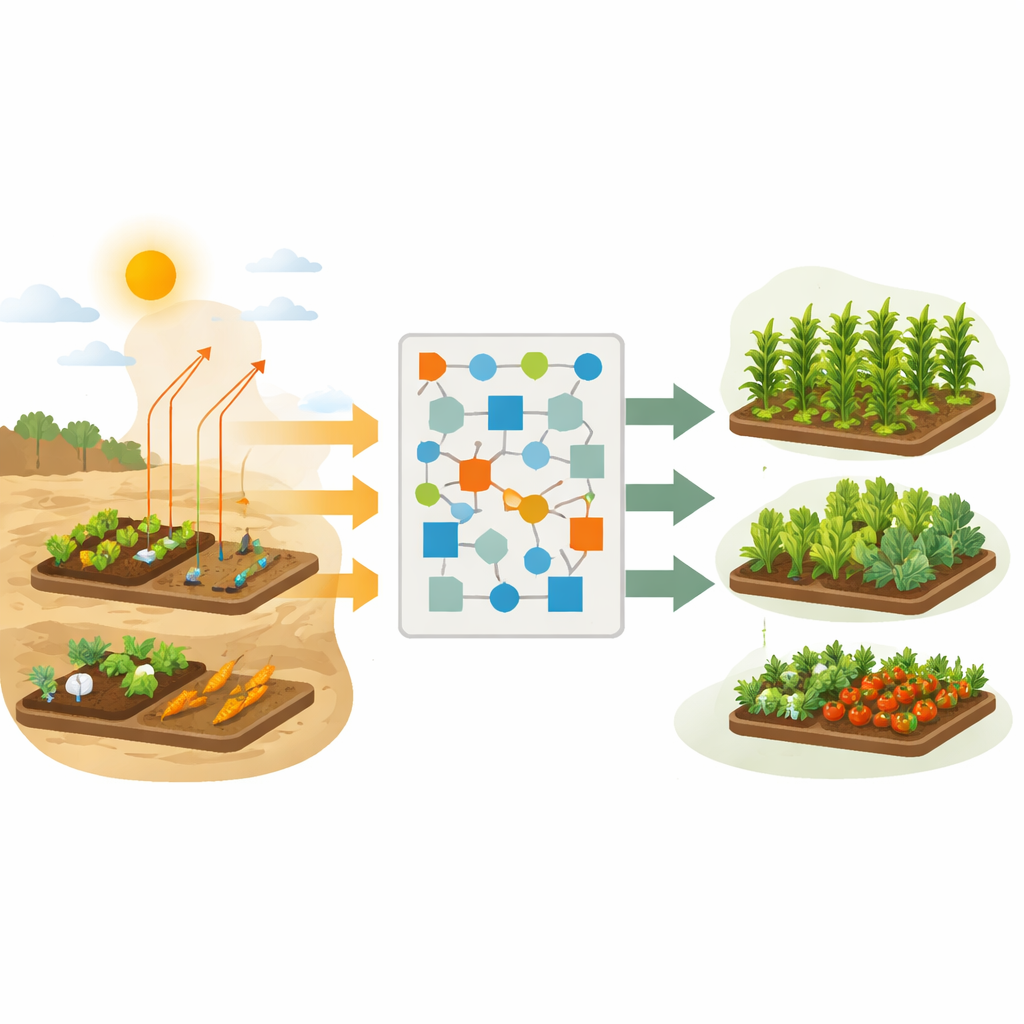
Turning Weather and Soil into Foresight
Raw measurements alone do not tell farmers what to plant next. The system first learns how rainfall behaves over decades, from 1982 to 2023, and uses a specialized type of neural network to forecast future rain. This upgraded “Intensified LSTM” model is tailored to handle sharp swings and rare heavy downpours better than standard versions, and clearly outperforms a more basic design when tested on different growing seasons. Its rainfall forecasts then feed a drought module that applies two established climate indices. One looks purely at rainfall shortages, while the other also accounts for heat‑driven water loss from soils and plants. In trials, the heat‑aware index proved more accurate, helping the system judge whether an upcoming season is likely to be wet, normal, or dry, and how severe any expected drought might be.
Letting Many Models Vote on the Best Crops
The heart of the approach is a “compound ensemble” crop recommender that does not trust a single algorithm. Instead, it trains 12 different prediction methods—ranging from simple statistical tools to decision trees and neural networks—on the combined sensor readings, rainfall forecasts, and drought levels. When given a new set of conditions, each model suggests a suitable crop, and the system takes a simple majority vote. This crowd‑like strategy reduces the impact of noisy data or quirks in any one model, leading to much steadier decisions. To fine‑tune these models without endless trial‑and‑error, the authors use a genetic search method that automatically evolves good parameter settings over many simulated “generations,” improving accuracy while keeping computing demands manageable. 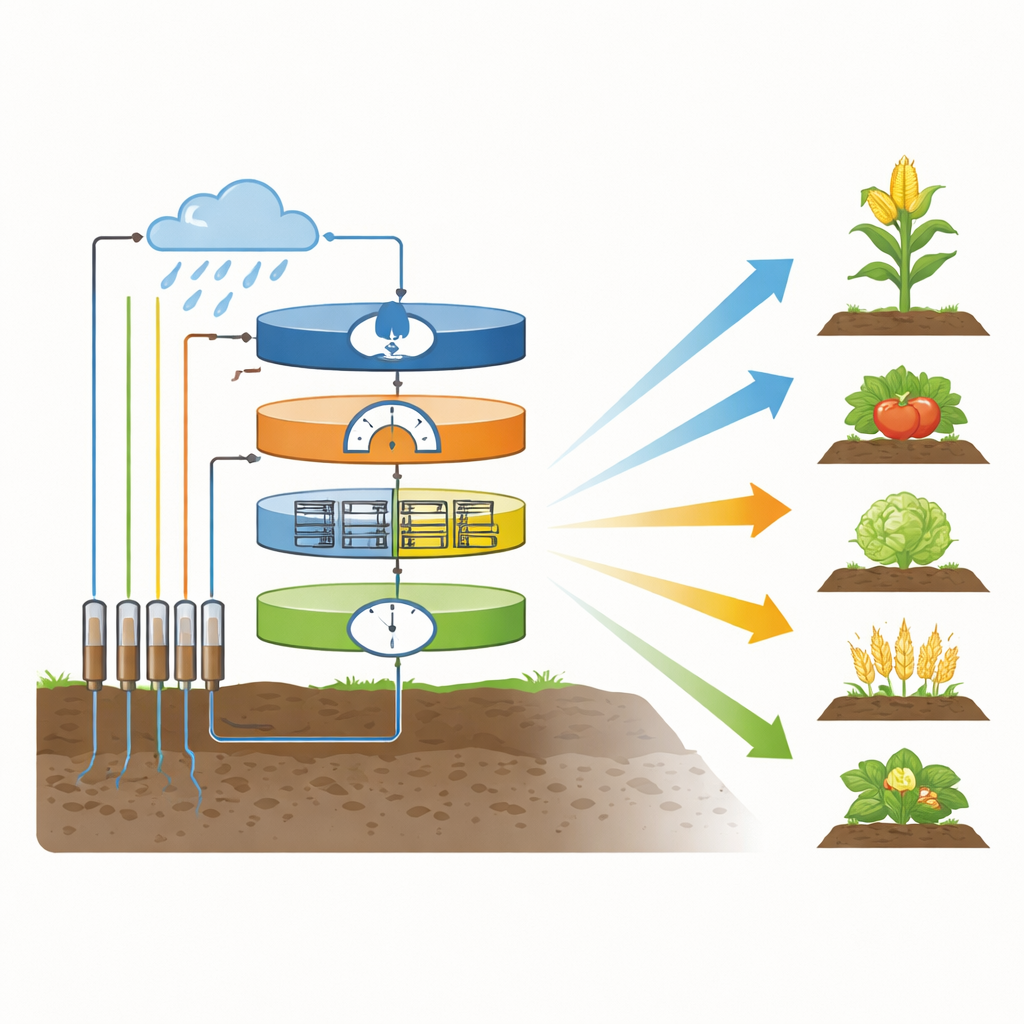
From Single Answer to Ranked Choices
Rather than stopping at one “best” crop, the system goes a step further and ranks multiple options. It compares the current soil and climate profile to the ideal conditions of each crop in the 50‑entry reference table, using a flexible distance measure that works well when many factors are involved. Crops whose preferred ranges sit closest in this multi‑dimensional space are placed higher on the list. Farmers or advisors can then choose among, say, the top three or five crops, balancing market prices, personal experience, or seed availability against the model’s suggestions. When the authors compared their system’s top recommendations with government statistics on what is actually grown in Chengalpattu, staples such as paddy and key vegetables appeared prominently in both, lending real‑world credibility to the tool.
What This Means for Farmers
The study shows that combining field sensors, advanced weather forecasting, and a voting group of machine‑learning models can produce highly accurate, locally tailored crop suggestions—achieving nearly 99.8% accuracy on the test data. In practical terms, this framework could help farmers in dry, climate‑sensitive regions choose crops that are better matched to upcoming rainfall and their soil’s true condition, cutting the risk of failure and making more efficient use of water and fertilizers. While the current work is a regional proof‑of‑concept and still needs long‑term testing on real harvests and farmer adoption, it sketches a clear path toward “smart” crop planning that could play an important role in future food security.
Citation: Poornima, S., Mishra, P., Mahishi, R.R. et al. Optimizing crop selection for sustainable agriculture: a compound ensemble approach integrating machine learning and IoT-based sensors. Sci Rep 16, 11350 (2026). https://doi.org/10.1038/s41598-026-40772-4
Keywords: crop recommendation, precision agriculture, drought resilience, IoT sensors, machine learning