Clear Sky Science · en
Robust high-capacity free-space optical communication using OAM-based structured light and intelligent adaptive signal processing
Light Beams as Invisible Data Highways
Imagine sending internet data not through buried fiber-optic cables or crowded radio waves, but across open air or outer space on thin, invisible beams of laser light. This paper explores how to make those light highways far faster and more reliable, even when Earth’s turbulent atmosphere tries to bend, blur, and break them. The work matters for everything from connecting remote communities to building dense satellite networks that could one day move data around the planet with almost no delay.
Why Free-Space Laser Links Are So Appealing
Free-space optical (FSO) communication uses tightly focused laser beams to carry information through the air or vacuum instead of through glass fibers or radio channels. These beams can deliver extremely high data rates, are difficult to eavesdrop on, and can be deployed quickly where laying fiber is impractical. But there is a catch: as light travels through real air, pockets of warm and cool air act like a constantly shifting funhouse mirror. The beam wanders, flickers, and breaks into speckle patterns, raising error rates and threatening link reliability, especially in fog, rain, or long paths to satellites. Conventional FSO systems use simple beam shapes and static correction schemes that struggle to keep up with these rapid changes.
Shaping Light to Heal Itself
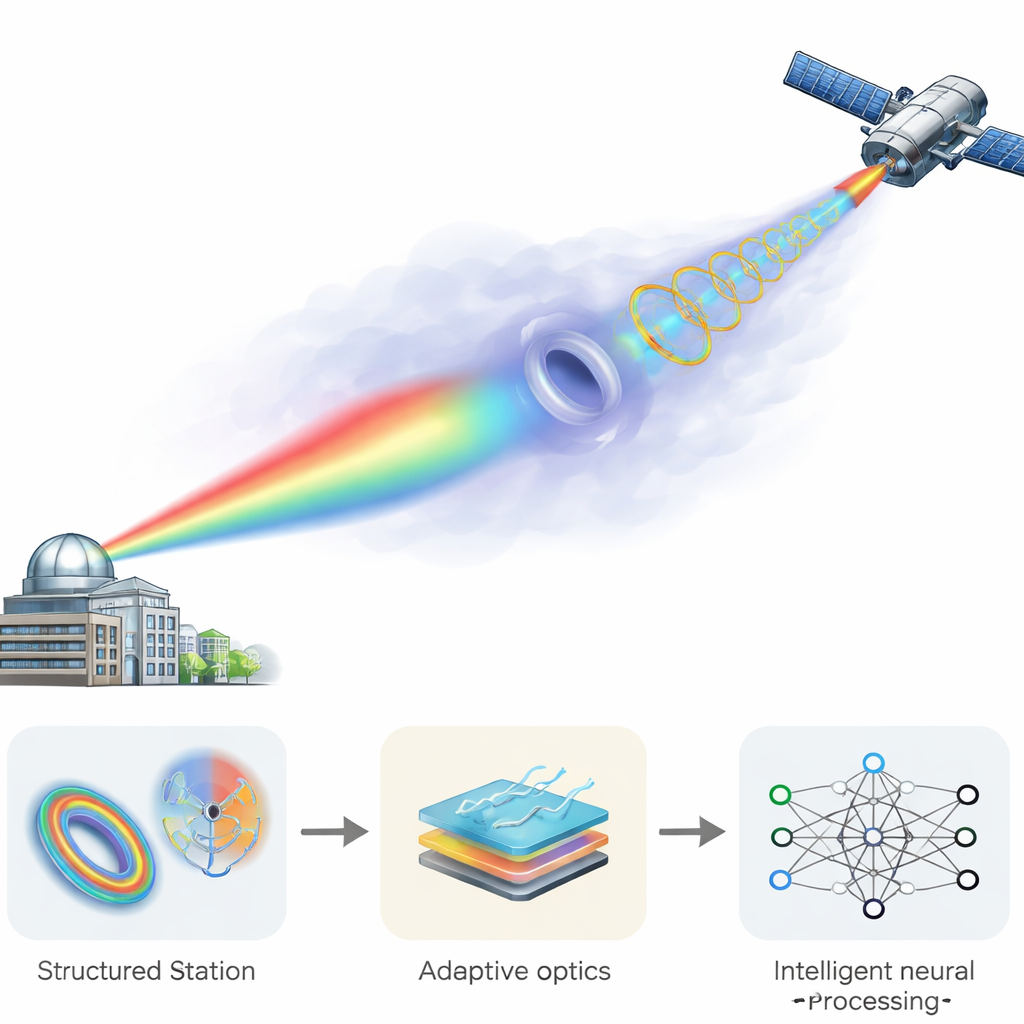
The authors propose starting the fight against turbulence not with electronics, but with the light beam itself. Instead of sending a plain, bell-shaped laser spot, they use structured beams such as Bessel, Airy, and vortex beams that carry orbital angular momentum, giving the light a corkscrew-like twist. These patterns can partially "self-heal" after being blocked or distorted and can stay focused over longer distances. Multiple twisted patterns can also be stacked in the same physical path like invisible lanes on a highway, each lane carrying its own data stream. The paper models how these beams behave as they cross turbulent air, how much power leaks between lanes, and which patterns remain most robust over many kilometers.
Smart Optics and Learning Systems Working Together
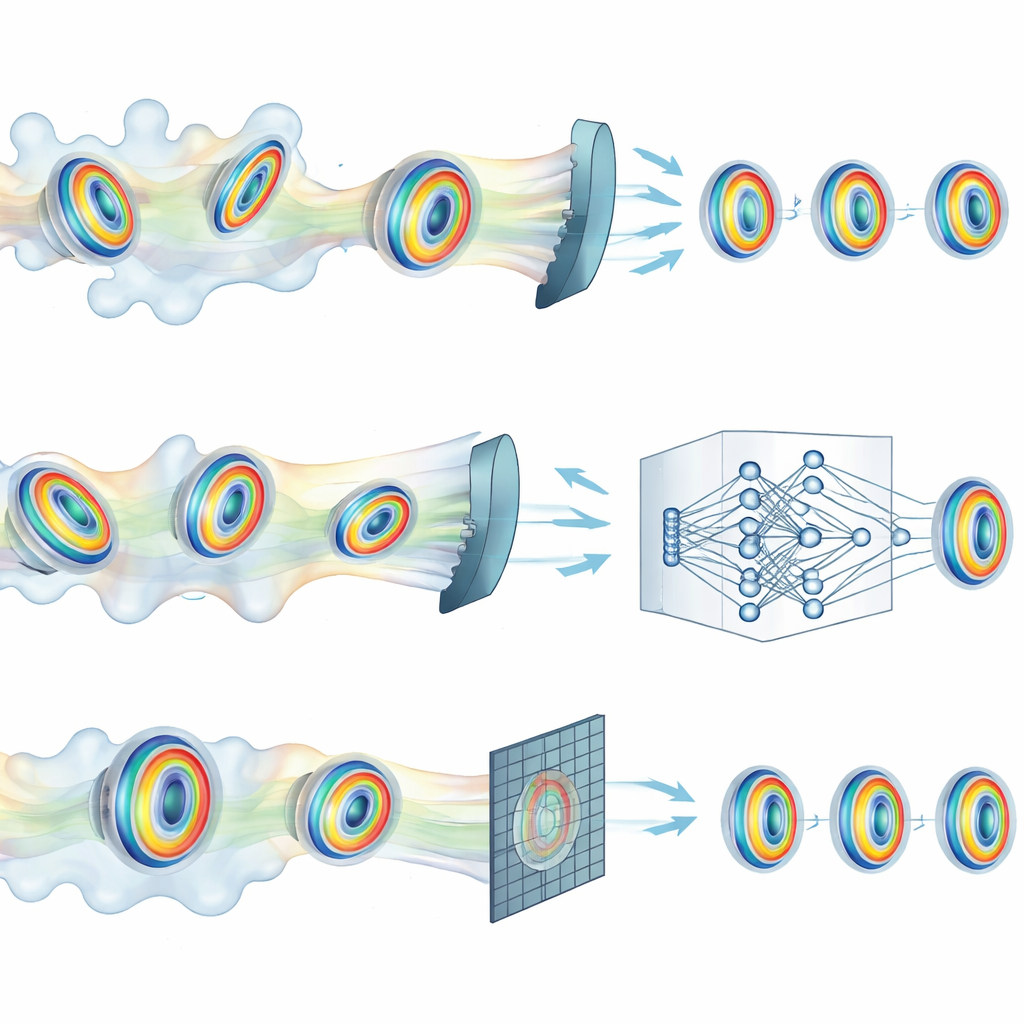
Shaped beams alone are not enough, so the framework adds two layers of intelligence. First, adaptive optics uses a deformable mirror to undo some of the warping introduced by the atmosphere in real time. A swarm-inspired optimization algorithm continuously tweaks mirror settings and beam parameters to maximize signal quality. Second, at the receiver, the signal is cleaned by a pair of learning-based tools: a deep convolutional neural network that watches how speckle patterns evolve frame by frame and predicts how to reverse them, and a neural–fuzzy equalizer that fine-tunes the correction sample by sample. This combination allows the system not only to react to current distortions, but to anticipate how they will change shortly in the future.
Stacking Colors and Beam Shapes for Huge Capacity
To push capacity even further, the authors model using several colors of light at once, in the mid-infrared band where the atmosphere is relatively transparent. Each color is then divided into multiple twisted-beam lanes, vastly multiplying the number of separate data channels in a single link. Instead of bulky optics, the design relies on ultra-thin "metasurfaces" carved with sub-wavelength structures to generate and sort these orbital-angular-momentum beams on a compact chip-like element. In simulations, this hybrid of wavelength and spatial multiplexing, combined with the adaptive correction chain, cuts error rates by more than half, boosts signal stability by over 20 percent, and yields about a ten-decibel increase in effective signal power compared with more traditional systems.
Bringing Space-Age Links Closer to Reality
Put simply, the paper shows that by carefully sculpting light, correcting it optically, and then cleaning it digitally with learning algorithms, we can move far more information through the same patch of air, even when that air is roiling and unsteady. Although the results are based on detailed simulations rather than outdoor experiments, they outline a practical path toward laser links that could reliably bridge cities, aircraft, and satellites with fiber-like capacity. If confirmed in hardware, this approach could help underpin future communication networks that are faster, more secure, and less dependent on physical cables.
Citation: Ahmad, M., Hayat, B., Fang, M. et al. Robust high-capacity free-space optical communication using OAM-based structured light and intelligent adaptive signal processing. Sci Rep 16, 8921 (2026). https://doi.org/10.1038/s41598-026-40704-2
Keywords: free-space optical communication, orbital angular momentum, structured light, adaptive optics, deep learning equalization