Clear Sky Science · en
Foxnut (makhana): a productive and economic crop providing good niche for soil carbon storage and stability in lower Gangetic wetlands
Why this wetland crop story matters
Across eastern India, many low-lying rice fields are being converted into ponds for growing foxnut, also called makhana—a crunchy "superfood" snack. This shift raises a crucial question: can farmers earn more while still keeping carbon safely stored in their soils, which helps slow climate change and supports long-term soil health? This study compares foxnut ponds with the region’s traditional double-rice system to see how each affects soil carbon, soil quality, and farm income in the lower Ganges basin of West Bengal.
Two ways of farming in the same landscape
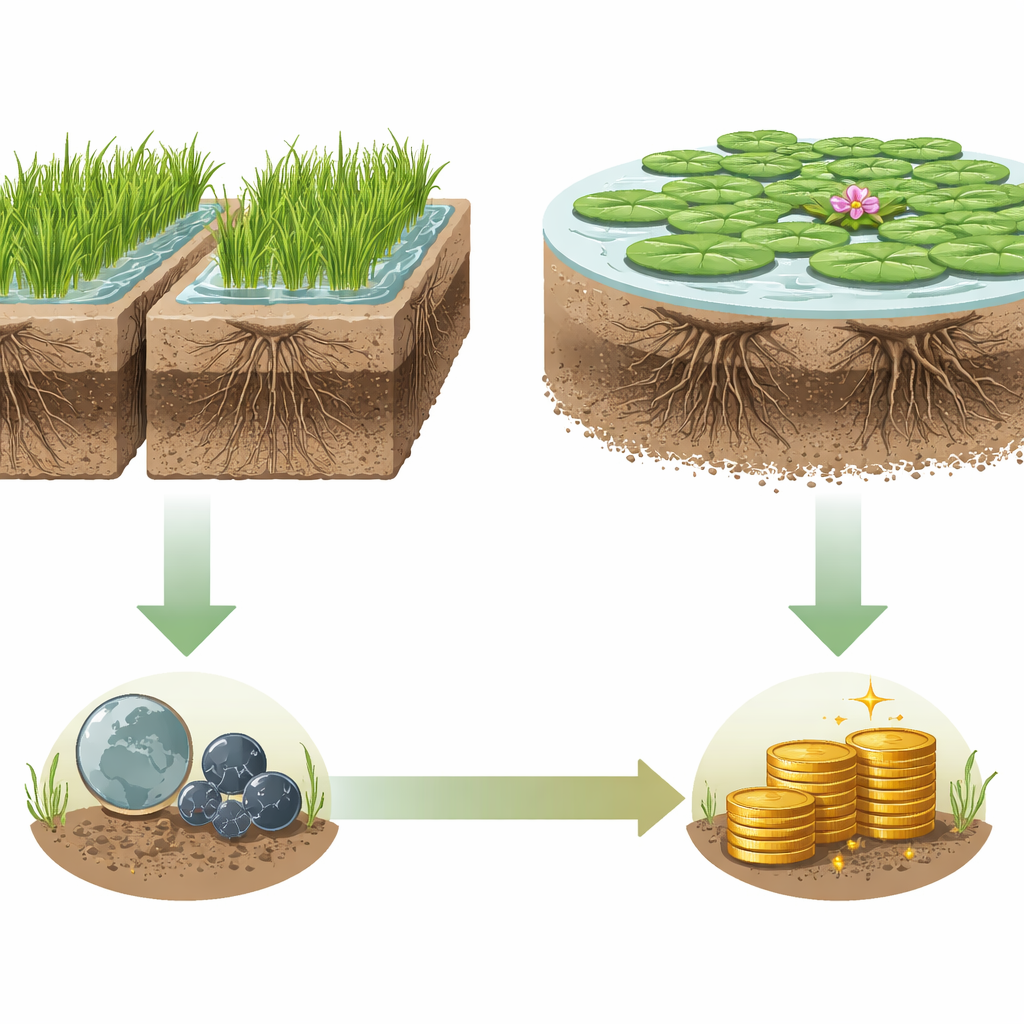
The researchers focused on wetlands in Malda district, where both foxnut and rice–rice–fallow systems have been grown for at least five years on similar alluvial soils. In the double-rice system, one rice crop is grown during the monsoon and another in winter, each under shallow standing water but with dry intervals in between. In foxnut ponds, by contrast, fields are kept continuously flooded for most of the year, with broad, spiky leaves floating across the surface while plants send thick roots into the mud. By sampling soil down to one meter at multiple sites and depths, the team was able to measure not just how much carbon was present, but how it was distributed through the profile.
Following carbon as it moves into the soil
Plant residues—roots, stubble, exudates from living roots, and aquatic algae—are the main way carbon enters wetland soils. The scientists estimated annual carbon inputs from each source. Double-rice fields produced more above-ground biomass overall and, even after most straw was removed for fodder, still returned more stubble and root carbon to the soil than foxnut ponds. Both systems hosted aquatic algae, but the longer flooded period in foxnut ponds led to somewhat higher inputs from aquatic biomass. Using a chemical method that separates soil carbon into more easily decomposed "active" fractions and slower, more resistant "passive" fractions, the team traced how these different inputs translated into stored carbon.
Which system stores more and which stores more stably?
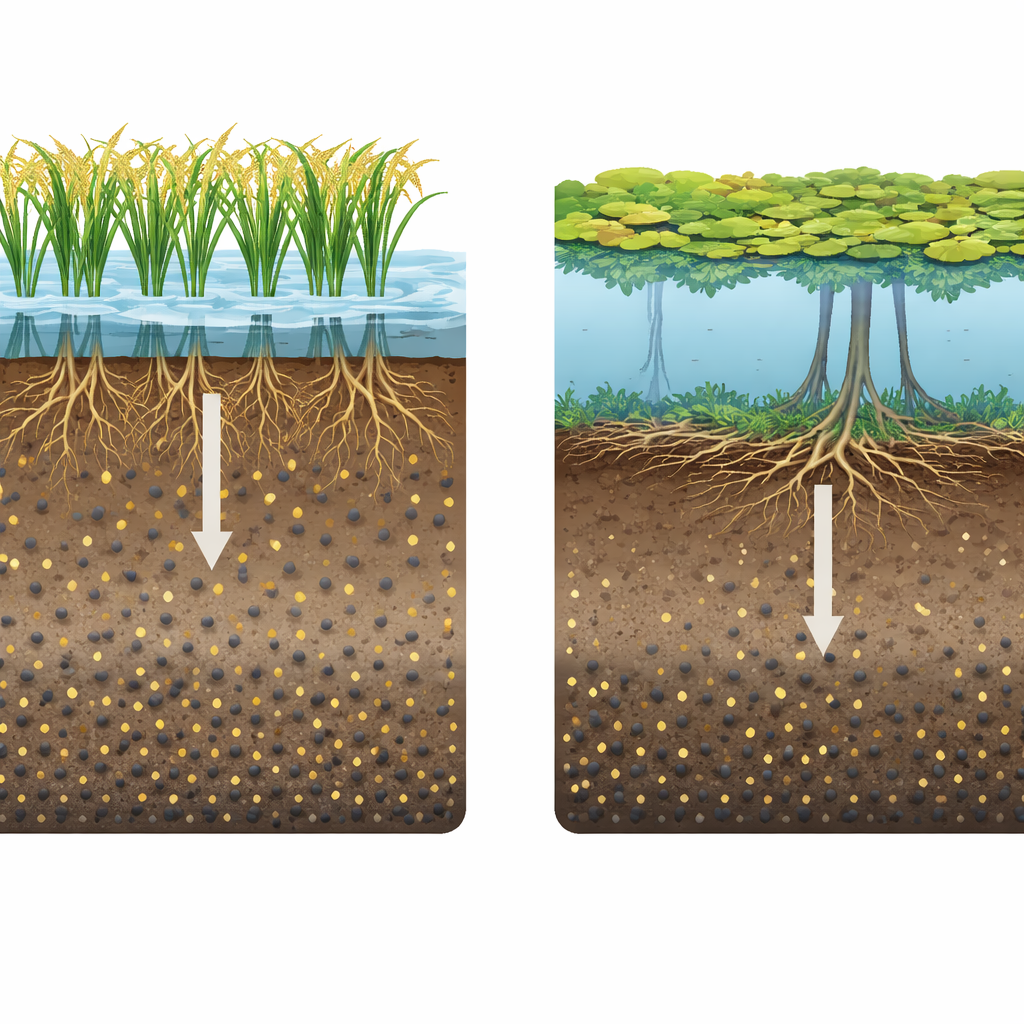
Across almost all depths, total organic carbon and its various fractions were higher in the double-rice soils than in foxnut soils. In particular, deeper layers (below 25 cm) under rice contained more carbon locked into passive, harder-to-decompose forms, aided by the fine texture and higher lime content of those soils. Repeated cycles of flooding, puddling, and partial drying in rice paddies seem to favour the build-up of stable organo-mineral complexes that hold carbon for longer periods. Foxnut soils, though sandier and slightly poorer in total carbon, showed a different pattern: near the surface, a larger share of their carbon sat in more resistant pools, reflected in higher "recalcitrance" indices. Continuous submergence and cooler, oxygen-poor conditions appear to slow breakdown of organic matter at the top, even though the overall carbon stock is smaller.
Soil quality, crop returns, and trade-offs
To translate these measurements into a picture of soil health, the authors used indices that combine carbon quantity, how it is layered with depth, and how much sits in active versus passive forms. By these measures, double-rice fields had better overall soil quality: higher total and active carbon, stronger vertical "stratification" of fresh carbon near the surface, and a higher carbon management index. Yet foxnut ponds offered a different kind of advantage. When yields were converted into a common unit based on rice prices, and production costs were accounted for, foxnut delivered a higher benefit–cost ratio than the rice–rice–fallow system. Farmers growing foxnut in perennial water bodies could therefore earn more income, while also hosting a relatively stable surface carbon pool.
What this means for farmers and the climate
Put simply, double-rice systems in the lower Ganges basin currently keep more carbon in the soil and in deeper, long-lived forms, which is good news for climate mitigation and long-term soil function. Foxnut ponds, although they store less total carbon, tend to protect a higher fraction of it near the surface in stable forms and provide better economic returns for farmers using waterlogged or degraded wetlands. The authors conclude that transplanted double-rice is the stronger option for building soil carbon stocks, while foxnut is a promising cash crop that maintains reasonably stable carbon in difficult wetland environments. They argue that long-term monitoring will be essential to understand how continued expansion of foxnut or similar wetland crops will shape both farm livelihoods and carbon storage in this vulnerable river-basin landscape.
Citation: Choudhury, S.G., Basak, N., Banerjee, T. et al. Foxnut (makhana): a productive and economic crop providing good niche for soil carbon storage and stability in lower Gangetic wetlands. Sci Rep 16, 9774 (2026). https://doi.org/10.1038/s41598-026-40676-3
Keywords: foxnut makhana, soil carbon, wetland farming, rice paddies, Ganges basin agriculture