Clear Sky Science · en
Hardware-independent control for partial gravity simulation using a 2-DOF robotic device
Why lighter gravity on Earth matters
As humans plan longer trips to the Moon and Mars, we urgently need to know how strange gravity levels will affect the body. Doing such tests in space is expensive and rare, so scientists use special spinning machines on Earth, called clinostats, to mimic low gravity for cells and tiny tissues. This paper presents a new way to control such a device so it can reliably imitate not only weightlessness, but also the weaker pulls of the Moon, Mars, and even gravity levels close to Earth’s—without being tightly tied to any one motor or piece of hardware.
Spinning our way to fake gravity
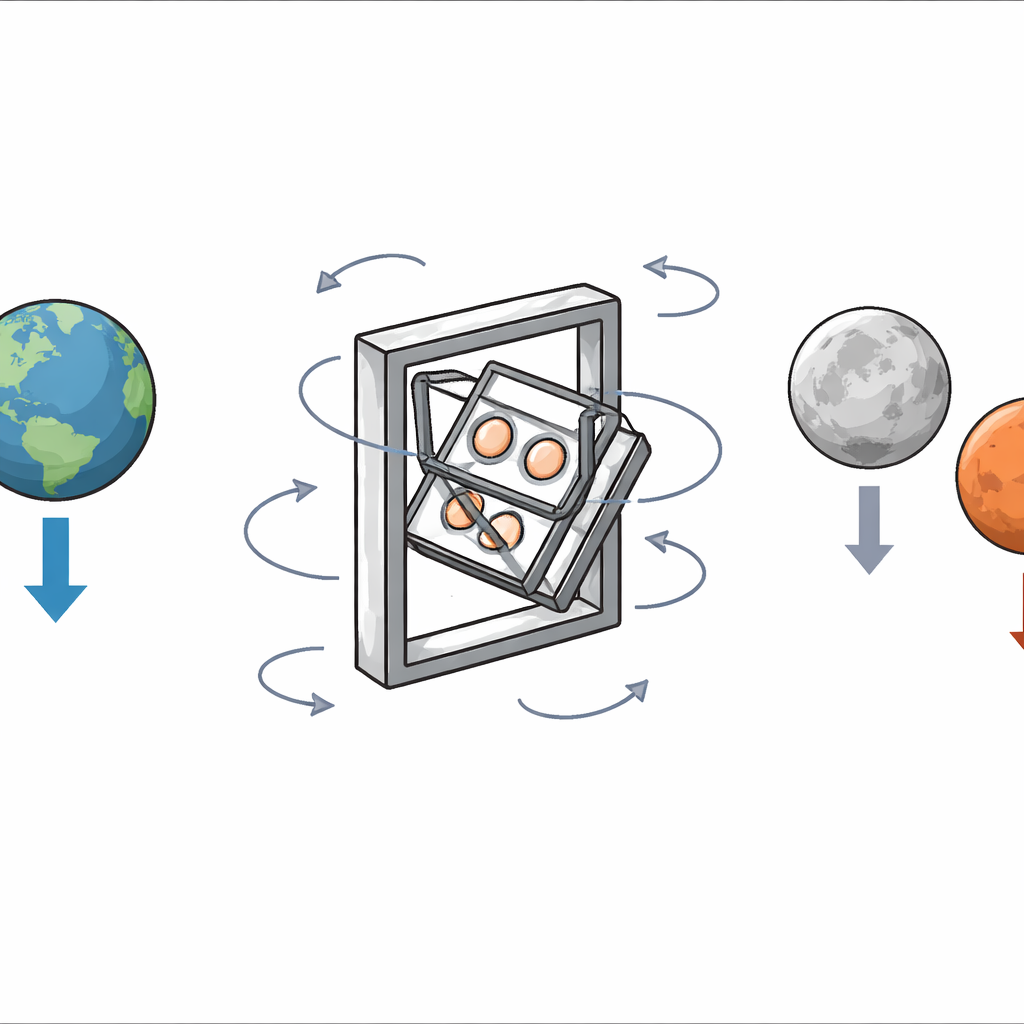
Near Earth’s surface, gravity points almost straight down everywhere. A three‑dimensional clinostat takes a small sample—such as cells or organoids in a dish—and slowly spins it around two perpendicular axes. Because the sample’s orientation keeps changing, the direction of gravity “seen” by the cells keeps shifting, and over time those pulls average out. When the rotations are arranged just right, the time‑averaged gravity can approach zero, mimicking microgravity in orbit. For many years, this simple idea has been used to study muscle loss, bone weakening, immune changes, and other space‑like effects without leaving the ground.
From weightless to “Moon‑like” gravity
More recently, researchers realized it is not enough to study only weightlessness. Astronauts on the Moon or Mars will live with gravity that is weaker, not absent. To bridge that gap, the concept of time‑averaged simulated partial gravity was introduced: instead of making the average pull vanish, the device keeps gravity pointing slightly more often in one direction than the others. That bias creates an average pull somewhere between zero and full Earth gravity, allowing scientists to imitate conditions like 0.17 g on the Moon or 0.38 g on Mars. Earlier control methods could do this, but they depended heavily on the exact motors and mechanics used, and they could not produce partial gravity higher than about 0.44 g.
New way to steer the spinner
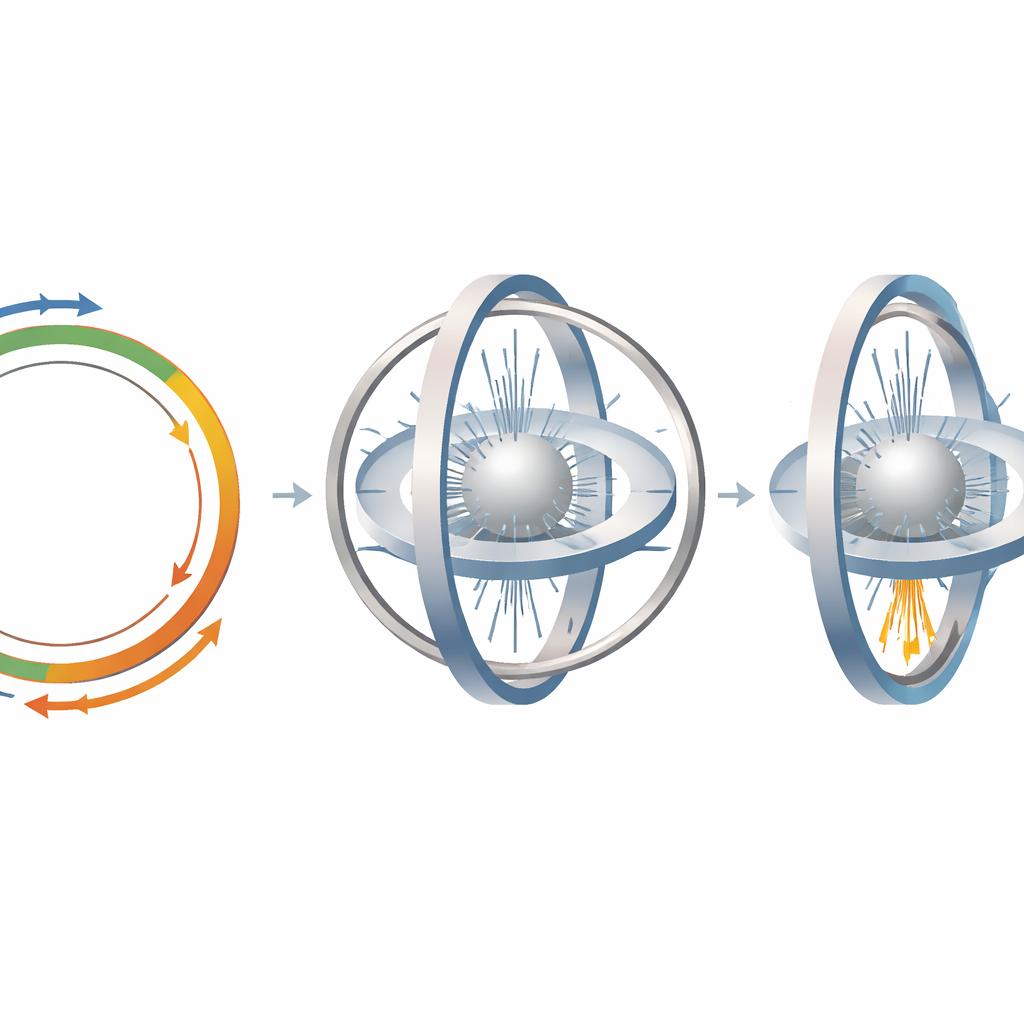
The core innovation of this study is to control the outer motor of the clinostat based on its angle, rather than on time. Previous methods prescribed how fast the motor should spin at each moment, but real hardware never follows that plan perfectly: small delays and motor limits cause the angle to drift, and those errors build up, forcing researchers to add extra feedback loops tuned to each specific device. Here, the authors redesign the control rule so that angular speed is given directly as a function of the current angle. That seemingly small shift greatly reduces error growth and makes the method largely independent of motor strength and inertia. At the same time, the inner motor is driven with a random‑like pattern so that gravity does not trace the same path over and over, improving experimental reliability.
Pushing gravity closer to home
Using computer simulations, the team mapped out how a key control parameter, called α, affects the final average gravity. By increasing α, they could raise the simulated partial gravity up to about 0.68 g—already much higher than the old 0.44 g limit. To go further, they introduced a “rest time” trick: whenever the outer frame reaches the angle where gravity lines up with the desired average pull, the motor briefly stops. During this pause, the sample feels a steady tug in that direction, strengthening the bias. Simulations showed that longer pauses push the effective gravity closer to Earth’s 1 g, and experiments confirmed values up to about 0.81 g with only about 1% difference from the predicted results in the most accurate range.
Testing Moon, Mars, and beyond
The researchers built a two‑axis clinostat driven by commercial servo motors and monitored the gravity direction using an inertial sensor mounted at the center. They tested a range of α values and rest times, measuring how quickly the average gravity settled and how closely experiments matched simulations. For moderate α values that correspond to 0.33–0.63 g, the mismatch was typically around 1% or less. Simulations and experiments for Moon‑like and Mars‑like settings produced average pulls near 0.17 g and 0.38 g, while still maintaining varied gravity paths from run to run. The authors also explored practical limits set by motor resolution and response delays, and they offer simple guidelines for choosing actuators and safety margins so that other labs can reproduce precise partial gravity levels.
What this means for future space health
In plain terms, this work turns a complex, hardware‑sensitive spinning setup into a more plug‑and‑play partial‑gravity simulator. By tying motor speed to angle and adding controlled pauses, the method can faithfully imitate a wide range of gravity levels, from deep space to Moon and Mars and up toward Earth, without constant hand tuning of control loops. That flexibility makes it easier for many research groups to study how cells, tissues, and organoids respond to specific gravity levels, helping us predict health risks and design countermeasures for long‑term space missions.
Citation: Kim, Y.J., Park, S. & Kim, S. Hardware-independent control for partial gravity simulation using a 2-DOF robotic device. Sci Rep 16, 9727 (2026). https://doi.org/10.1038/s41598-026-40665-6
Keywords: partial gravity simulation, clinostat, space biology, microgravity research, robotic motion control