Clear Sky Science · en
Plant spraying quality when used by drone-robots
Flying Helpers for Healthier Crops
Drones are rapidly moving from hobby gadgets to hard‑working tools on farms. This study asks a deceptively simple question with big consequences: when a small spray drone flies low over individual plants, how well does the protective liquid actually coat the leaves? By carefully measuring how the spinning rotors push air and droplets around real rapeseed and potato plants, the researchers show how drone height, air flow, and plant density together decide whether sprays reach deep into the foliage or stay stuck on the top leaves. Their findings can help make drone spraying both more effective against pests and kinder to the environment.
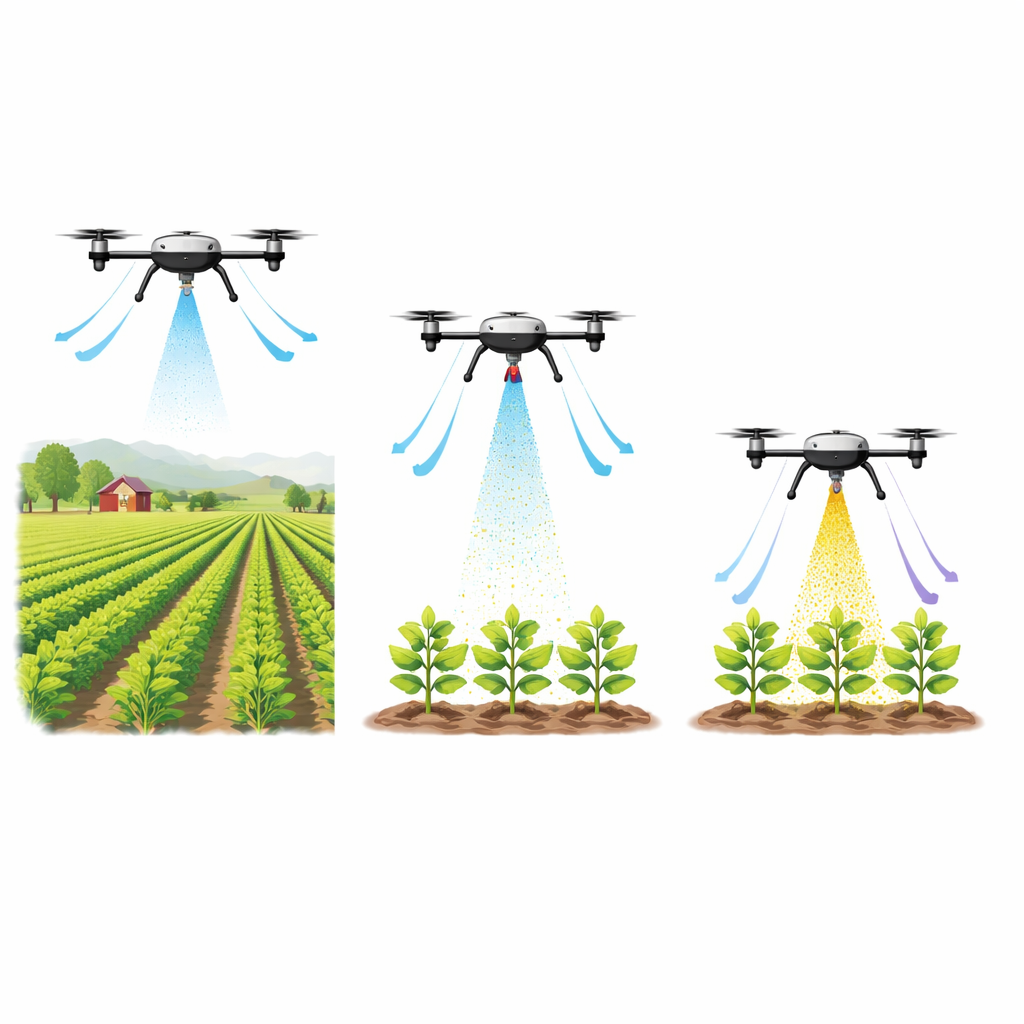
Why Spraying with Drones Is Different
Traditional crop sprayers roll across fields on wheels, dragging a long boom of nozzles at a fixed height. Drones instead hover on whirling rotors, carrying a small tank and a few nozzles under the propellers. That difference matters: the fast‑moving air pushed down by the rotors changes how droplets spread, fall, and stick to plants. Used well, this downwash can press droplets into the canopy and cut drift into neighboring fields. Used poorly, it can leave patchy coverage or fling chemicals away from the target. As agriculture moves toward “smart” systems that treat only stressed plants or small patches, understanding this airflow becomes essential.
A Track, a Test Drone, and Two Types of Crops
To isolate the drone’s influence from changing wind and weather, the team built a laboratory track that pulled a six‑rotor drone at controlled speeds over potted plants. Under one rotor they mounted a single flat‑fan nozzle, a common type used on farm sprayers. They tested two flight heights: about half a meter above the plant tops, similar to a field sprayer boom, and one meter. They also set three rotor conditions: not spinning at all, spinning at a speed matching an empty tank, and spinning faster to mimic a full tank. As targets they chose rapeseed, with relatively open foliage, and potatoes, with dense leafy canopies—two important food and biofuel crops that offer very different structural challenges for spray penetration.
Following Air and Droplets Through the Canopy
The researchers first mapped the downward air speeds under the rotors using multiple small anemometers. They saw strong, focused jets of air directly beneath the rotors that weakened and evened out with distance and with higher flight altitude. Next, they measured how this air changed the spray pattern from the nozzle using rows of small collectors. Without rotor airflow, raising the nozzle from 0.5 to 1.0 meters widened the spray but thinned it in the middle, creating a “saddle” of lower dose directly under the nozzle. When the rotors spun, the air narrowed the pattern by about 20 percent and boosted the droplet volume in the center, especially at the higher altitude. In other words, the drone’s downwash squeezed and intensified the spray stream.
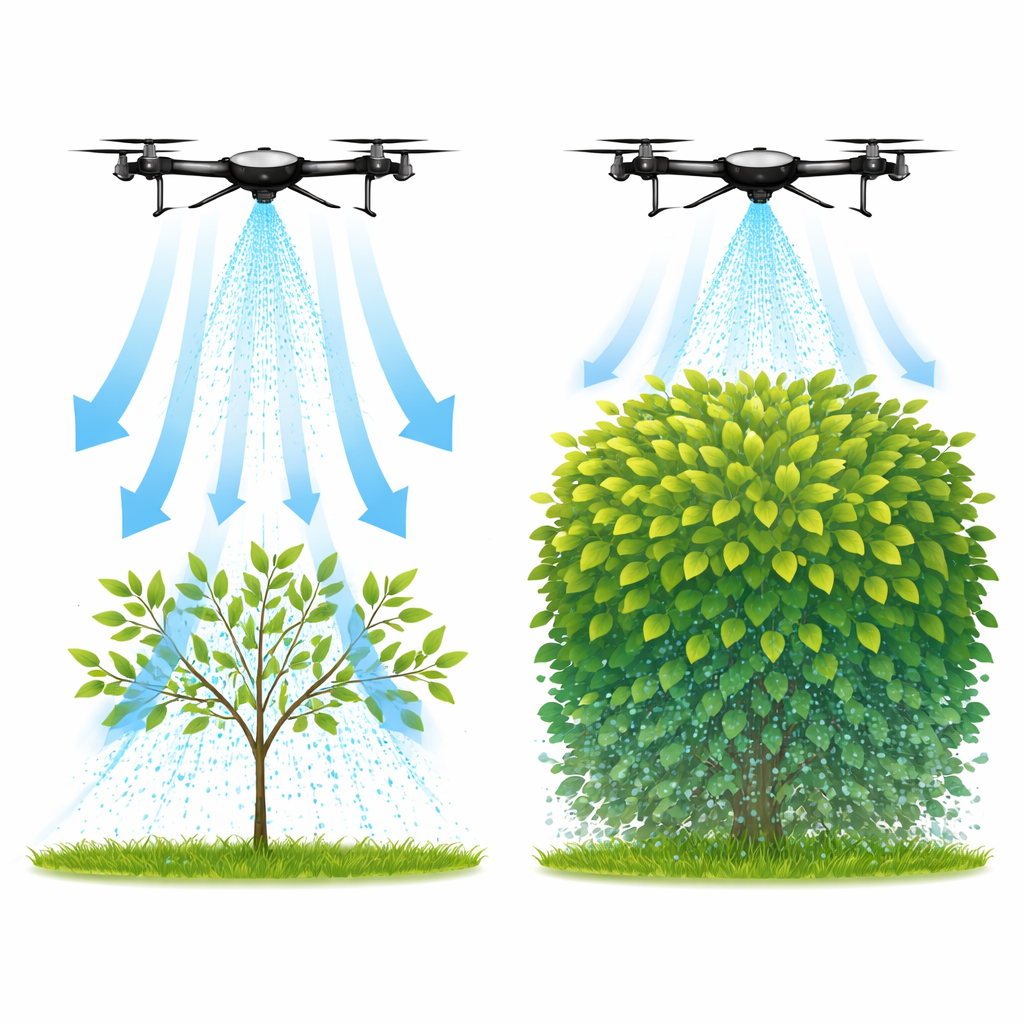
How Plant Density Controls Spray Reach
To see what actually landed on plants, the team placed small sticky labels at several heights within the canopies of rapeseed and potato, then used a dye to calculate how much liquid hit each level. Spinning rotors consistently increased the amount of liquid at lower levels in both crops, showing that the airflow helped push droplets into the interior. However, plant structure strongly modulated this effect. Rapeseed had a much lower leaf area index—a measure of how much leaf surface sits above a square of ground—than potatoes. Its more open canopy allowed droplets, driven by the downwash, to reach deeper layers and produced more even coverage from top to bottom. In contrast, the dense potato foliage blocked droplets, so the lower parts received relatively little spray even with strong airflow, and coverage varied widely between levels.
Flying Lower for Smarter, Cleaner Sprays
By analyzing thousands of measurements, including a uniformity score that captures how evenly spray is spread across plant levels, the authors concluded that two factors dominate spray quality from small drone sprayers: flight height and plant leafiness. Flying lower—around half a meter above the crop—improved uniformity and penetration, while higher flights diluted and widened the spray footprint. At the same time, plants with a lower leaf area index, like the tested rapeseed, were easier to treat evenly than dense potato plants. The work suggests that future “drone‑robots” should adjust their altitude and nozzle setup according to crop structure, using the rotor downwash deliberately to press droplets into the canopy. Done right, this could enable precise treatment of only the plants that need protection, reducing wasted chemicals and limiting environmental contamination.
Citation: Berner, B., Chojnacki, J., Kukiełka, L. et al. Plant spraying quality when used by drone-robots. Sci Rep 16, 11147 (2026). https://doi.org/10.1038/s41598-026-40649-6
Keywords: drone spraying, precision agriculture, crop protection, spray drift, leaf area index