Clear Sky Science · en
Habitat overlap of Canada lynx and sympatric mesopredators increases following cyclical reduction in primary prey
Why this snowy forest story matters
Across northern forests, the lives of predators and their prey rise and fall in dramatic cycles. This study peeks into that hidden drama in the woods of central British Columbia, where Canada lynx, coyotes, wolverines, and fishers all hunt in the same landscape. By tracking these animals with camera traps during years when their favorite prey—the snowshoe hare—was plentiful and then scarce, the researchers show how changing food supplies can reshuffle who shares space with whom, and how often these carnivores may be pushed into competition.
Feast, famine, and shifting neighbors
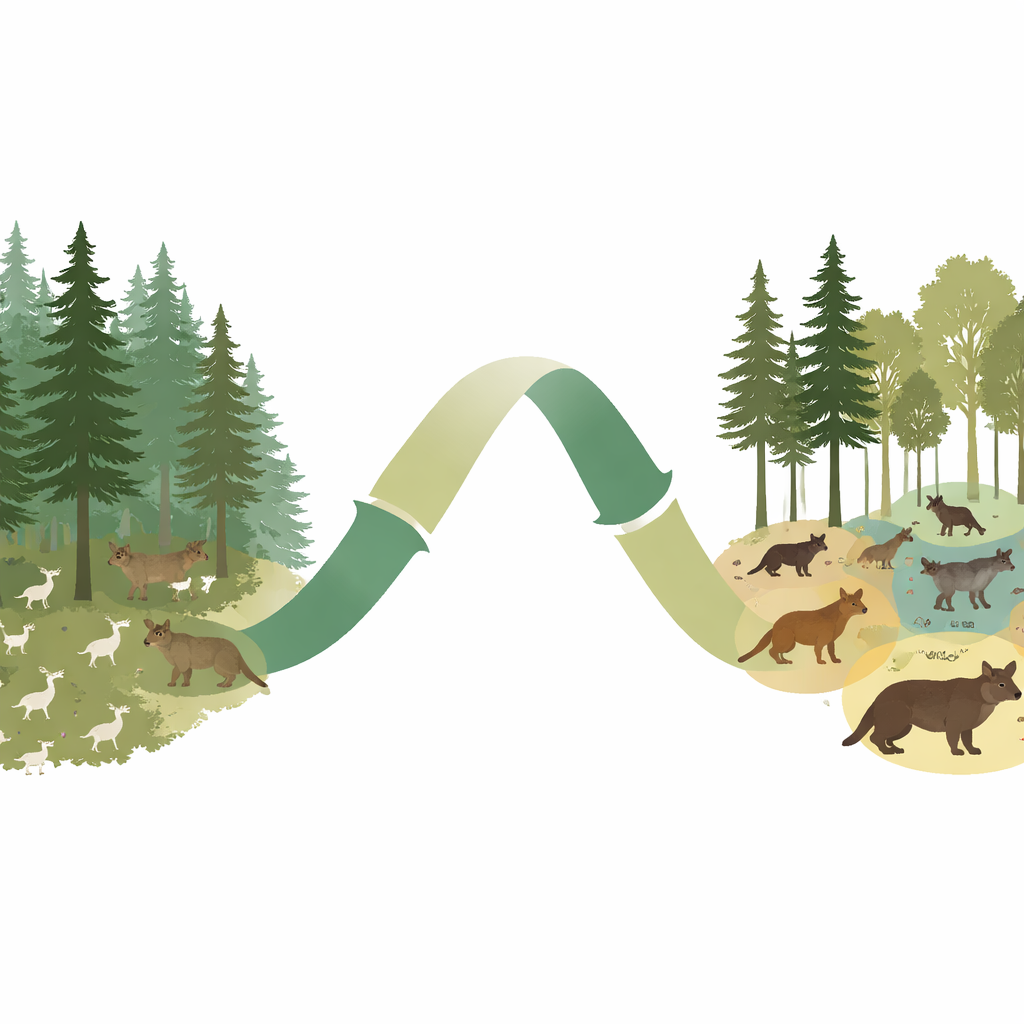
In this region, snowshoe hare numbers naturally rise and crash every 8 to 11 years. Canada lynx are tightly tied to hares, while coyotes, wolverines, and fishers can eat a wider variety of prey. The team expected that when hares dwindled, lynx would be forced to broaden where and what they hunt, bumping into other predators more often. To test this idea, they compared two winter periods separated by only four years: one when hares were abundant and another when hare numbers had fallen sharply.
Camera traps as watchful eyes
The researchers set up 66 motion-triggered cameras on a regular grid across about 390 square kilometers of mixed-age forest. Each camera looked over a small scent and bait station designed to draw in any carnivores already nearby without strongly altering their broader movements. The cameras ran through late winter and mid-winter in both time periods, recording videos whenever an animal passed. Using thousands of camera-days of footage, the team counted how often each species appeared at each site, then linked those sightings to fine-scale measurements of forest structure, recent logging, and proximity to streams and lakes.
When hares fall, overlap grows
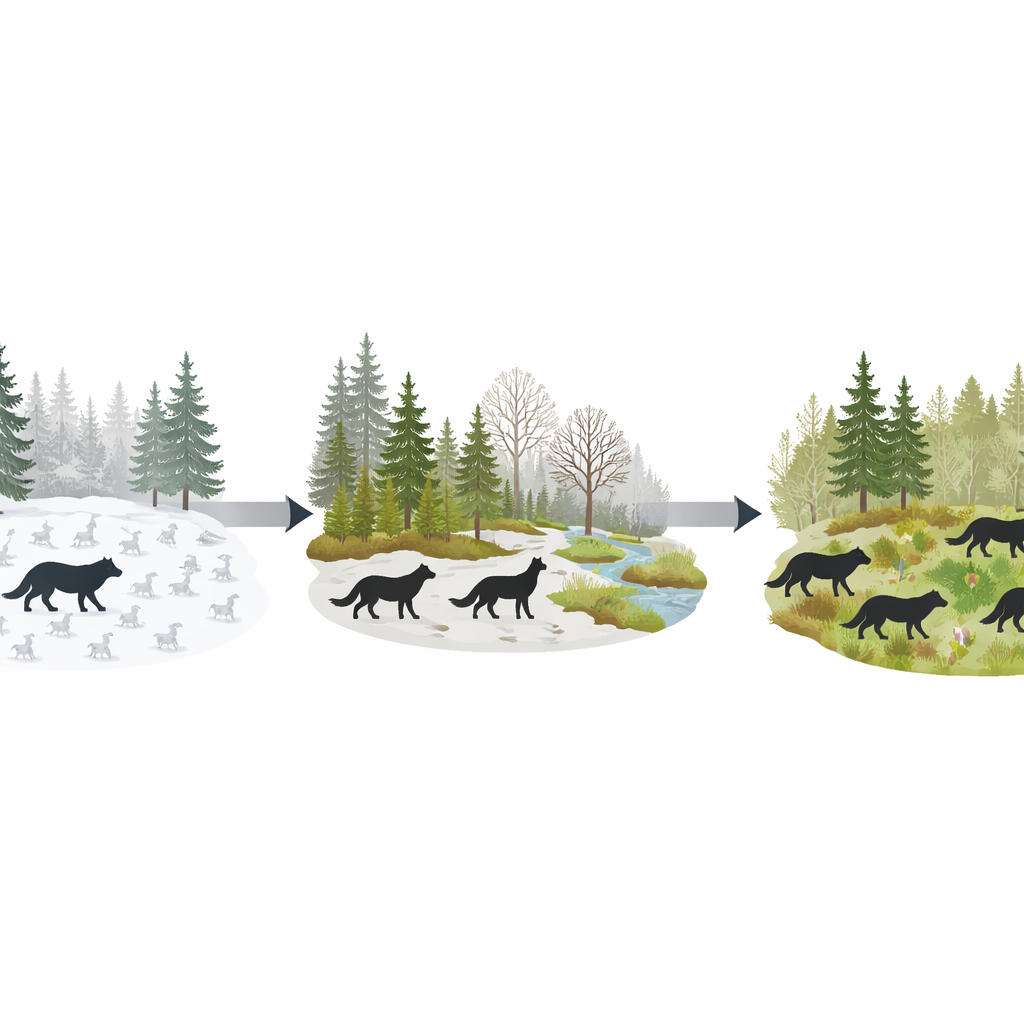
Between the two study periods, the number of lynx detections dropped by about three-quarters, closely tracking a similar crash in hare activity. Yet detections of wolverines and fishers rose, and coyotes remained about the same. During the hare-rich years, lynx used certain types of forest—especially areas with dense mid-level cover and relatively few very tall trees—but overlapped only modestly with the other carnivores. In the hare-poor years, that changed: lynx and mesopredators increasingly used the same kinds of places, notably younger or mid-aged forests and riparian zones along streams and lakes, which likely harbor a richer mix of small mammals. Statistical models confirmed that shared use of camera sites by lynx and wolverines, lynx and fishers, and, to a lesser extent, lynx and coyotes all rose when hares were scarce.
Forest structure and hidden competition
The study also reveals how detailed features of the forest shape these interactions. Using laser-based mapping data, the researchers found that cover at mid height (about 3–10 meters) drew both lynx and other carnivores, while very tall, closed canopies were less favored when overlap was greatest. Recent clear-cut logging within a kilometer tended to reduce use by these predators, pushing them toward remaining patches of suitable cover and especially toward riparian strips that often retain mature trees. As hare numbers dropped, these preferred patches became shared hunting grounds, raising the potential for interference—such as direct harassment—or even predation of lynx by other carnivores.
What it means for lynx and changing forests
For a layperson, the main takeaway is that the fortunes of lynx and their neighbors are tightly bound to the boom-and-bust cycles of a single small herbivore. When hares are plentiful, lynx can capitalize on their snow-running prowess and maintain some separation from other mid-sized predators. When hares crash, everyone is forced into the same remaining rich pockets of habitat, increasing the odds of competition and conflict. Because climate change and industrial logging are altering snow patterns and forest structure across the boreal region, understanding these shifting overlaps is crucial. Long-term, landscape-scale monitoring like this study provides an early warning of how subtle changes in habitat and prey cycles can ripple through entire carnivore communities.
Citation: Crowley, S.M., Johnson, C.J. & Hodder, D.P. Habitat overlap of Canada lynx and sympatric mesopredators increases following cyclical reduction in primary prey. Sci Rep 16, 8654 (2026). https://doi.org/10.1038/s41598-026-40648-7
Keywords: Canada lynx, snowshoe hare cycle, boreal forest predators, habitat overlap, camera trap study