Clear Sky Science · en
Simulation assessment of autonomous electric vehicles on urban sustainability in Riyadh City
Why smarter cars matter for city life
Imagine a version of Riyadh where traffic moves more smoothly, crashes are rarer, and huge parking lots give way to homes, parks, and shops. This study explores how self-driving electric cars could help create that future. By using detailed Saudi data and computer simulations, the researchers put a price tag on today’s hidden side effects of driving—such as accidents, traffic jams, noise, and the land swallowed by parking—and then estimate how much these costs could fall if autonomous battery electric vehicles became common on city streets.
Counting the true costs of getting around
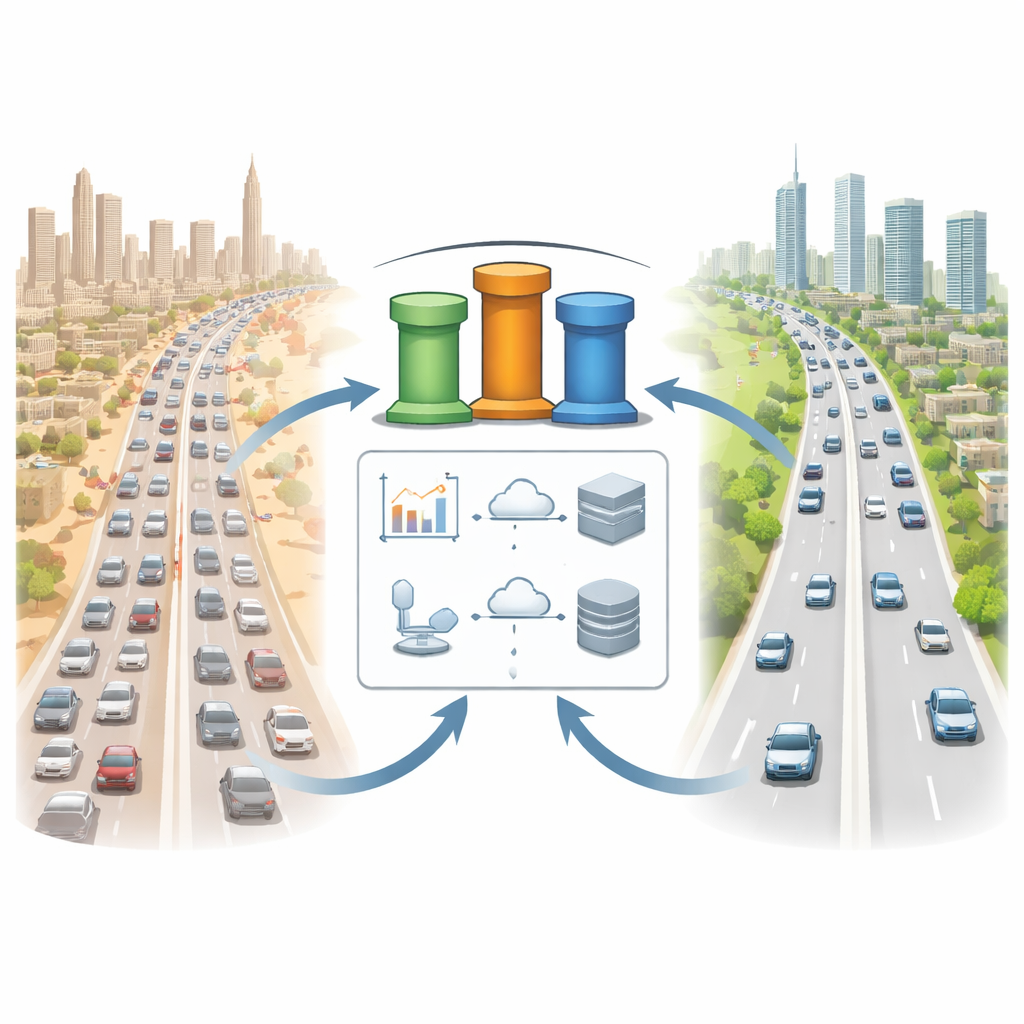
Most of the damage cars cause to cities never shows up on a fuel receipt or toll bill. The authors focus on five such “external” costs: crashes that injure people and damage property, delays from congestion, pollution from power generation, land taken up by parking, and noise that lowers quality of life. Instead of treating these impacts separately or borrowing numbers from Europe or the United States, the team builds a Saudi-specific picture using 2023–2024 data from national transport, energy, land valuation, and statistics agencies. Every impact is converted into Saudi Riyals per kilometer driven, making it possible to compare them on a common scale and see which ones matter most.
How the study tests a driverless future
The researchers compare two scenarios for Riyadh’s roads. In the first, electric cars are driven by humans, reflecting today’s early stage of battery vehicle adoption. In the second, those same types of cars drive themselves and are used in shared fleets rather than being parked for most of the day. To ground their estimates in real traffic, the team builds a detailed computer model of Prince Mohammed Bin Salman Road, a 22.5-kilometer corridor that links major neighborhoods. Using the SUMO traffic simulator and hourly congestion records from 2023 and 2024, they adjust the model until it reproduces observed speeds, queues, and peak-hour patterns. They then “switch on” autonomous driving in the simulation by shortening headways between vehicles, smoothing starts and stops, and reducing crash risk in line with international safety studies.
What changes when cars drive themselves
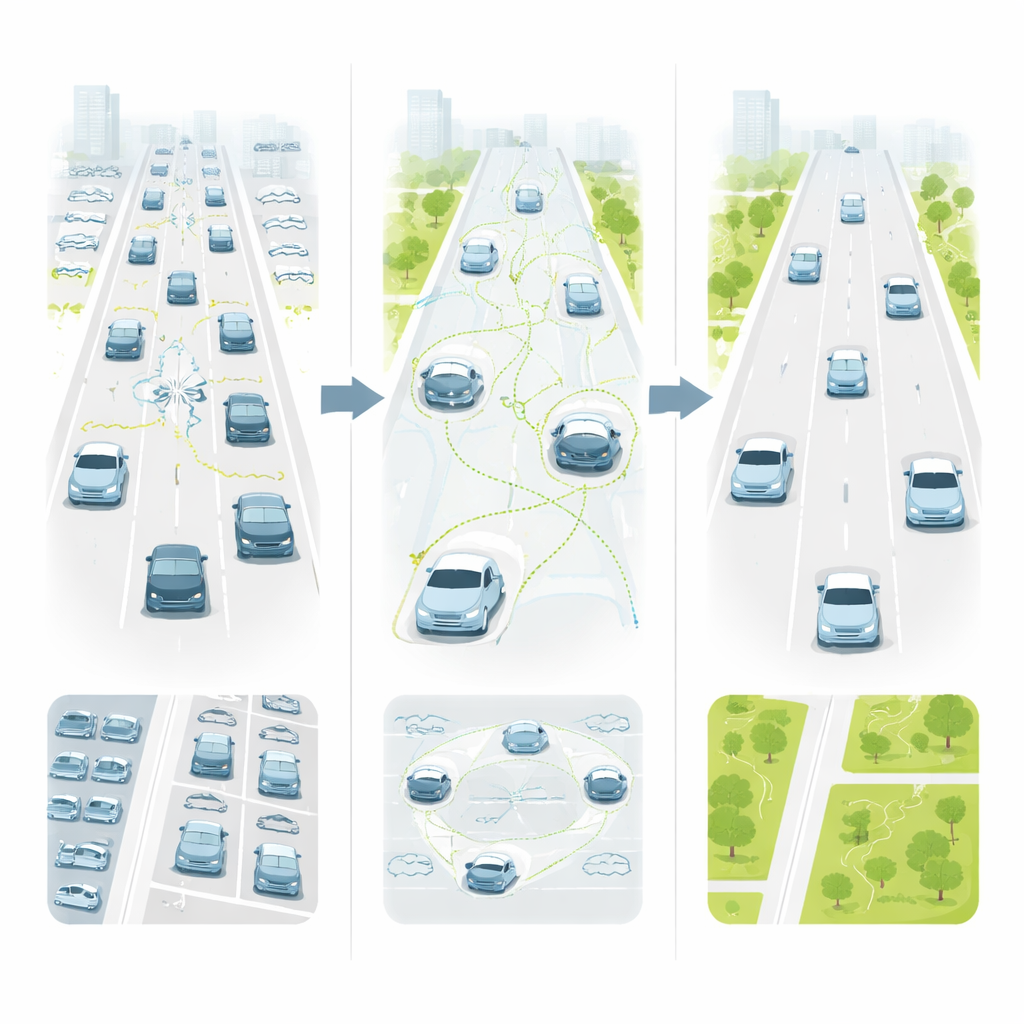
When the numbers are added up, the autonomous scenario cuts the total external cost of driving in Riyadh by about 39 percent, or 1.138 Saudi Riyals per kilometer. The biggest saving comes from safety: automated vehicles are assumed to avoid many human errors, leading to a 55 percent drop in accident-related costs. Land use is the next major winner. Because shared self-driving fleets need far less parking and can be stored away from prime city locations, the effective land cost per kilometer falls by around 40 percent. Congestion-related costs drop by about 25 percent as traffic flows become steadier, especially on signalized arterials where smoother platoons reduce wasted time at lights. Noise impacts decline modestly, while emissions remain unchanged in the core comparison because both scenarios rely on the same electric grid and assume similar energy use per kilometer.
How results evolve with cleaner energy and wider use
The study does not stop at a simple before-and-after comparison. It explores how benefits change across different levels of automation, from basic driver assistance to fully autonomous shared fleets, and blends these with possible market shares out to 2050. As higher automation and sharing become more common, the safety and land gains grow. The authors also examine “what if” cases where Saudi Arabia’s power system contains 30 to 50 percent renewable energy by 2030. Under those cleaner-grid conditions, the environmental share of the benefits rises and total external costs could fall by roughly 44 to 49 percent compared with today’s human-driven electric vehicles. Even when they stress-test key assumptions—such as making the cars somewhat less safe or less efficient than expected—the overall savings remain above one third.
What this means for policy and daily life
For city planners and decision-makers, the message is clear: in Riyadh’s context, the strongest gains from autonomous electric vehicles come from safer streets, fewer wasted hours in traffic, and freeing valuable urban land from parking. The authors argue that to unlock these gains, technology alone is not enough. Saudi Arabia will need updated rules for testing and certifying self-driving systems in harsh desert conditions, new curb and parking policies that favor shared fleets over private ownership, and coordinated planning between the transport and energy sectors to ensure that cleaner cars also run on cleaner power. For residents, the study suggests that if these steps are taken, a shift to autonomous electric mobility could translate into fewer crashes, more reliable trips, and a cityscape where space now reserved for parked cars is gradually reclaimed for more livable neighborhoods.
Citation: Louati, A., Louati, H. & Kariri, E. Simulation assessment of autonomous electric vehicles on urban sustainability in Riyadh City. Sci Rep 16, 9401 (2026). https://doi.org/10.1038/s41598-026-40646-9
Keywords: autonomous electric vehicles, urban sustainability, Riyadh transport, traffic simulation, Saudi Vision 2030