Clear Sky Science · en
Fractal analysis of quartz boundaries as a strain rate proxy for tracing Earth’s stress history
Reading Earth’s Past in Common Mineral Grains
Mountains remember. Long after the forces that built them have faded, the rocks deep inside still carry a record of how the Earth was squeezed and stretched. This study shows that the humble mineral quartz, found in everyday rocks like granite and sandstones, can act as a tiny archive of that stress history. By measuring how twisty and irregular the edges of quartz grains have become, the authors develop a way to estimate how quickly rocks once deformed—offering a new window into the hidden life of active mountain belts.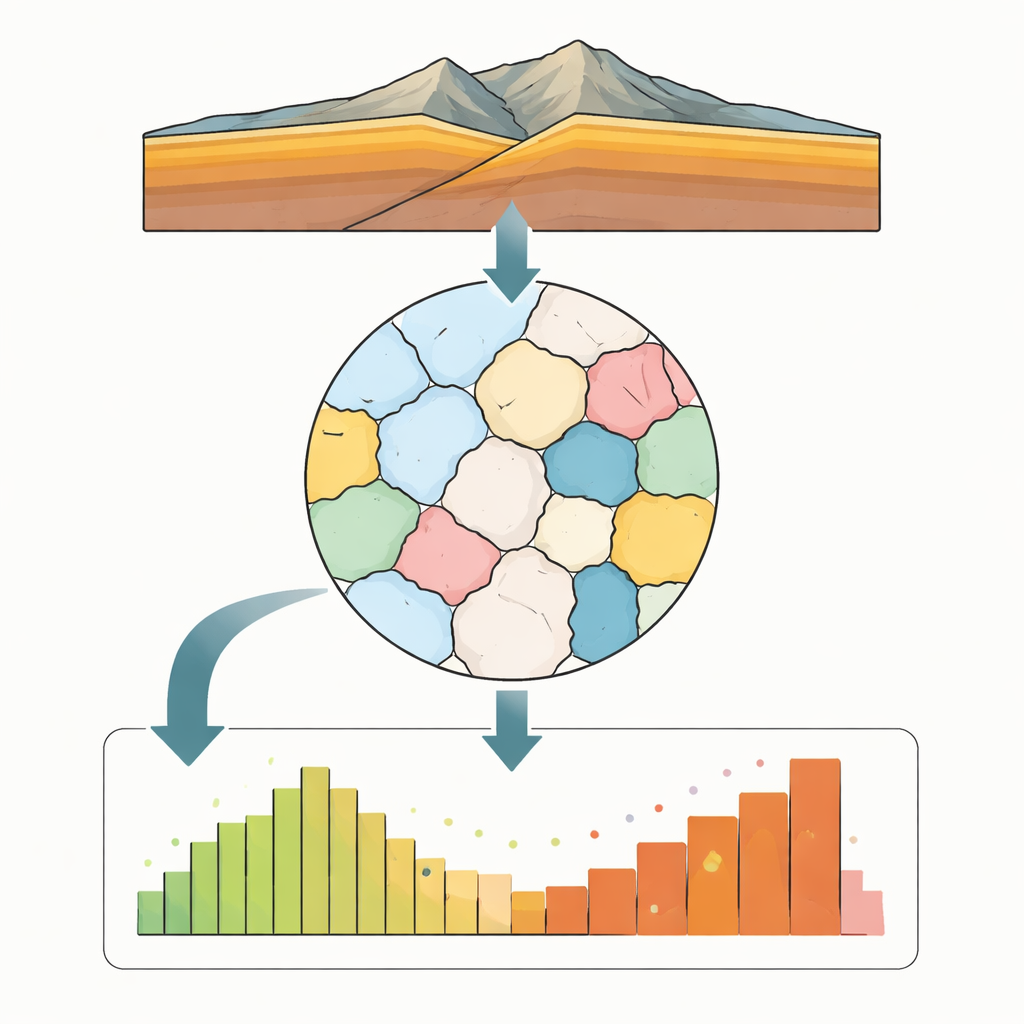
A Busy Collision Zone Deep Underground
The research focuses on the Chahzar Thrust Zone in southwestern Iran, part of the long Zagros mountain system where two continental plates have collided for tens of millions of years. In this region, ancient volcanic and sedimentary rocks were buried, heated, and squeezed into banded rocks called gneisses, several tens of kilometers below the surface. There, temperatures of roughly 420–600 °C and high pressures allowed minerals to slowly change shape instead of cracking. Because quartz makes up a large share of these rocks and connects throughout them, its internal texture provides an especially sensitive record of how the crust flowed during the collision.
How Quartz Grains Respond to Stress
Under heat and pressure, quartz does not stay rigid. Its grains develop new crystals, bend, and rearrange their internal structure. Earlier work showed that different deformation styles tend to appear at different temperatures: bulging along grain edges at relatively low temperatures, the formation and rotation of subgrains at intermediate conditions, and sweeping migration of grain boundaries at higher temperatures. But newer studies reveal that these textures are not controlled by temperature alone. They also respond strongly to how fast the rock is deforming, how much water is present, and how stress is distributed. That complexity makes it hard to turn grain shapes directly into precise temperatures or stress levels, but it also suggests that grain shape encodes rich information about the overall deformation environment.
Turning Irregular Grain Edges into Numbers
To tap into this information, the authors apply a mathematical tool from the study of rough shapes: fractal analysis. They take high-quality microscope images of quartz in eight gneiss samples and manually trace the outer edges of at least 45 grains per sample. They then lay down grids of progressively smaller squares over each outline and count how many squares intersect the grain boundary. Plotting these counts against the box size on a logarithmic scale reveals how complex the boundary is across scales. The slope of that line is the “fractal dimension,” a single number between 1 and 2 that increases as boundaries become more jagged and intricate. Using an experimentally derived equation that links this fractal dimension to deformation temperature and strain rate, the team translates boundary roughness into estimates of how fast the rocks were deforming when the textures formed.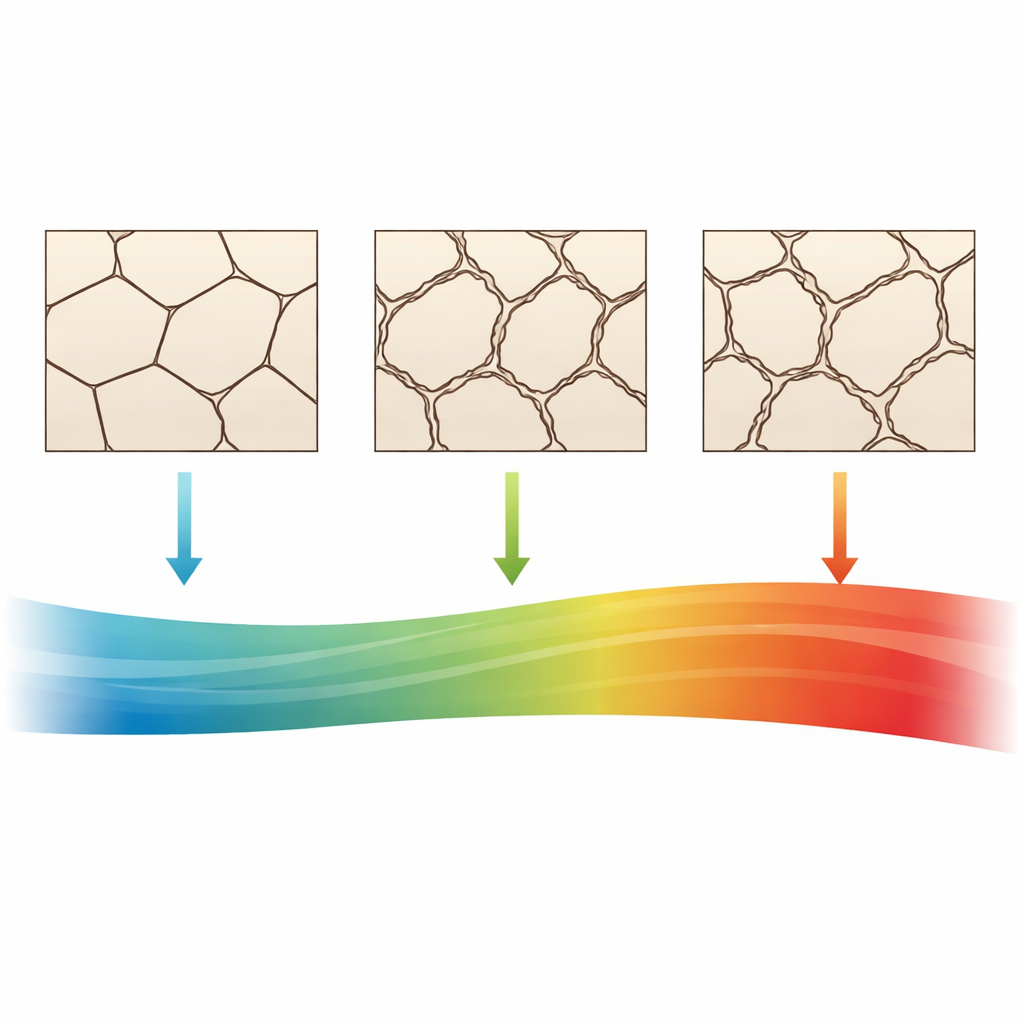
What the Numbers Say About Hidden Deformation
The quartz in the Chahzar gneisses shows a full suite of features—from gentle bulges to highly serrated, lobed boundaries—indicating that the rocks experienced several overlapping deformation stages. Fractal dimensions vary from just above 1.01 to about 1.21, implying a broad spread in deformation intensity. When combined with temperature ranges inferred from the overall mineral assemblage and quartz textures, these values yield estimated strain rates between roughly 10⁻¹⁰·⁹ and 10⁻⁶·⁸ per second. These values are higher than many textbook estimates for large-scale, long‑term crustal flow, but they fit with a picture in which deformation is not steady and uniform. Instead, it can be focused into narrow zones or short-lived bursts, producing locally high strain rates even within otherwise slowly deforming crust.
Why This Matters for Understanding Mountain Building
By showing that the roughness of quartz grain boundaries can serve as a semi‑quantitative indicator of strain rate, this study adds a powerful new line of evidence to the geologist’s toolkit. The method does not claim to deliver perfect, unique answers for temperature or stress, and the authors stress that it works best when combined with traditional microscopic observations and regional geological context. Still, it demonstrates that tiny, irregular seams inside common minerals can reveal when and where rocks in the middle crust deformed more intensely. Applied to other mountain belts, this approach could help clarify how and when the Earth’s crust localizes strain, accommodates continental collision, and ultimately shapes the landscapes we see at the surface.
Citation: Abdolzadeh, M., Hosseini, S.R., Rasa, I. et al. Fractal analysis of quartz boundaries as a strain rate proxy for tracing Earth’s stress history. Sci Rep 16, 9759 (2026). https://doi.org/10.1038/s41598-026-40639-8
Keywords: quartz deformation, fractal analysis, strain rate, mountain belts, tectonic stress