Clear Sky Science · en
Interaction effect of courtyard building form and orientation on energy performance of hospitals in warm humid climate
Why hospital shapes matter for comfort and costs
Anyone who has waited in a hot, stuffy hospital corridor knows that buildings can make us feel better or worse. In warm, humid coastal regions, keeping hospitals cool, airy, and affordable to run is especially challenging. This study asks a deceptively simple question: can the overall shape of a hospital and the direction it faces dramatically change how much energy it uses, while still keeping patients and staff comfortable?

The big idea behind smarter hospital layout
The researchers focus on hospitals in India’s warm, humid coastal belt, where cooling and ventilation consume large amounts of electricity year-round. Instead of looking at equipment or air‑conditioning systems, they concentrate on the basic geometry of the buildings: the outline of the floor plan, how courtyards are carved into it, and which way the whole structure is turned relative to the sun and prevailing winds. They measure energy use through an Energy Performance Index, which captures how much energy a hospital consumes per square meter of floor area in a year.
Testing different courtyard shapes in the computer
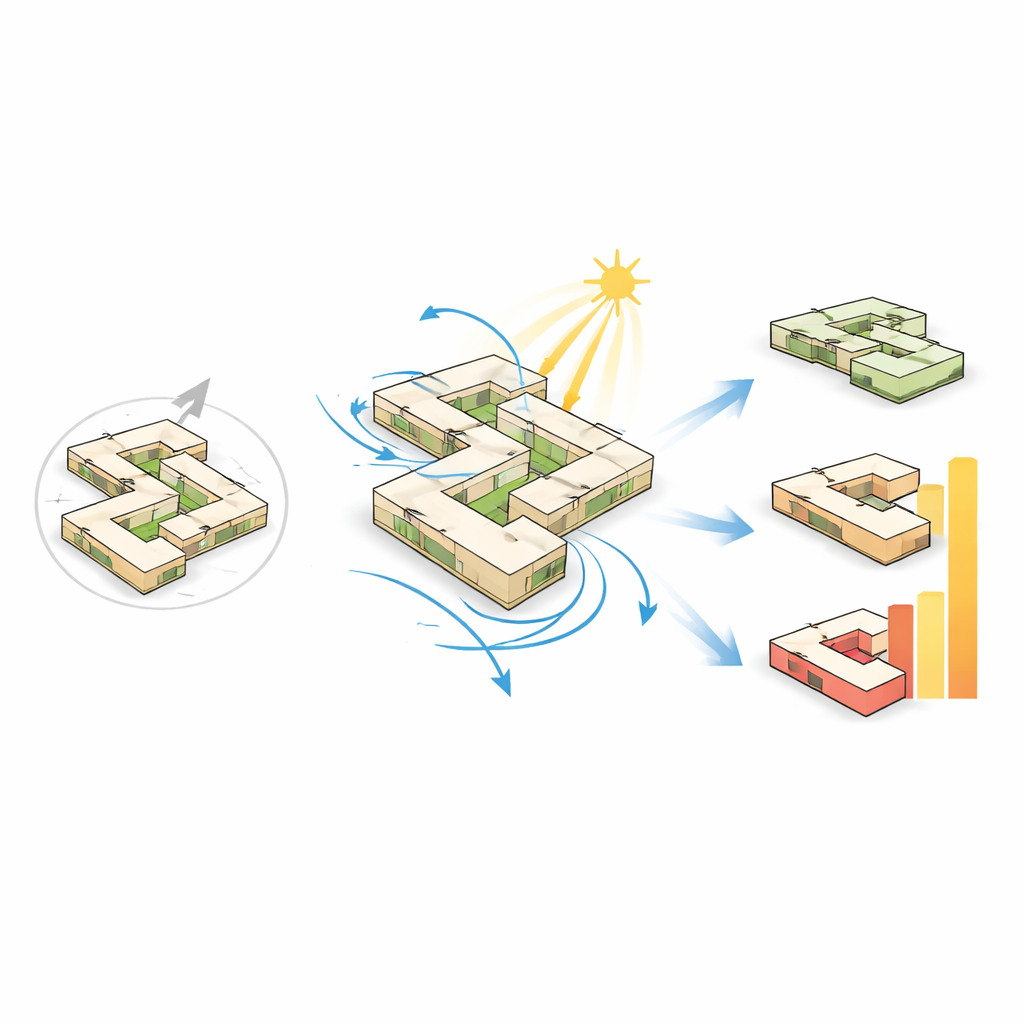
To probe these questions without rebuilding real hospitals, the team created digital models of six different layouts based on an actual 500‑bed government hospital in Mangalore, Karnataka. All variants had the same total floor area and similar room functions, windows, walls, and equipment, but their outlines changed: H‑shaped, E‑shaped, S‑shaped, rectangle, octagon, and pentagon, all with courtyard arrangements. Using the DesignBuilder/EnergyPlus simulation engine and weather data for a typical year, they rotated each layout through eight compass directions and tracked monthly and annual energy use, while keeping equipment, occupancy, and construction details constant.
What matters more: shape or direction?
A detailed statistical analysis showed that building form consistently dominates energy performance. Across seasons, the overall outline and courtyard configuration explain most of the variation in the Energy Performance Index, with the model accounting for about 98–99% of differences between cases. Orientation still matters, but its influence changes with the time of year. During the long, cloudy monsoon, when direct sun is weaker and humidity is very high, turning the building has relatively little effect; managing moisture and airflow is more important. In the post‑monsoon months, when skies clear and winds shift, orientation becomes much more significant because it controls solar heat gain and wind‑driven ventilation.
The winning combination for coastal hospitals
By examining how form and direction interact rather than treating them separately, the authors uncovered an especially efficient pairing: an S‑shaped hospital with a semi‑closed courtyard, oriented roughly toward the northwest. In simulations, this setup achieved an Energy Performance Index of about 124.8 kWh per square meter per year, outperforming the same S‑shape facing west or southwest. The northwest orientation reduces exposure to punishing late‑afternoon sun while lining up better with prevailing winds, improving natural cross‑ventilation in general wards and outpatient areas. Meanwhile, more heat‑sensitive, air‑conditioned zones such as operating theatres and intensive care units can be placed on less exposed sides of the plan, where shading and insulation further cut cooling loads.
Design lessons for future healing spaces
For non‑experts, the takeaway is clear: in hot, humid coastal climates, the basic shape of a hospital is one of the most powerful levers for cutting energy use, and the direction it faces fine‑tunes that efficiency, especially outside the monsoon season. Semi‑enclosed courtyard forms like S‑ and H‑shapes help channel breezes, shade interiors, and create cooler shared spaces, while careful orientation allows naturally ventilated wards to benefit from wind and filtered daylight. The study argues that if architects and planners treat overall form and orientation as a combined design decision from the earliest stages, they can build hospitals that are more comfortable, cheaper to run, and better prepared for a warming climate.
Citation: Harshalatha, Patil, S. Interaction effect of courtyard building form and orientation on energy performance of hospitals in warm humid climate. Sci Rep 16, 9790 (2026). https://doi.org/10.1038/s41598-026-40632-1
Keywords: hospital design, courtyard buildings, energy efficiency, warm humid climate, building orientation