Clear Sky Science · en
An electrochemical hypothesis of earthquakes exploring a theoretical link between radiated seismic energy and Pourbaix potential
Why Electricity Might Lurk Behind Quakes
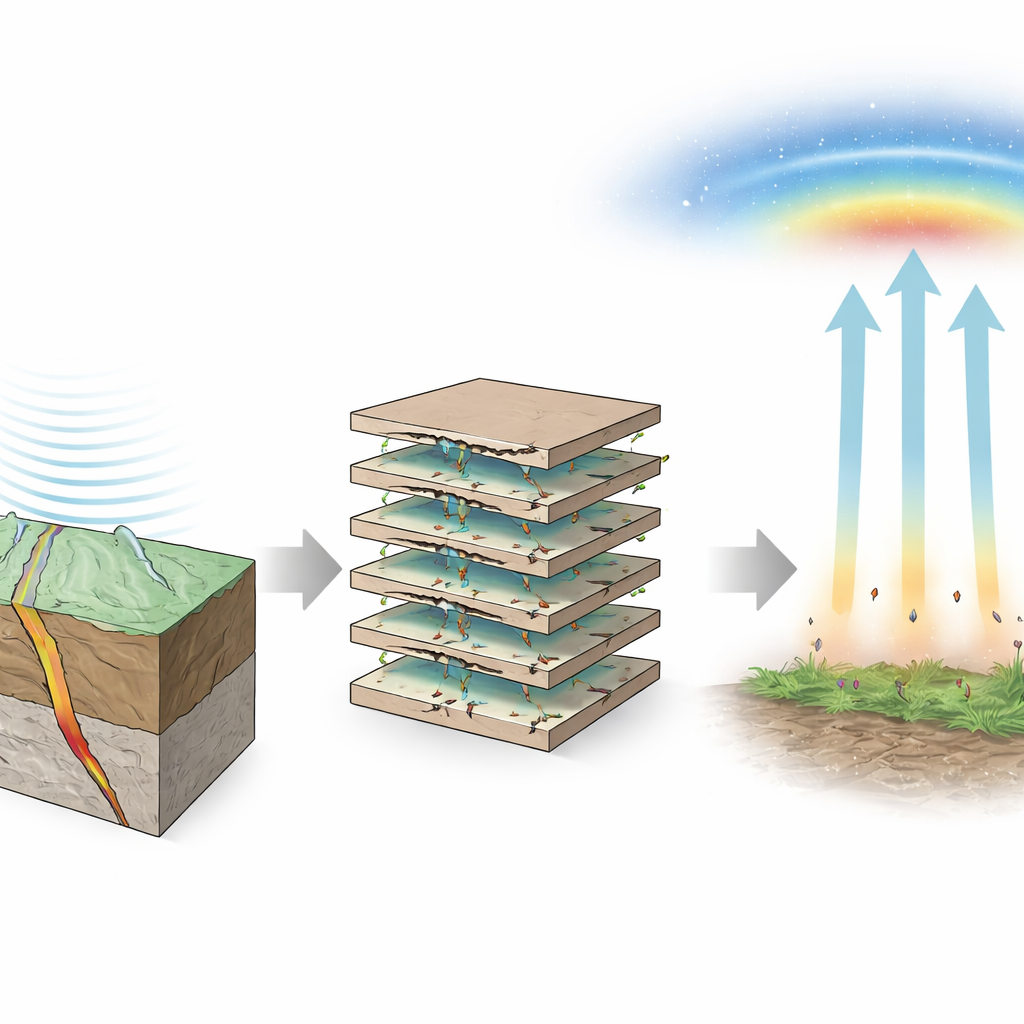
Earthquakes are usually described as giant mechanical events: blocks of rock grind, lock, and suddenly slip, sending waves through the ground. But for decades, observers have also noticed strange electrical happenings before some major quakes—glows in the sky, unusual signals in the atmosphere, and changes in the ionosphere far above Earth. This paper proposes that these electrical clues are not mere side effects, but hints that earthquakes may tap into a hidden electrochemical energy source stored in water‑soaked clay deep in fault zones.
How We Usually Measure a Quake’s Power
Seismologists already have precise ways to describe how powerful an earthquake is. Two key measures are the seismic moment—which depends on how far a fault slips, over what area, and in what kind of rock—and the moment magnitude, the familiar scale on which each whole number step represents about 32 times more energy. From these, researchers can estimate the elastic energy radiated as seismic waves. Yet one nagging question remains: what process actually stores such vast energy in the crust before it suddenly lets go? Most studies treat this energy as purely mechanical strain, but this work asks whether part of it could in fact be electrical in origin.
Borrowing Ideas from Batteries and Corroding Metals
The authors turn to electrochemistry, the science behind batteries and metal corrosion. They focus on the Pourbaix potential, a way of describing the electrical energy that can be generated when solids like metal oxides interact with water and dissolved ions. Using standard equations that relate pH, ion exchange, and electrode voltage, they show that the mathematical form of this electrochemical energy looks strikingly similar to the well‑known relation between earthquake energy and magnitude. By carefully rearranging the formulas, they demonstrate a quantitative equivalence: the way electrochemical potential grows with certain ion‑exchange factors mirrors how seismic energy grows with seismic moment.
Clay Layers Acting Like a Giant Underground Battery
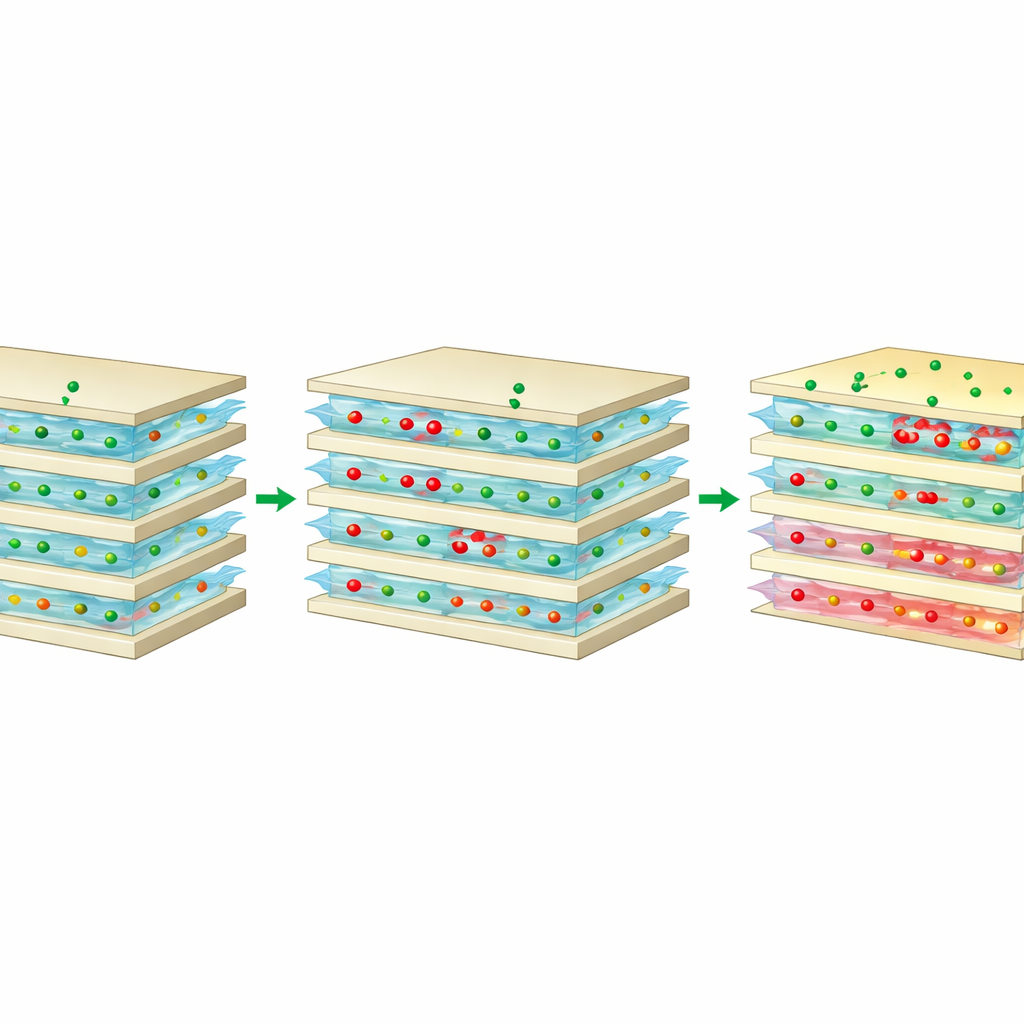
To connect this abstract math to real rocks, the study turns to clay minerals—especially smectite—that are rich in silica and alumina and hold water between their ultra‑thin layers. A single cubic centimeter of such clay can expose thousands of square meters of reactive surface, offering enormous capacity for exchanging ions with water. Each tiny interface between a clay sheet and the surrounding fluid can act like a miniature electrochemical cell. Stacked by the thousands in clay‑rich fault zones, these layers could behave like a vast array of nano‑batteries wired in parallel, slowly building up electrical potential over time as ions redistribute and charges separate.
Linking Electrochemical Energy to Real Earthquake Signals
The authors calculate how the electrochemical potential generated at these clay–water interfaces—based on realistic ion‑exchange factors and pH—can match the “seismic electrical potential” derived from observed earthquake energy over a wide range of magnitudes. They show that when the energy‑per‑unit‑charge from these reactions is multiplied by the immense reservoir of exchangeable ions in smectite‑rich faults, the total stored energy can approach that of moderate earthquakes. This electrochemical viewpoint also offers a natural way to interpret puzzling pre‑quake phenomena, such as changes in ground electric fields, atmospheric heating, ionospheric disturbances, and even occasional earthquake lights, as different expressions of charge build‑up and sudden discharge around a stressed fault.
Rethinking What Really Drives a Quake
In the end, the paper does not claim to have proven that earthquakes are batteries gone wild, but it does present a carefully argued framework in which electrochemical processes in clay‑rich faults provide a major hidden energy source. In this picture, mechanical rupture and shaking are the dramatic release of energy that has been quietly stored as separated electrical charges in water‑soaked minerals over long periods. If this hypothesis holds up under laboratory tests and detailed field observations, it could reshape how scientists think about earthquake preparation, help explain a host of mysterious electrical precursors, and potentially point toward new ways to monitor and perhaps one day forecast dangerous seismic events.
Citation: Das, A., Bag, S.P. An electrochemical hypothesis of earthquakes exploring a theoretical link between radiated seismic energy and Pourbaix potential. Sci Rep 16, 8701 (2026). https://doi.org/10.1038/s41598-026-40629-w
Keywords: earthquake precursors, fault zone electrochemistry, clay minerals, seismic energy, earthquake lights