Clear Sky Science · en
Shear performance of unreinforced masonry walls with door and window openings strengthened using welded steel mesh
Why safer brick walls matter
Many homes, schools, and small buildings around the world are made of simple brick walls without internal steel reinforcement. These walls are inexpensive and easy to build, but they can be dangerously fragile in earthquakes, especially where windows and doors interrupt the wall. This study explores a low-cost way to make such walls much tougher by adding a thin layer of welded steel mesh under ordinary plaster—an approach that could help protect lives in earthquake-prone regions without requiring complete rebuilding.
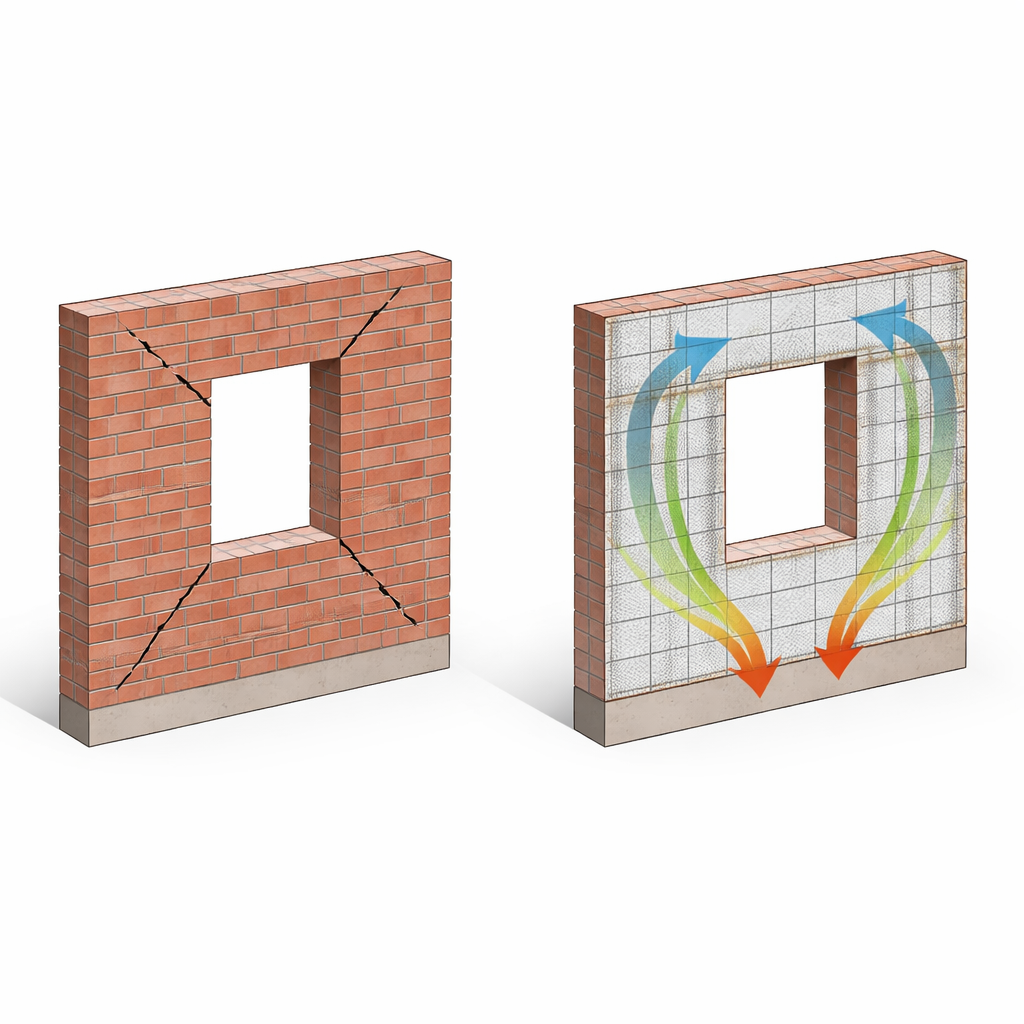
How earthquakes break everyday walls
When the ground shakes, brick walls can fail in several ways. One of the most common is a diagonal tear that runs from corner to corner, much like ripping a sheet of paper. Openings for doors and windows make this problem worse by concentrating stress at their corners and interrupting the flow of forces through the wall. In tests and in real earthquakes, these weak spots often crack first, splitting bricks and mortar and sometimes leading to partial or complete collapse. Because many existing buildings were designed with little consideration for earthquakes, finding practical ways to shore up these vulnerable walls is a pressing safety issue.
A simple mesh jacket for weak walls
The researchers tested a straightforward strengthening method: attaching a thin welded steel mesh to the surface of the wall and covering it with a regular mortar layer, much like plastering. They built eleven small-scale brick wall panels—some solid and some with a central opening that mimics a door or window—and loaded them diagonally to imitate the in-plane forces produced by earthquakes. Different layouts of the steel mesh were tried: strips running straight up and across, strips placed diagonally, partial coverage around the opening, full coverage over the whole wall, and mixed combinations. Each version used the same basic ingredients familiar to masons: hollow clay bricks, standard cement mortar, and a light diamond-pattern steel mesh.
What the tests revealed
The unstrengthened wall with an opening performed poorly: cracks quickly formed at the corners of the opening, and its ability to carry shear forces was about half that of a similar solid wall. Simply adding a plain mortar covering layer, without any mesh, already improved strength and stiffness by confining the surface. However, adding welded steel mesh beneath that layer led to clearly better behavior. Cracks still formed, but they were finer, more widely spread, and appeared later in the loading. Walls with diagonal mesh, in particular, worked with the natural diagonal cracking pattern, bridging the cracks and helping to carry tension that bare brick and mortar cannot handle well.
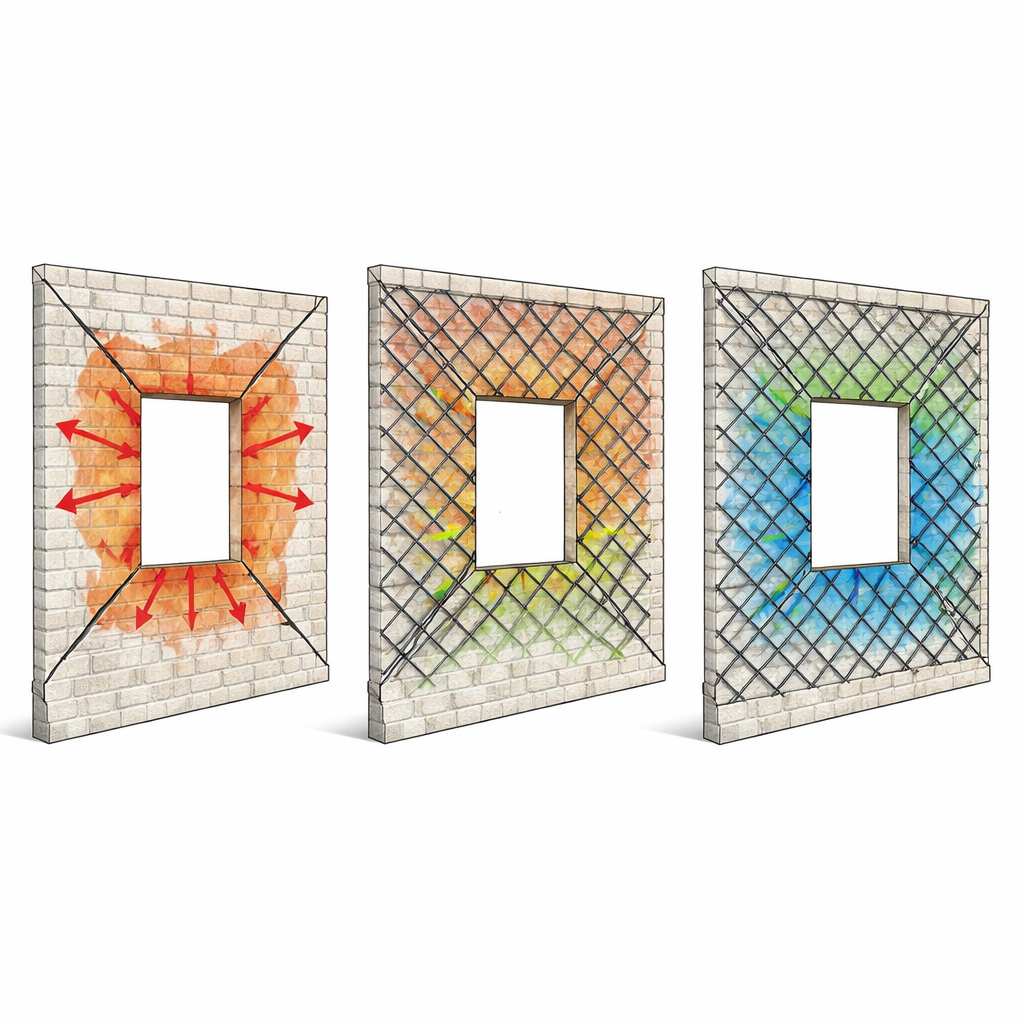
The best-performing mesh patterns
Among all the layouts, the most effective was a full mesh jacket covering the entire wall around the opening. This configuration increased the ultimate load capacity by about 28 percent, roughly doubled the initial stiffness, and boosted the energy the wall could absorb before failure by more than half, compared with the same wall without mesh. Walls with diagonal mesh strips, especially wide ones, also outperformed those with straight, orthogonal strips, because their orientation more closely matched the direction of the damaging diagonal stresses. More complex mixed patterns offered some benefits but did not surpass the simple full-coverage diagonal mesh. Importantly, the bond between mesh, plaster, and brick remained sound in the tests, so the system acted as a unified skin that held cracked masonry together.
Looking inside with computer models
To extend their findings beyond the limited number of laboratory specimens, the authors built detailed computer models that reproduced the walls, mesh, and loading conditions. These simulations matched the test results closely in terms of how cracks formed, how much load the walls could carry, and how they softened after peak strength. Using the validated model, the team explored design questions that would be hard to study experimentally, such as how increasing the amount of mesh or changing the size of openings affects performance. They found that a modest mesh ratio of about 0.08 percent of the wall thickness offered an efficient balance of strength gain and material use, and that larger openings sharply reduced capacity—even when fully wrapped with mesh.
What this means for real buildings
For non-specialists, the main message is that a thin steel mesh hidden beneath ordinary plaster can significantly improve the earthquake resistance of existing brick walls with doors and windows. While it cannot turn a weak building into a fully modern seismic structure, it can delay cracking, increase the forces a wall can withstand, and help it stay in one piece longer during shaking. The work also highlights trade-offs between simplicity, cost, and performance: full diagonal coverage works best but uses more material and labor. Overall, the study suggests that welded steel mesh is a practical, scalable tool in the retrofitting toolkit—one that could be applied to many vulnerable buildings worldwide to reduce damage and casualties in future earthquakes.
Citation: Ghalla, M., Bazuhair, R.W., Mlybari, E.A. et al. Shear performance of unreinforced masonry walls with door and window openings strengthened using welded steel mesh. Sci Rep 16, 8704 (2026). https://doi.org/10.1038/s41598-026-40618-z
Keywords: unreinforced masonry, seismic retrofitting, welded steel mesh, brick walls with openings, earthquake engineering