Clear Sky Science · en
Optimizing the trench area proportion in rice crayfish co-culture systems balances greenhouse gas mitigation and productivity
Farming rice and crayfish on the same land
Rice paddies in central China are doing double duty: they grow grain and raise crayfish in the same flooded fields. This rice–crayfish pairing has become hugely popular because it boosts farmers’ income and makes use of water and nutrients more efficiently. But there is a catch. The water-filled trenches that shelter crayfish can also leak powerful greenhouse gases into the air. This study asks a simple but pressing question: how much trench is “just enough” to keep both food production and the climate in balance?
Two zones in one field
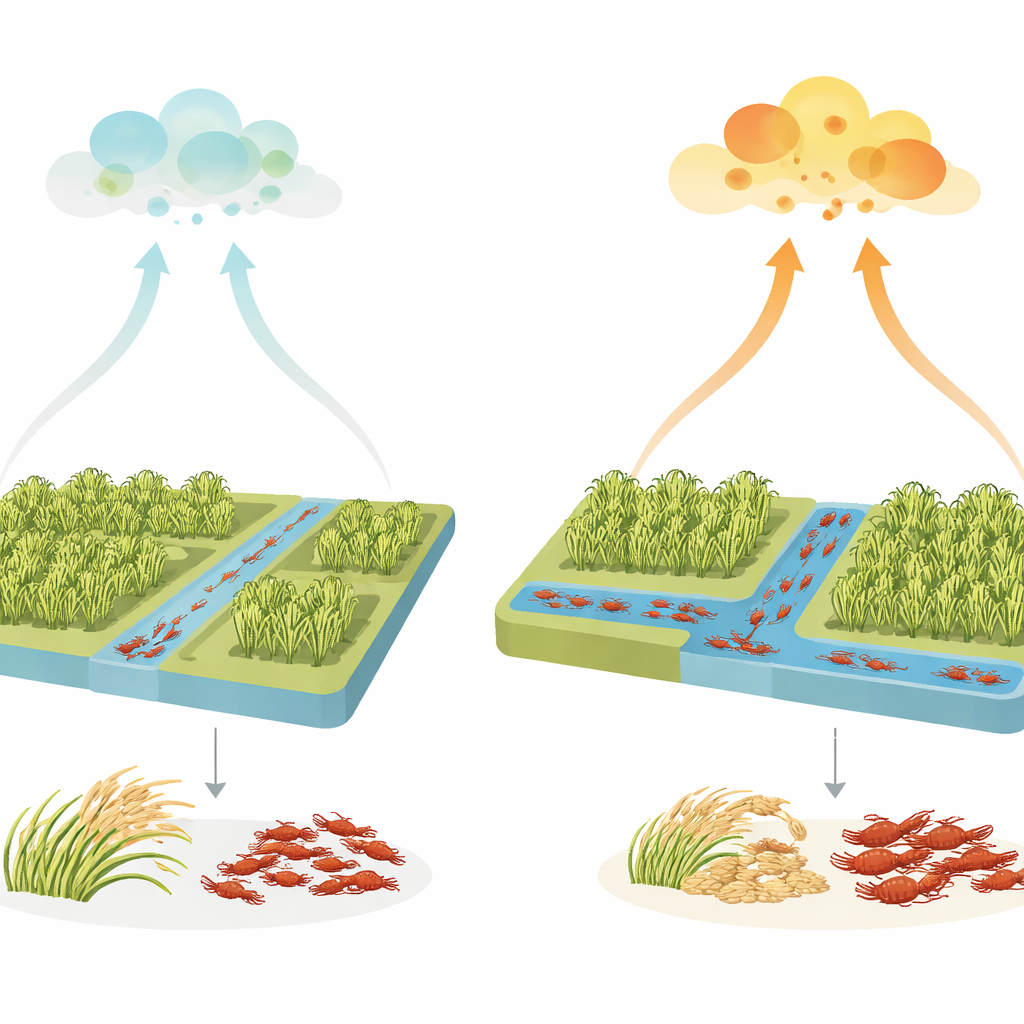
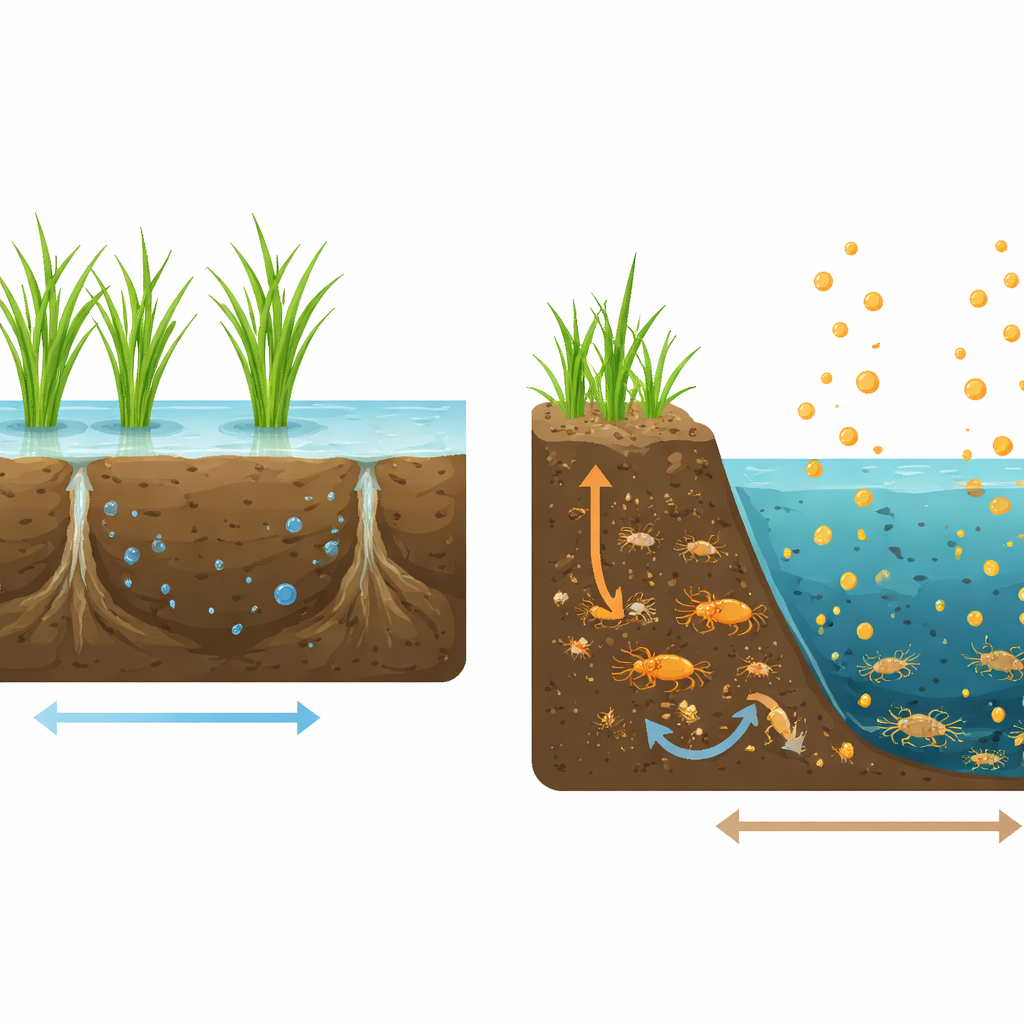
A typical rice–crayfish field has two main parts. In the broad, shallow zone, rice grows as usual while crayfish roam, burrow, and feed. Around the edges, farmers dig deeper trenches that stay flooded all year. These ditches act as highways and hideouts for crayfish and help with irrigation and drainage. Yet they also create dark, low-oxygen conditions that favor microbes which release methane, a greenhouse gas far more heat-trapping than carbon dioxide. As farmers enlarge these trenches to raise more crayfish, they risk turning a climate-friendly field into a strong source of emissions and shrinking the area left for rice.
Using a digital twin of the paddies
To understand this trade-off, the researchers built a “digital twin” of rice paddies using a well-known computer model called DNDC. This model simulates how carbon and nitrogen move through soil, water, crops, and the air, and how gases like methane and nitrous oxide escape from the field. The team fed the model with weather, soil, and management data from many field experiments across the Middle–Lower Yangtze Plain, including both traditional rice-only paddies and rice–crayfish fields. Crucially, they split each co-culture farm into its two real-life zones: the rice field surface and the crayfish trench, giving each its own soil, water, and feeding conditions.
Where most of the warming comes from
After carefully checking the model against measurements from dozens of sites, the authors used it to recalculate greenhouse gas emissions and rice yields for ten representative rice–crayfish systems. The pattern was clear. The rice-growing zone in co-culture fields released less methane than ordinary rice paddies, partly because crayfish burrows allow more oxygen into the soil, which suppresses methane-producing microbes. However, the permanently flooded trenches emitted more than three times as much methane per unit area as the rice zone. When trench emissions were included, total methane from the co-culture systems was higher than from rice-only fields, even though nitrous oxide—a second, potent greenhouse gas—was actually lower in the trenches.
Finding the sweet spot for trench size
The next challenge was to find a trench area that balances climate impact with harvests. The researchers used the model to explore different trench proportions and then applied a decision tool that weighs three goals at once: rice yield, crayfish yield, and the combined warming effect of methane and nitrous oxide. They assumed that more trench area means more space for crayfish, and thus higher crayfish output, while also nibbling away at rice land and potentially raising methane. By ranking ten critical trench sizes drawn from real-world studies, they found that a trench share of about 8.3 percent of the field performed best, with a robust “sweet spot” between roughly 7.5 and 9.0 percent. Within this band, climate impact is near its minimum while rice and crayfish production both remain high.
What this means for future rice–crayfish farms
For policy makers and farmers, the message is straightforward: rice–crayfish co-culture can help feed people and support rural economies, but only if trench expansion is kept in check. Oversized trenches may bring in more crayfish in the short term, yet they raise methane emissions and squeeze out rice, undermining food security and China’s long-term climate goals. By pointing to a practical trench range of 7.5–9.0 percent of the field, this study offers a concrete guideline for “one field, double harvest” that is kinder to the climate and better aligned with sustainable development plans.
Citation: Xu, Z., Xia, GQ., Zhao, PY. et al. Optimizing the trench area proportion in rice crayfish co-culture systems balances greenhouse gas mitigation and productivity. Sci Rep 16, 9451 (2026). https://doi.org/10.1038/s41598-026-40595-3
Keywords: rice-crayfish co-culture, greenhouse gas emissions, methane from paddies, sustainable aquaculture, climate-smart agriculture