Clear Sky Science · en
Strain-tunable electronic transport in MXenes for sensing and stable electronics
Stretchable materials for tomorrow’s gadgets
From fitness bands to electronic skin, our devices are increasingly expected to bend, stretch, and still work flawlessly. This study looks at an emerging class of ultra-thin materials called MXenes and asks a simple but important question: when you pull or squeeze them, do their electrical properties change in useful ways or stay rock solid? The answer helps decide whether a material is better suited for sensitive strain sensors, like pressure pads that feel every touch, or for sturdy flexible circuits that must keep working no matter how they are bent.
Flat sheets with surprising abilities
MXenes are atomically thin sheets made of metals and carbon, with a surface coating of light elements such as oxygen or fluorine. They conduct electricity well, can flex without breaking easily, and can be chemically adjusted, making them promising for next-generation electronics. In this work, the authors focus on two specific MXenes, known by their short formulas Ti₃C₂O₂ and Sc₃C₂F₂. Although they look similar on paper, the team shows that they respond quite differently when strained, revealing a built-in division of labor: one material behaves like a sensitive gauge, the other like a dependable wire in a bendable circuit.
How the team probed tiny channels
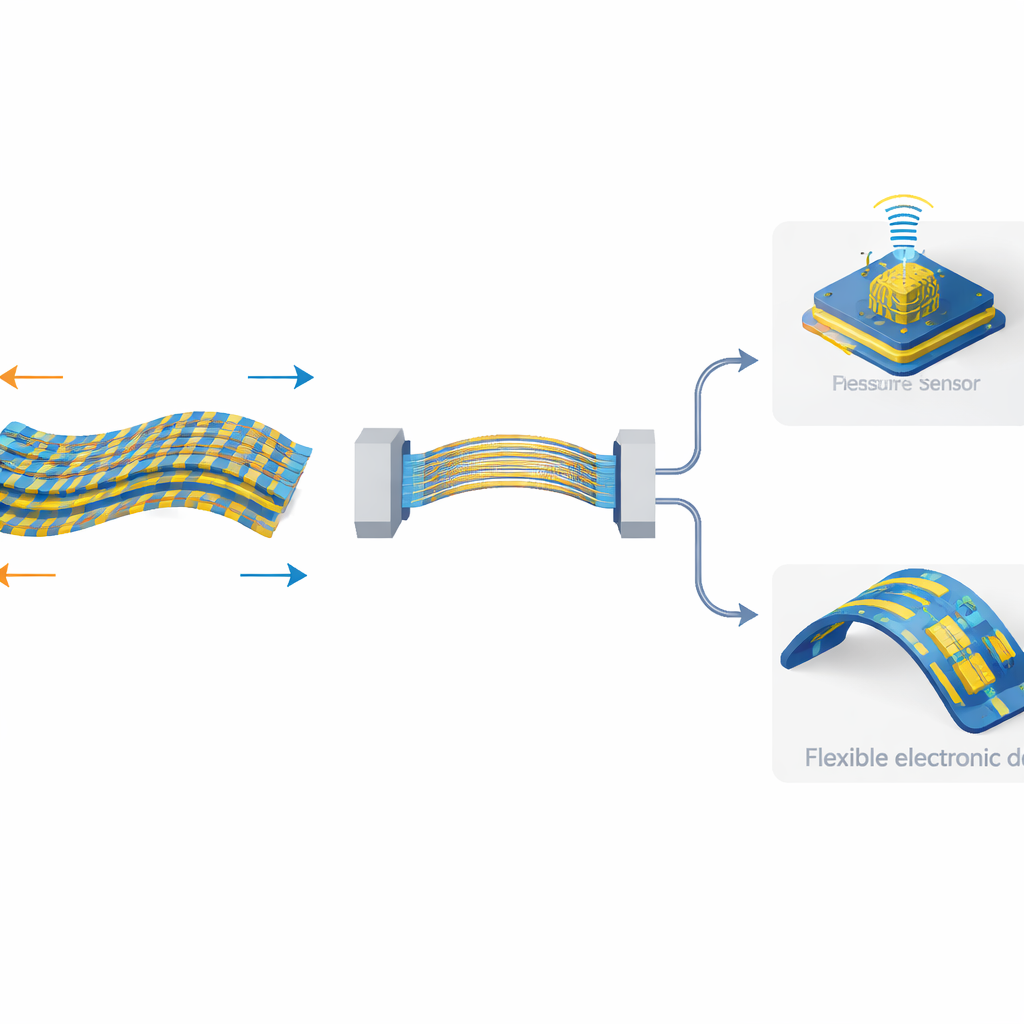
Because these materials are only a few atoms thick, the researchers used computer simulations rather than physical prototypes. They modeled a narrow strip of MXene acting as the channel between two metallic electrodes, much like a miniature wire between two contact pads. Then they “stretched” or “compressed” this strip along different directions—within the plane of the sheet and perpendicular to it—by up to about six percent, a range comparable to what real flexible devices can experience. With a well-established quantum transport approach, they calculated how easily electrons move through the channel, tracking changes in the allowed energy states and in the current flowing under an applied voltage.
When squeezing makes a better pressure sensor
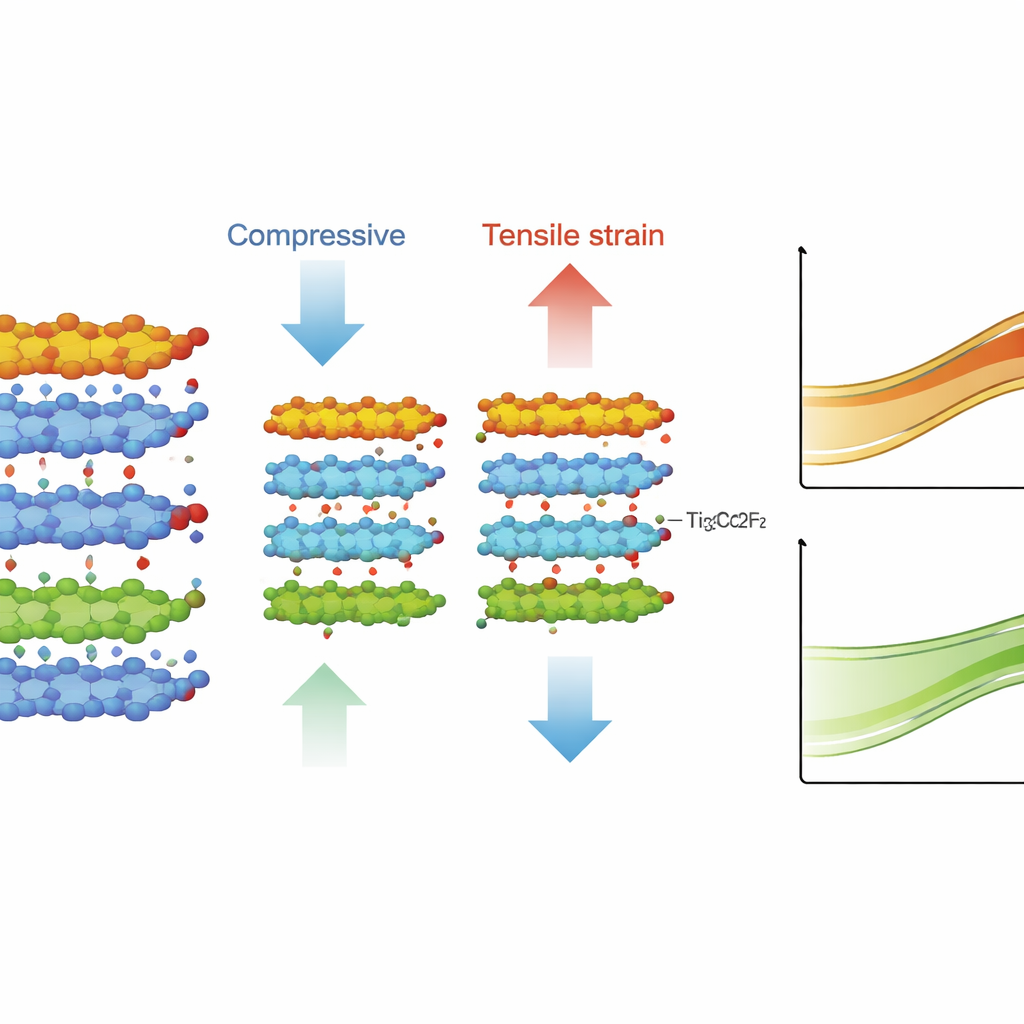
The simulations reveal that Ti₃C₂O₂ is quite sensitive to strain applied perpendicular to its plane. Under compression, the spacing between atoms changes just enough to shrink the energy gap that electrons must cross to conduct. As that barrier shrinks, electronic states shift closer to the working energy of the device, so current starts to flow at lower voltages and grows more strongly as the voltage rises. In practical terms, this means that pushing on a Ti₃C₂O₂-based device could noticeably change its electrical response, a key requirement for pressure or strain sensors that must convert small mechanical changes into readable electrical signals.
When stability is the winning feature
Sc₃C₂F₂ tells a different story. Across the same range of stretching and squeezing, especially out of the plane, its internal energy landscape changes only slightly. The pathways available for electrons remain largely intact, and the current–voltage curves barely shift compared with the unstrained case. Even where there are modest variations or regions of negative differential resistance—a non‑linear effect interesting for specialized circuits—the overall conduction is remarkably robust. This mechanical indifference is valuable for flexible electronics that must keep their performance steady even as the device bends, folds, or twists during everyday use.
What this means for future flexible tech
By comparing just these two MXenes in detail, the study shows how the same material family can offer both sensitive and stable options, depending on the atomic recipe. Ti₃C₂O₂, with its strain-responsive current, is a strong candidate for pressure sensors and other devices that deliberately translate deformation into an electrical signal. Sc₃C₂F₂, which keeps its conduction channels largely unchanged under strain, looks better suited for reliable wiring and components in stretchable or wearable circuits. Together, they hint at a design toolbox where engineers can choose, within a single material class, whether a given part of a flexible device should feel every bend—or barely notice it.
Citation: Soltani, O., Jafari, M.R. Strain-tunable electronic transport in MXenes for sensing and stable electronics. Sci Rep 16, 9355 (2026). https://doi.org/10.1038/s41598-026-40587-3
Keywords: MXenes, flexible electronics, strain sensors, 2D materials, electronic transport