Clear Sky Science · en
Co-design of a natural fiber-timber hybrid structural system using dual-robot coreless filament winding
Building More with Less
As cities grow, we need far more buildings—but the way we build today uses enormous amounts of energy and raw materials. This paper explores a different path: combining wood and plant-based fibers into a new kind of lightweight structure, made with robots, that aims to use fewer resources while still being strong and durable. The researchers test this idea by designing and constructing a full-scale outdoor pavilion that showcases how smart design and digital fabrication can make architecture both lighter on the planet and visually striking.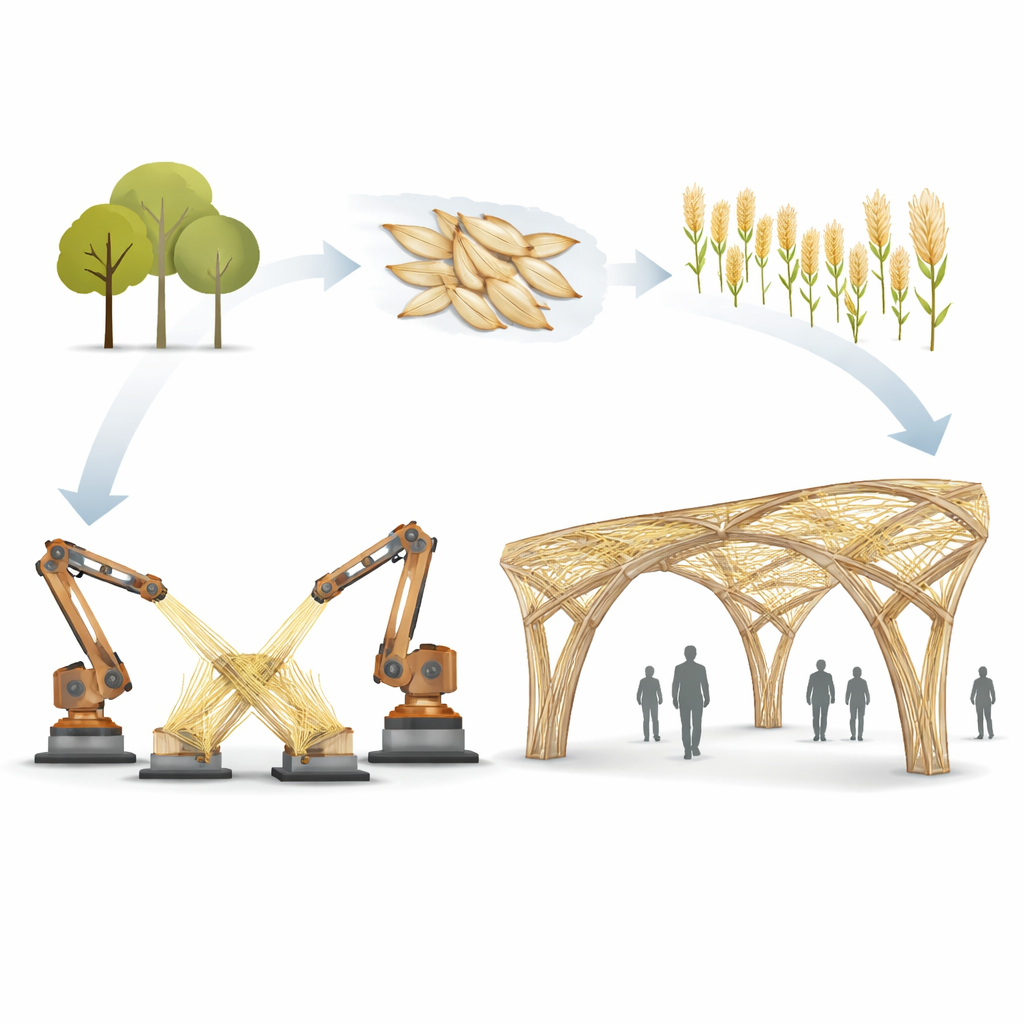
Why Rethinking Materials Matters
Concrete, steel, and conventional plastics are responsible for a large share of global carbon emissions. Wood is often promoted as a greener alternative because trees store carbon as they grow. But if most new buildings were made of wood alone, we would need vastly more forest plantations, raising worries about deforestation, pests, and loss of biodiversity. At the same time, there is rising interest in natural fibers such as flax, which grow in a single season and require less energy to process than metals or synthetic fibers. The authors argue that instead of depending heavily on any one material, we should combine several renewable ones so that each is used only where it performs best.
A New Kind of Hybrid Structure
The team develops a structural system that pairs timber plates and struts with bundles of flax fibers embedded in a partially bio-based resin. In this system, wood takes on forces that push and press, while the fiber network handles forces that pull and stretch. Unusually, the wood does double duty: instead of acting only as structure, it also replaces the temporary steel frames normally used to shape fiber composites. The fibers are wound directly around carefully milled grooves and pockets in the timber, and after the resin cures, wood and fibers stay together as a single, interdependent system. This approach reduces waste and turns what used to be throwaway tooling into part of the finished building.
Robots Weaving a Wooden Canopy
To fabricate the pavilion, the researchers rely on an advanced version of a technique called coreless filament winding. Rather than laying fibers on a solid mold, they stretch them between anchor points and let the final shape emerge from the tension in the strands. Here, two industrial robots work together around a shared timber frame. Each robot feeds its own flax-fiber bundle through a resin bath, and they wind in sync from opposite sides of the slender wooden struts so that the pulling forces stay balanced and the wood does not crack. A detailed digital workflow links global form-finding, structural simulation, joint design, and robot path planning, ensuring that geometry, strength, and manufacturability all inform one another.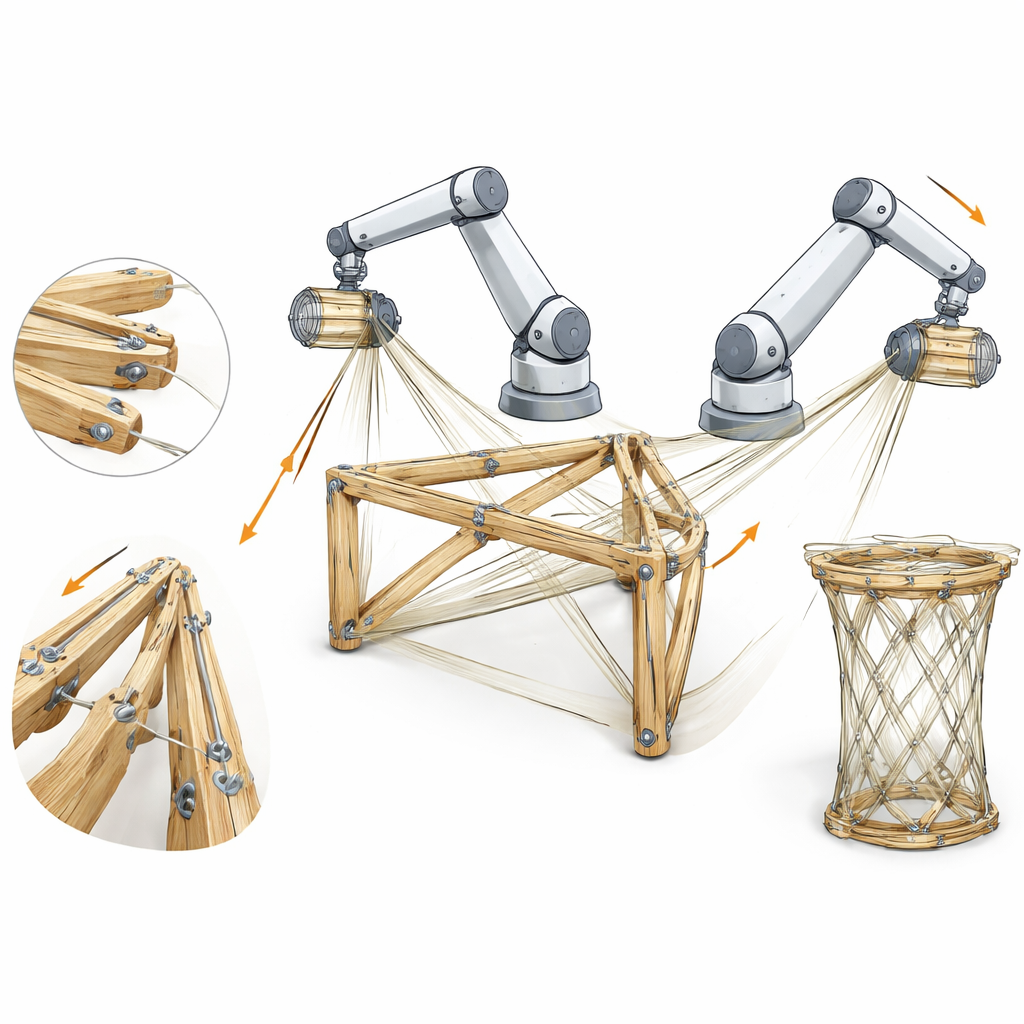
A Pavilion as a Testbed
The outcome is a canopy supported by three hybrid columns and five roof panels, installed on a temporary foundation in a campus park. Slender timber plates, only 42 millimeters thick, span up to 7.5 meters thanks to the reinforcing fiber mesh below. Structural analyses show that the hybrid system can match the stiffness of a much thicker solid timber slab while cutting total structural weight by nearly half. In the columns, some fibers work in tension like cables, while others and the timber struts share compressive loads, creating an intricate but efficient load path. The authors also design reversible connections between components and develop “fiber stitches” that tie neighboring fiber bodies together, enabling the pavilion to be assembled and later disassembled on site.
Taking Structures Apart, Not Just Putting Them Up
After its use, the pavilion is carefully taken apart to test how easily materials can be recovered. Workers cut at the limited contact zones where fibers meet timber, remove screws, and separate plates, struts, and fiber meshes. The wood components are reused in other projects, while the flax-composite offcuts are repurposed for experiments with bio-based fillers such as mycelium. This demonstrates that even though the fiber–wood joints look permanent, the system can still support disassembly and circular use of materials. The study also highlights the remaining hurdles: the resin is only partly bio-based, the dual-robot process is complex, and fine-tuning tolerances and winding paths is challenging.
What This Means for Future Buildings
In simple terms, the pavilion shows that we can build light, strong, and expressive structures by letting different natural materials share the work instead of relying on one heavy-duty option. By weaving flax fibers around timber with coordinated robots, the system uses less material overall, cuts structural weight, and opens up new architectural forms. While more research is needed on long-term durability, fire safety, and fully renewable resins, this hybrid approach points toward buildings that are easier on forests, emit less carbon, and can be more easily taken apart and reused. It suggests a future where architecture behaves less like a permanent object and more like a carefully assembled—and re-assemblable—ecosystem of renewable parts.
Citation: Duque Estrada, R., Kannenberg, F., Chen, TY. et al. Co-design of a natural fiber-timber hybrid structural system using dual-robot coreless filament winding. Sci Rep 16, 8154 (2026). https://doi.org/10.1038/s41598-026-40584-6
Keywords: bio-based architecture, hybrid timber structures, natural fiber composites, robotic fabrication, lightweight pavilion design