Clear Sky Science · en
Ovule and pollen development in Camelina sativa provides systematic insights
Why tiny plant parts matter for food and fuel
Oilseed crops like Camelina sativa are quietly becoming important players in sustainable agriculture, from cooking oils to aviation biofuels. Yet every bottle of oil begins with a successful seed, and every seed depends on the flawless formation of pollen and ovules inside a flower bud. This study peeks into that hidden world, mapping how Camelina’s male and female reproductive structures form, mature, and ultimately create the next generation. By understanding this invisible choreography, scientists can better protect yields, breed hardier varieties, and clarify how this crop fits into the wider mustard family tree.
Getting to know a rising oilseed crop
Camelina sativa, sometimes called “false flax” or “gold of pleasure,” has been grown for roughly 6,000 years and is now attracting attention as a hardy oilseed that tolerates poor soils, low water, and harsh climates. It belongs to the same family as cabbages and the model plant Arabidopsis. Although many relatives in this group have been studied in detail, Camelina’s own flower and seed development had remained surprisingly underexplored. The authors grew plants in controlled greenhouse conditions and sampled flower buds at different sizes. Using thin sections under a light microscope and high‑resolution scanning electron microscopy, they followed the development of both pollen and ovules from the earliest primordia to seed-forming stages. 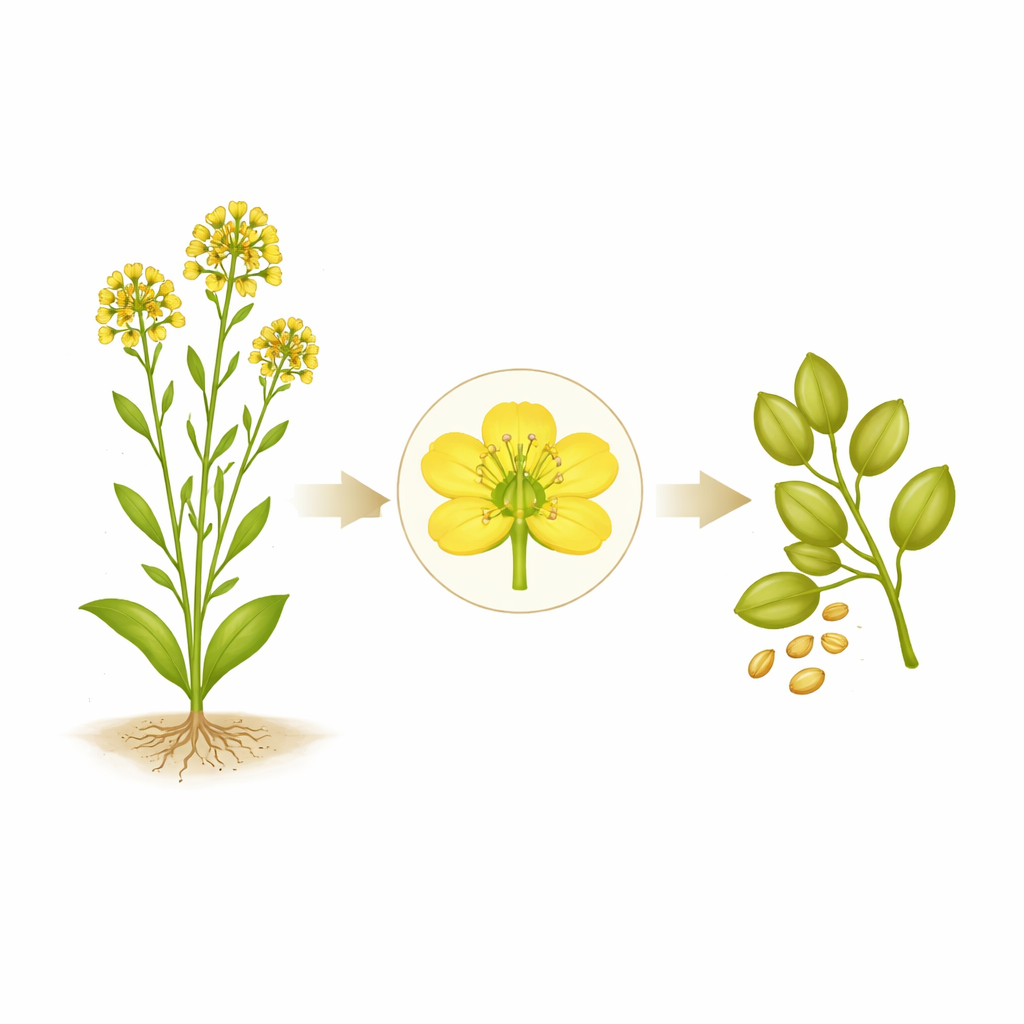
How Camelina builds and launches pollen
Inside each Camelina flower, six stamens form the male side of reproduction, with four tall and two shorter ones surrounding the central pistil. The anthers at their tips contain four pollen sacs whose walls consist of distinct layers, including an outer skin, a mechanical support layer, and a nutritive layer that feeds developing pollen. Within these sacs, special cells undergo meiosis to produce clusters of four young pollen grains. As they mature, each grain builds a tough outer coat sculpted into a fine, netlike pattern and develops separate internal cells that will later form the pollen tube and two sperm cells. Under the electron microscope, Camelina’s pollen appears as medium‑sized, nearly spherical grains with three elongated openings and a micro‑reticulate surface, features that not only affect how the grains hydrate and survive but also help botanists distinguish Camelina from its relatives.
How the ovule prepares for new life
On the female side, the central pistil elongates and differentiates into ovary, style, and stigma. Inside the ovary, rows of tiny ovules arise, each with a narrow stalk and two protective coats. Deep within each ovule, a single cell is set aside to undergo meiosis, producing four potential megaspores lined up in a row. Only the one at the chalazal (base) end survives and expands, going through three rounds of nuclear division to become an eight‑nucleate embryo sac of the so‑called Polygonum type, the most common pattern in flowering plants. This sac organizes into a highly ordered structure: an egg flanked by two helper cells near the opening where the pollen tube will enter, two central nuclei that fuse, and three short‑lived cells at the opposite end. Surrounding tissues, including a specialized layer called the endothelium and a chain of structures that channel nutrients from the ovule’s base, form a dedicated supply route to support the future embryo.
From pollination to embryo, with family ties revealed
Once pollen lands on the stigma and sends a tube down the style, one sperm cell fuses with the egg to form the zygote, while the other joins the central nuclei to start the endosperm, the temporary tissue that feeds the young embryo. In Camelina, early embryo development follows the same basic pattern seen in well‑studied relatives such as Arabidopsis and Capsella: an asymmetrical first division creates a small cell that builds the embryo proper and a larger suspensor that anchors and nourishes it. By comparing these detailed steps in Camelina with published data from two closely related families, Cleomaceae and Capparaceae, the authors show that many features—such as the type of embryo sac, number of ovule coats, and pollen aperture pattern—are strongly conserved. 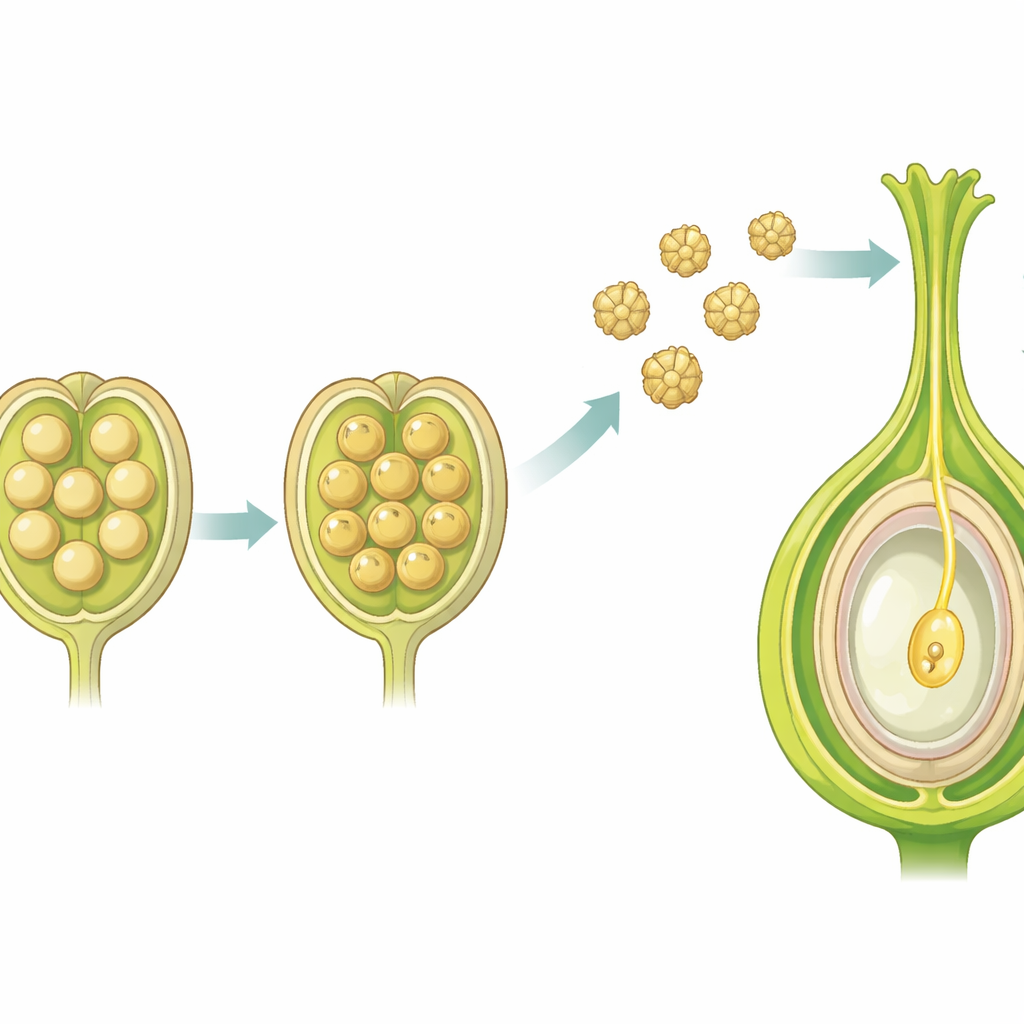
What this means for crops and plant relatives
For non‑specialists, the key message is that the intricate structures hidden inside a Camelina flower are both strikingly conservative and subtly unique. The study supplies a complete “developmental atlas” of how Camelina forms pollen, ovules, and embryos, confirming its close kinship with other mustards while highlighting fine differences in pollen surface and ovule architecture. These traits help taxonomists place Camelina more securely within the Brassicaceae and distinguish it from its nearest cousins, information that matters for breeding, biodiversity studies, and tracing plant evolution. In practical terms, knowing exactly how and when reproductive structures form lays groundwork for improving seed set, diagnosing causes of sterility, and ultimately making this resilient oilseed an even more reliable source of food and biofuel.
Citation: Tahmasebi, S., Jonoubi, P., Majdi, M. et al. Ovule and pollen development in Camelina sativa provides systematic insights. Sci Rep 16, 9403 (2026). https://doi.org/10.1038/s41598-026-40573-9
Keywords: Camelina sativa, plant reproduction, pollen and ovule development, Brassicaceae, oilseed crops