Clear Sky Science · en
Air volume not spray concentration determines in vivo efficacy of volatile organic compounds against Plasmopara viticola
Why this matters for wine and our environment
Grapevines around the world are constantly threatened by downy mildew, a disease that can devastate yields and force growers to spray vineyards many times a season. This heavy reliance on fungicides brings environmental costs and growing concerns about resistance. The study behind this article explores whether fragrant, naturally occurring vapors from plants—called volatile organic compounds—could help protect grapevines in a cleaner way, and what it would actually take to make them work on real plants rather than just in lab tests. 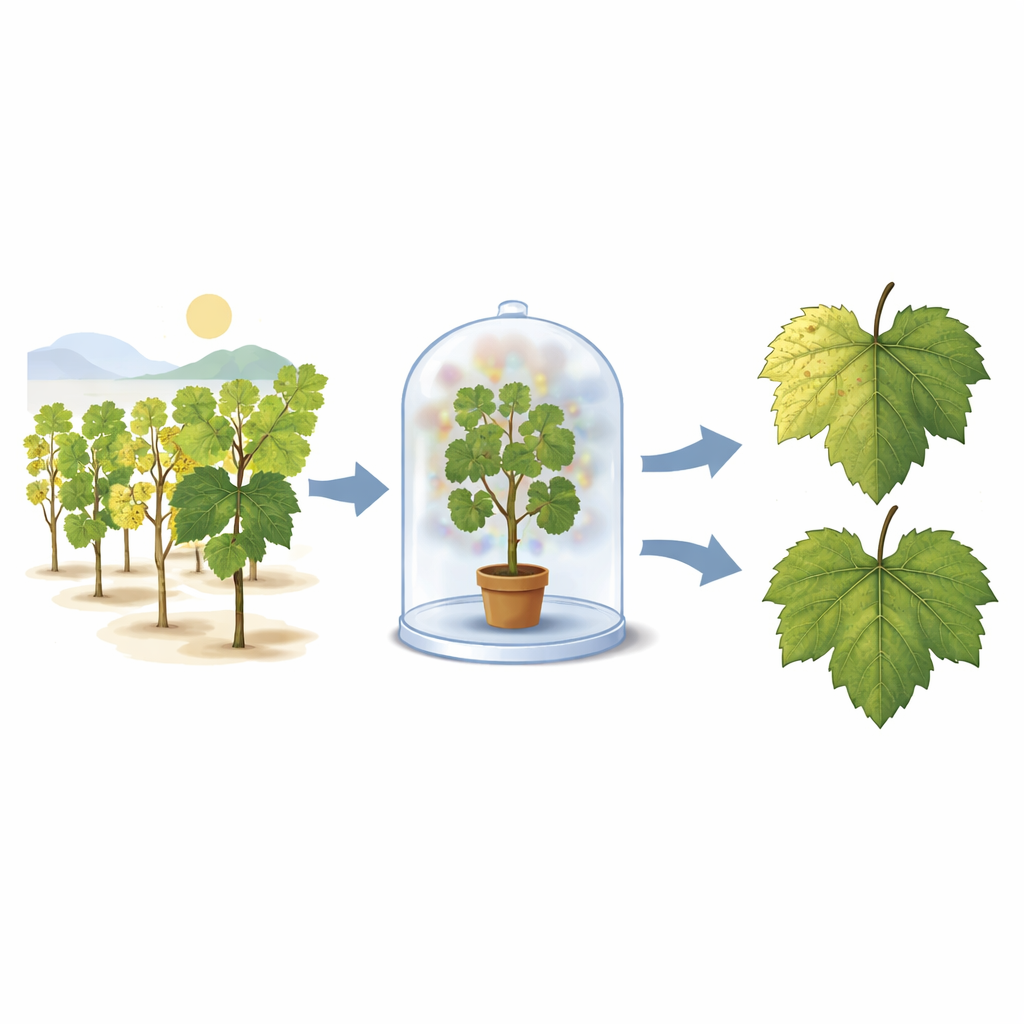
Fragrant defenses from plants
Many plants and microbes release small, easily evaporating molecules into the air. These vapors can signal distress, call in beneficial insects, or directly slow down disease-causing microbes. Earlier experiments on detached grape leaves in sealed lab dishes showed that three such vapors—2-phenylethanol, β-cyclocitral, and linalool—can strongly reduce symptoms of downy mildew, which is caused by the water-mold Plasmopara viticola. Intriguingly, these same vapors are naturally produced at higher levels by grapevine types that resist the disease, hinting that they might form part of the vine’s own chemical shield.
Putting plant perfumes to the test
The researchers moved from petri dishes to whole potted grapevines grown in a greenhouse. They compared two very different ways of delivering the vapors. In the first, they mimicked a fumigation chamber: a defined amount of each compound was placed on filter paper inside a glass container that completely enclosed the aboveground part of the plant overnight. In the second, they followed the standard farm practice of spraying: each compound was mixed into water with a solvent and applied as a fine mist directly onto the leaves, without any cover. In both cases, treated vines were later exposed to downy mildew spores, and the team measured how much of each leaf became covered in white, fuzzy growth. 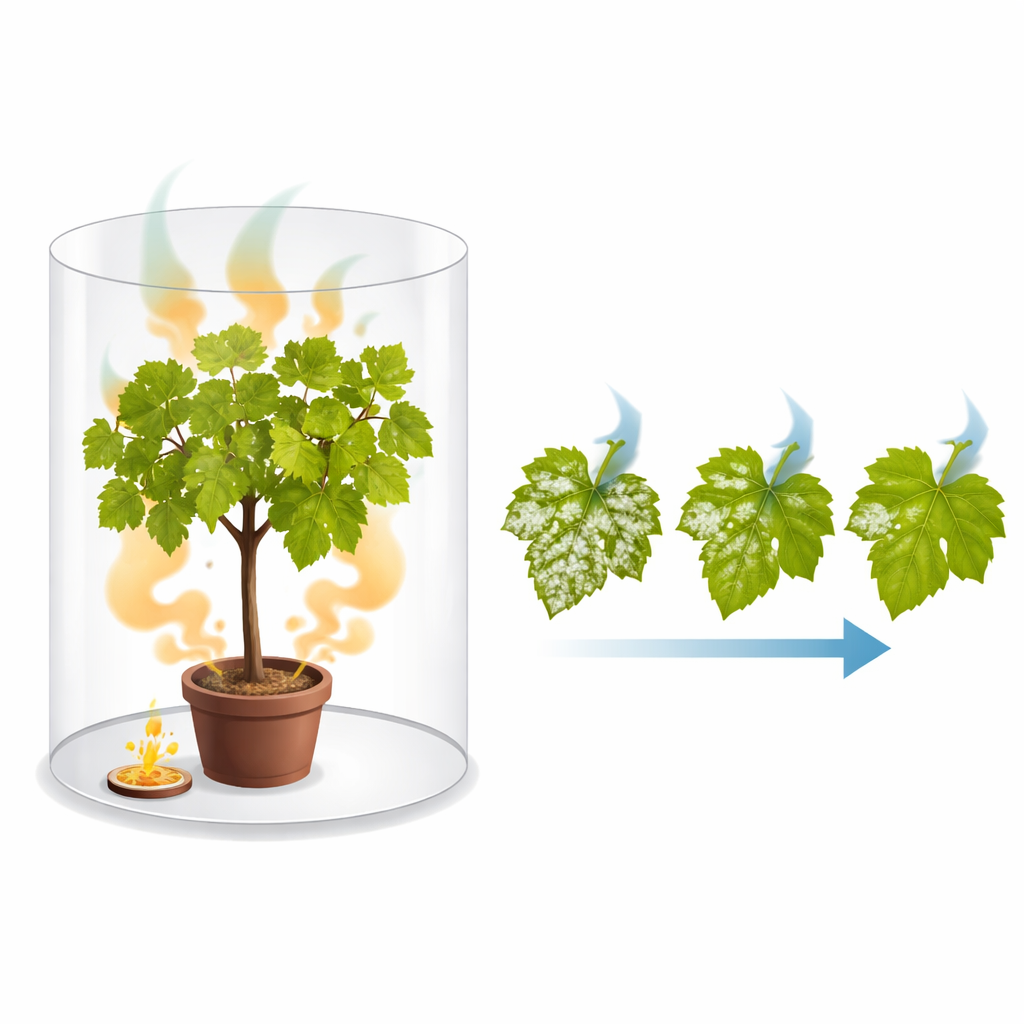
Air around the plant beats liquid on the leaf
When the vapors were trapped in a limited air volume around the plants, two of the compounds clearly helped. Linalool, at a dose that did not visibly damage leaves, cut disease severity by about two-thirds on average, while 2-phenylethanol reduced it by nearly half. β-cyclocitral, by contrast, showed only modest and inconsistent protection. Importantly, pushing the dose too high quickly caused burn-like damage to the leaves, showing that there is a narrow window between “helpful” and “harmful.” The key message was that enclosing the plants so the vapors remained concentrated for many hours made them effective even at relatively low amounts.
Why simple spraying failed
Spraying the same vapors in liquid form told a very different story. Even at very high concentrations that approached the limit of what the leaves could tolerate, none of the three substances reduced downy mildew on whole plants. At the highest spray doses, leaves began to scorch, yet the pathogen still prospered. The authors argue that this is because these vapors evaporate and disperse too quickly when applied in the open: there is no sustained cloud of protective molecules around the plant, so the pathogen is barely exposed. In contrast, the glass enclosures in the fumigation setup acted like mini-greenhouses, holding the vapors near the leaves long enough to matter.
Rethinking how we deliver green pesticides
From these experiments, the authors conclude that the surrounding air volume and the duration of exposure—not just how much compound is applied—largely determine how well such vapors can protect grapevines. Linalool and 2-phenylethanol look promising as ingredients for more sustainable disease control, but they cannot simply be sprayed like conventional fungicides. Instead, they will likely require new formulations—such as slow-release beads, microcapsules, or companion plants that constantly emit protective vapors—to keep effective levels in the air without burning the crop. If these delivery challenges can be solved, fragrant plant volatiles could become valuable tools to curb downy mildew while reducing dependence on traditional chemicals.
Citation: Oberhofer, S., Avesani, S., Perazzolli, M. et al. Air volume not spray concentration determines in vivo efficacy of volatile organic compounds against Plasmopara viticola. Sci Rep 16, 9325 (2026). https://doi.org/10.1038/s41598-026-40527-1
Keywords: grapevine downy mildew, volatile organic compounds, linalool, biological plant protection, sustainable viticulture