Clear Sky Science · en
Participatory development and proof-of-concept of an intersectionality-informed art-based group intervention for BIPoC girls
Why this matters for girls of color
Across Europe, many young people grow up facing racism, but girls of color often carry a double burden: they are judged for both their race and their gender. This study asks a hopeful question: what if creative group art sessions, designed together with the girls themselves, could offer safer spaces to talk about racism, build confidence, and strengthen emotional well-being? The researchers developed and tested a new program in Germany called “Colors of Empowerment” to explore whether such an approach feels helpful, respectful, and doable in real life.
Listening to the girls first
The project began with a long conversation circle—a focus group—with eight Black, Indigenous, and other girls of color aged 14 to 16. In this space, the girls described how racism shows up in everyday life: in schools, on the street, even from teachers and strangers. They spoke about the emotional tug-of-war between wanting to speak up and wanting to stay safe, and how anger and sadness can build up over time. Many said that art, music, and other creative outlets helped them express feelings they did not always want to put into words. They also stressed what they would need to feel safe in a workshop: small groups, facilitators who share similar backgrounds or are clearly sensitive to racism, and a gentle, step‑by‑step way of introducing painful topics.
Testing a journal as a gentle support
Next, the team created a self-reflection journal filled with simple weekly pages: short affirmations, self-care ideas, mood tracking, gratitude lists, goals, and small creative prompts. They first tried it with four teenage girls to see whether the format was practical and emotionally helpful. Use of the journal varied widely: some wrote or drew more often, others only occasionally. Still, most weekly ratings described the journal as helpful or sometimes helpful, especially sections on affirmations, gratitude, and self-care. Many participants said it helped them notice their achievements, shift their perspective, or briefly feel calmer and more positive. At the same time, tiredness and lack of time were common reasons for not using it every week, suggesting that such tools work best when offered flexibly rather than as strict homework.
Bringing art, stories, and safety together
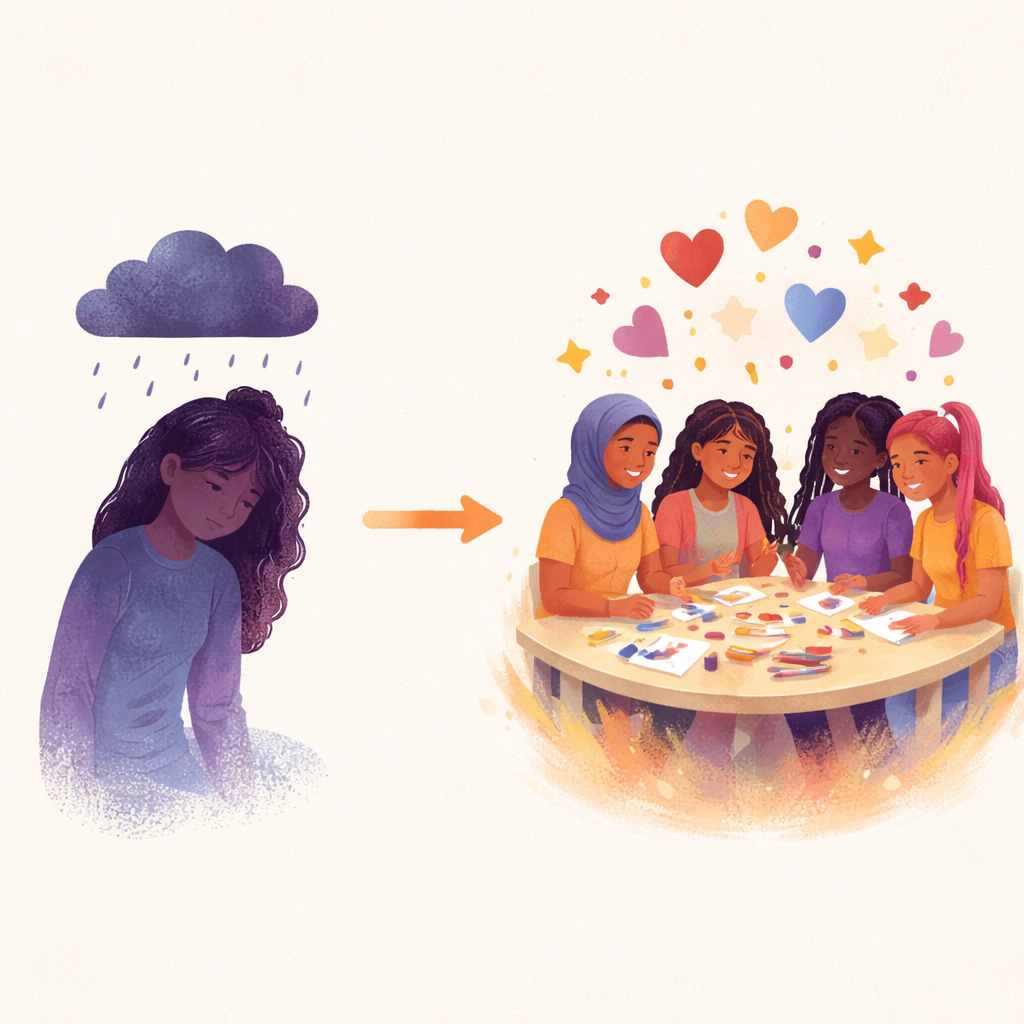
In the final and most important phase, seven BIPoC girls took part in a six‑week art-based group program, co-led by two clinicians of color. Each three-hour session blended creative activities with group reflection and optional use of the journal. Themes included how the girls see themselves, how they talk to themselves on the inside, how to build trust in their own abilities, and how to process feelings—especially anger and fear—connected to racism. Attendance was strong: all girls came to at least half of the sessions, and most came to four or more. Session “report cards” were very positive, with nearly all rated in the top two school grades, and three-quarters of the evaluations noting that participants felt better after the session than before.
What changed for the girls
Before the program started, all seven girls reported having experienced racism, such as being called names, seeing family members mistreated, or being treated unfairly by teachers. They also reported moderate levels of racial trauma symptoms and only “sometimes” feeling optimistic, worthy, or capable. After six weeks, the data were still preliminary and based on a small group, so the researchers did not run formal statistical tests. Descriptively, however, there were modest increases in self-worth, self-efficacy (the belief that “I can handle things”), and optimism. Emotional and behavior problems also appeared slightly higher, which may reflect growing awareness and more open acknowledgment of difficult feelings, rather than worsening health. During weekly check-ins, many girls said the sessions helped them cope with everyday problems, and short-term self-satisfaction ratings were higher at the end of each session than when thinking back over the previous week.
What this work suggests for the future
For everyday readers, the main takeaway is that art, community, and cultural understanding can be powerful ingredients in mental health support for girls of color. This small pilot study shows that a carefully designed, racism-aware art group can feel safe, meaningful, and acceptable to BIPoC girls in Germany, and may give a boost to inner strengths like self-confidence and self-acceptance. The reflective journal, while less widely used, seems promising as a gentle add‑on for those who like writing or drawing on their own time. Because the study involved few participants and no comparison group, it cannot prove long‑term benefits—but it offers a clear proof of concept. It points toward a future in which mental health programs are co-created with young people, honor their lived experiences of racism, and use creative practices to help them turn everyday pain into shared strength.
Citation: Birnkammer, S., El-Haj-Mohamad, R. & Calvano, C. Participatory development and proof-of-concept of an intersectionality-informed art-based group intervention for BIPoC girls. Sci Rep 16, 6710 (2026). https://doi.org/10.1038/s41598-026-40521-7
Keywords: art-based mental health, BIPoC girls, racism and youth, resilience, creative group therapy