Clear Sky Science · en
Analyzing leaping and movement potential at a migratory barrier
Why jumping fish and river barriers matter
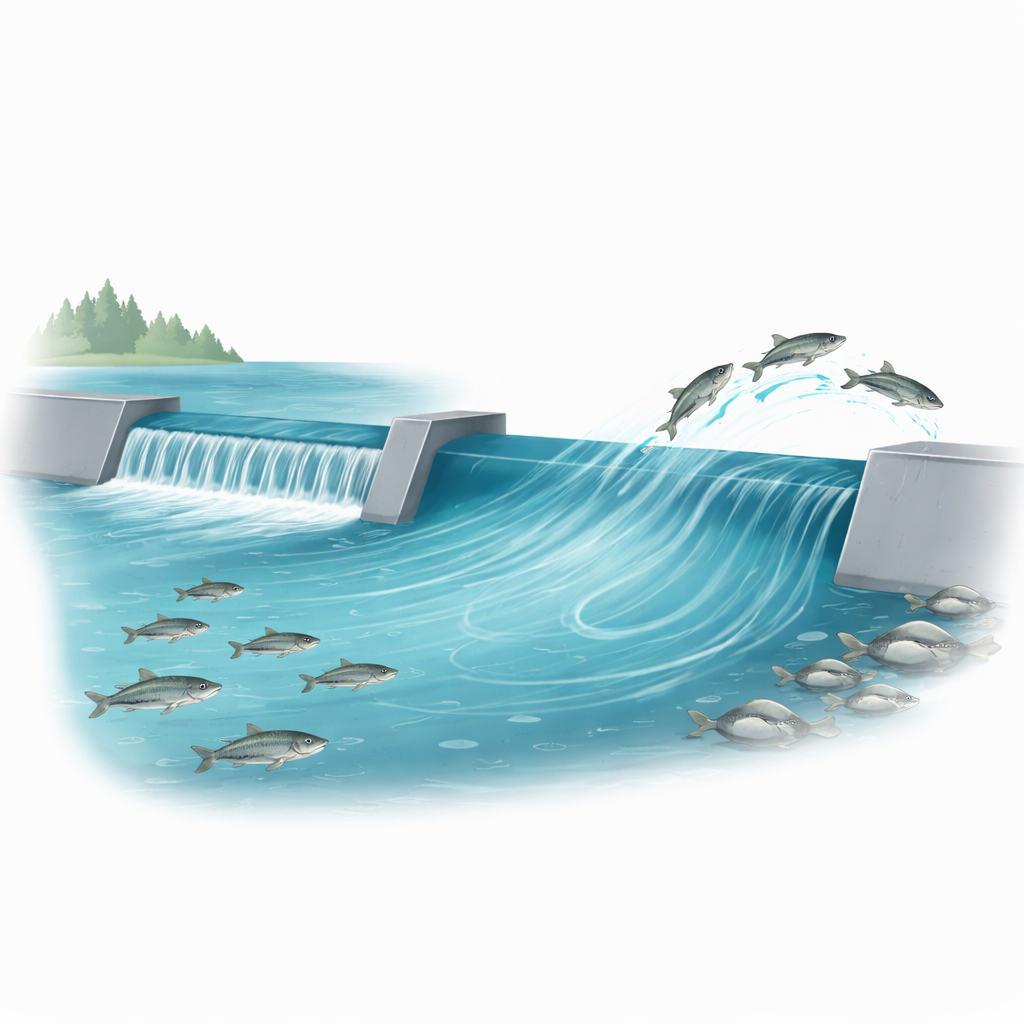
Across the world, rivers are laced with small dams, weirs, and culverts that break long stretches of flowing water into disconnected pieces. These structures can help protect native species by blocking invaders, but they can also prevent salmon and other migratory fish from reaching the places where they feed and spawn. This study looks closely at one dramatic moment in that journey—the split second when a fish tries to leap over a barrier—and uses a new computer model to ask a simple but important question: under what conditions can a fish actually make it over?
Rivers broken into steps
Most barriers in rivers are not huge concrete walls but low structures only a couple of meters tall. Whether fish can get past these small drops depends on a tricky mix of biology and physics: how strong and long the fish are, how fast and deep the water is, how high the drop is, and how turbulent the flow becomes as it plunges into the pool below. Managers face a dilemma. In some rivers they want to make it easier for prized species, such as steelhead trout, to move upstream. In others, they want to stop invasive species from spreading. Either way, they need to know when a barrier really stops fish—and when determined jumpers can still slip through.
Building a digital leap
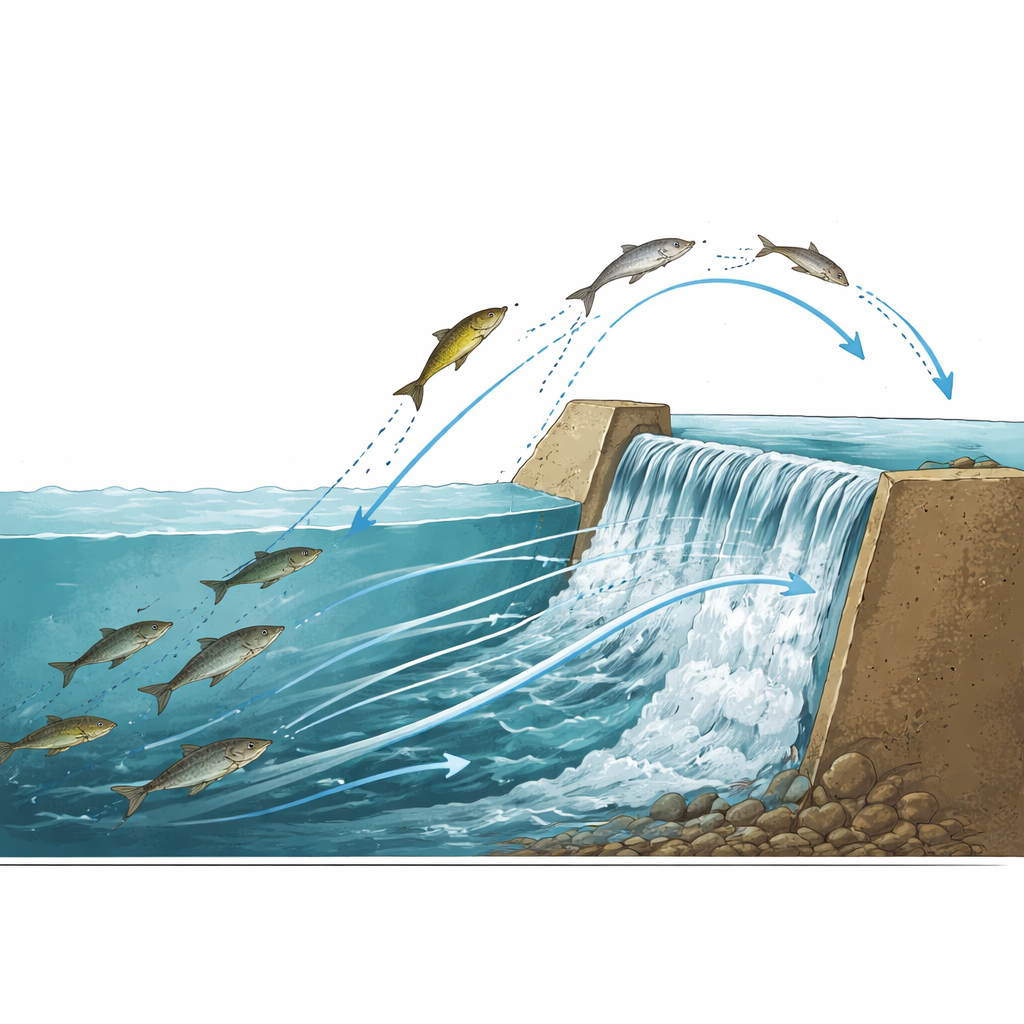
Earlier tools often treated fish jumps in very simplified ways, using just a single barrier height or an average water speed to decide whether passage was possible. The new model developed in this paper is more like a digital wind tunnel for fish. It combines a classic description of a jumping body’s arc through the air with high‑resolution, three‑dimensional simulations of how water moves around a structure. Into this virtual river, the researcher releases thousands of simulated fish, each with slightly different body lengths, top speeds, starting positions, and jump angles. The model then tracks which individuals clear the barrier and which fall short, producing a map of “good” and “bad” places to launch and an overall chance of success for the population.
Testing the model in the real world
To see if this approach matched reality, the author first calibrated it at an existing dam in Michigan where steelhead attempts had been recorded on video. By adjusting how many times a typical fish was allowed to try again from a new spot, the model was tuned so that its predicted success rate matched what was seen in the field. With that calibration in hand, the study moved to a second site called FishPass, a newly built structure with a curving, maze‑like crest designed to block unwanted fish while allowing controlled experiments on passage tools. Here, the model explored a wide range of river flows, from ordinary conditions to rare, extreme floods, and estimated how often steelhead might manage to leap over.
What the computer fish revealed
The virtual experiments showed that, for most flow levels, the chance of a steelhead jumping past the FishPass barrier was very low—below 1% at typical flows and only rising to around 10% even during a severe flood. Successful leaps tended to come from larger, faster individuals starting from very specific spots where water depth and flow direction lined up just right. At low flows, water in the plunge pool was too shallow for big fish to gain speed; at high flows, the deeper water and stronger currents created more opportunities, especially inside the curved pockets of the structure. Nearly all successful jumps occurred over the arc‑shaped weir rather than the adjacent low‑flow section, which was kept shallow and fast to discourage passage.
Designing better barriers and fishways
This work concludes that the new model can offer managers a much sharper picture of how small changes in barrier shape, pool depth, or flow pattern affect the odds that fish will get through. For FishPass, the results suggest that the current design will act as a strong barrier for most steelhead under most conditions, helping to limit unintended movement of fish while other control tools are tested. More broadly, the study shows that by pairing detailed water physics with realistic variation in fish abilities, it is possible to design river structures that either open doors for desired species or firmly close them to invaders—without relying on rough rules of thumb.
Citation: Zielinski, D.P. Analyzing leaping and movement potential at a migratory barrier. Sci Rep 16, 9746 (2026). https://doi.org/10.1038/s41598-026-40492-9
Keywords: fish passage, river barriers, steelhead, computational fluid dynamics, fish leaping