Clear Sky Science · en
Small punch testing and scanning electron microscopy analysis of damage evolution in dual-phase steel
How safer cars start with tiny metal tests
Modern cars rely on special steels that are both strong and bendable, so that body panels can be shaped in the factory yet still protect passengers in a crash. This article looks inside one such steel, called dual-phase steel, to see exactly how and where it begins to crack when pushed to its limits. By watching damage form on microscopic scales during a specially designed lab test, the researchers hope to help engineers design lighter, safer vehicles and more accurate computer models of how car parts fail.
A closer look at a workhorse car metal
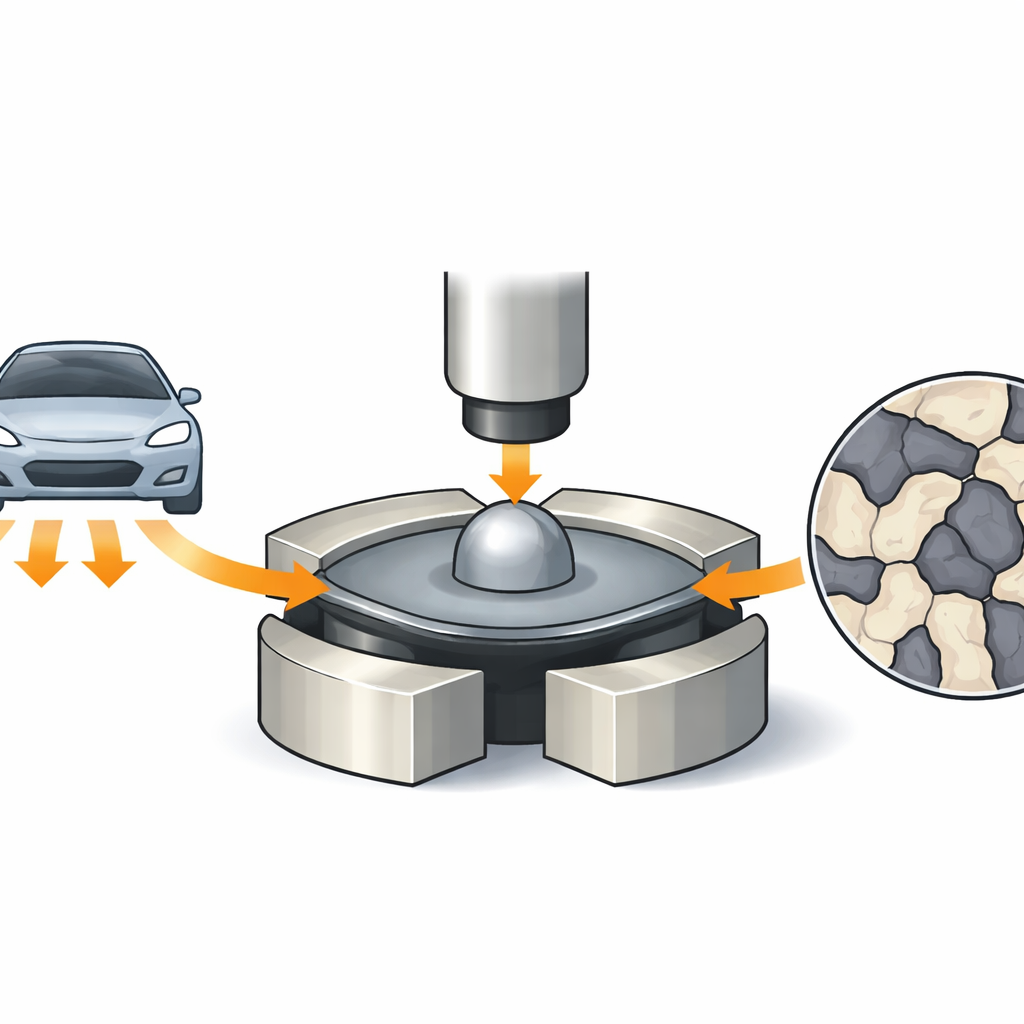
Dual-phase steels are widely used in the automotive industry because they combine hard and soft regions in the same metal. The soft ferrite phase allows the sheet to stretch, while hard martensite islands provide strength. In the grade examined here, known as DP1000, roughly half of the metal volume is martensite. This mixture is created by carefully heating and rapidly cooling the steel so that part of it transforms into martensite while the rest remains ferrite. Although this recipe is well established, engineers still lack a clear picture of how tiny cracks start and spread between these phases when the material is pressed or bent in ways similar to real forming operations.
A miniature press to mimic real forming
To probe this behaviour, the team developed a refined "small punch" test. Instead of stretching a long strip of metal in one direction, they clamp a thin circular disk and push a rounded punch into its centre, creating a dome-like bulge and a complex, two-direction stretch similar to that in industrial forming tools. The setup was tailored to work with two powerful viewing methods. In one series of tests, the sample surface was coated with a fine speckle pattern so that a stereo camera system (three-dimensional digital image correlation) could track how every point on the surface moved and stretched until failure. In another series, the same style of punch test was repeatedly paused so that the specimen could be moved into a scanning electron microscope, where the evolving micro-cracks could be imaged at high magnification.
Following cracks from first flicker to final break
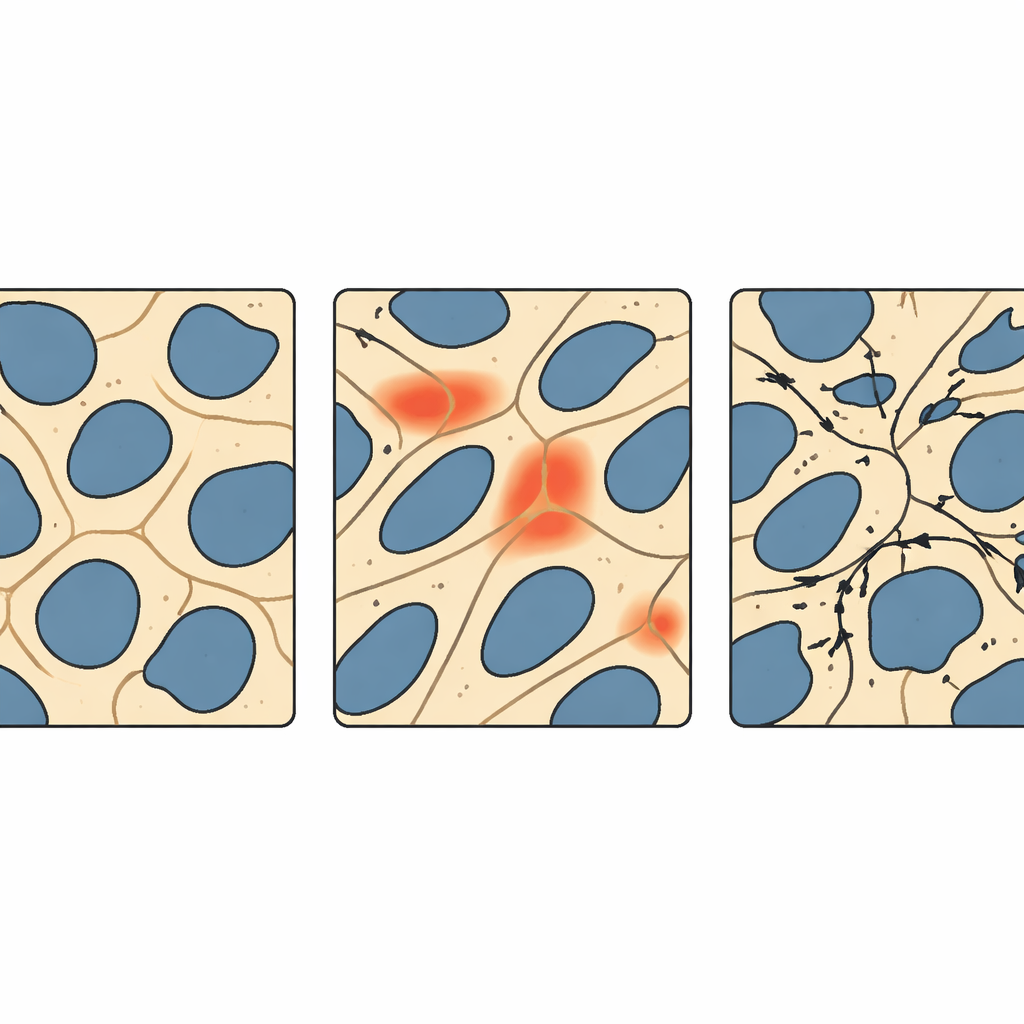
The combined tests revealed a three-stage journey from smooth metal to rupture. At small punch displacements the disk deformed elastically; then plastic stretching set in, and finally the steel entered a stage of unstable flow and fracture. Tiny cracks first appeared at a punch displacement of about 1.12 millimetres, long before a visible surface crack formed. These early flaws were linked to strong local stretching near the junctions between ferrite and martensite. Because ferrite is softer, it deforms more, while the surrounding hard martensite constrains it, concentrating stress at the boundaries. Under continued loading, the ferrite developed shear bands, voids, and small cracks, while neighbouring martensite islands occasionally fractured where this constraint was greatest. Three-dimensional surface measurements showed that the steel reached local principal strains of around 23 percent at the point where a surface crack finally appeared.
Inside the fracture: who really gives way?
After failure, the authors cut out small blocks around the damaged zone and examined their cross-sections in the electron microscope. This view through the thickness showed that the main crack usually started at the surface in contact with the punch and then worked its way through to the outer surface. Along its path, the crack threaded primarily through the ferrite, with many voids forming and linking up in this softer phase, especially near ferrite–martensite boundaries. Martensite islands did crack, particularly in the early stages, but most of the final crack path ran through ferrite regions that had been heavily stretched under the martensite’s constraint. Compared with lower-strength dual-phase steels, the damage in DP1000 developed more gradually, with an extended stage of void formation and coalescence before a clear macroscopic crack appeared.
What this means for lighter, safer structures
For non-specialists, the key message is that the way a strong car steel fails is controlled less by a single weak spot and more by the interaction between its soft and hard regions. This study shows that a carefully designed miniature punch test, combined with surface strain mapping and high-resolution imaging, can capture that interaction in detail. The findings confirm that ferrite carries most of the stretching, while martensite shapes how and where damage concentrates, especially at their shared boundaries. By providing high-quality data on when and where cracks start under realistic loading, this work lays the groundwork for better computer models and, ultimately, improved steels and forming processes that let manufacturers reduce vehicle weight without sacrificing safety.
Citation: Alsharif, A., Moinuddin, S.Q. & Pinna, C. Small punch testing and scanning electron microscopy analysis of damage evolution in dual-phase steel. Sci Rep 16, 9477 (2026). https://doi.org/10.1038/s41598-026-40489-4
Keywords: dual-phase steel, small punch test, microstructural damage, automotive materials, formability