Clear Sky Science · en
Ensemble learning-based prediction of the backbone curve for corroded reinforced concrete columns using experimental database
Why aging concrete columns matter
Many of the bridges and buildings we rely on every day stand on reinforced concrete columns that quietly rust as decades pass. Salt from de‑icing, sea spray, and polluted air can slowly eat away the steel hidden inside, weakening these supports just as they may be called on to withstand earthquakes. This paper presents a new way to use large amounts of test data and modern machine learning to predict how such damaged columns will behave during strong shaking, helping engineers decide when to repair, strengthen, or replace them.
How rust changes the strength story
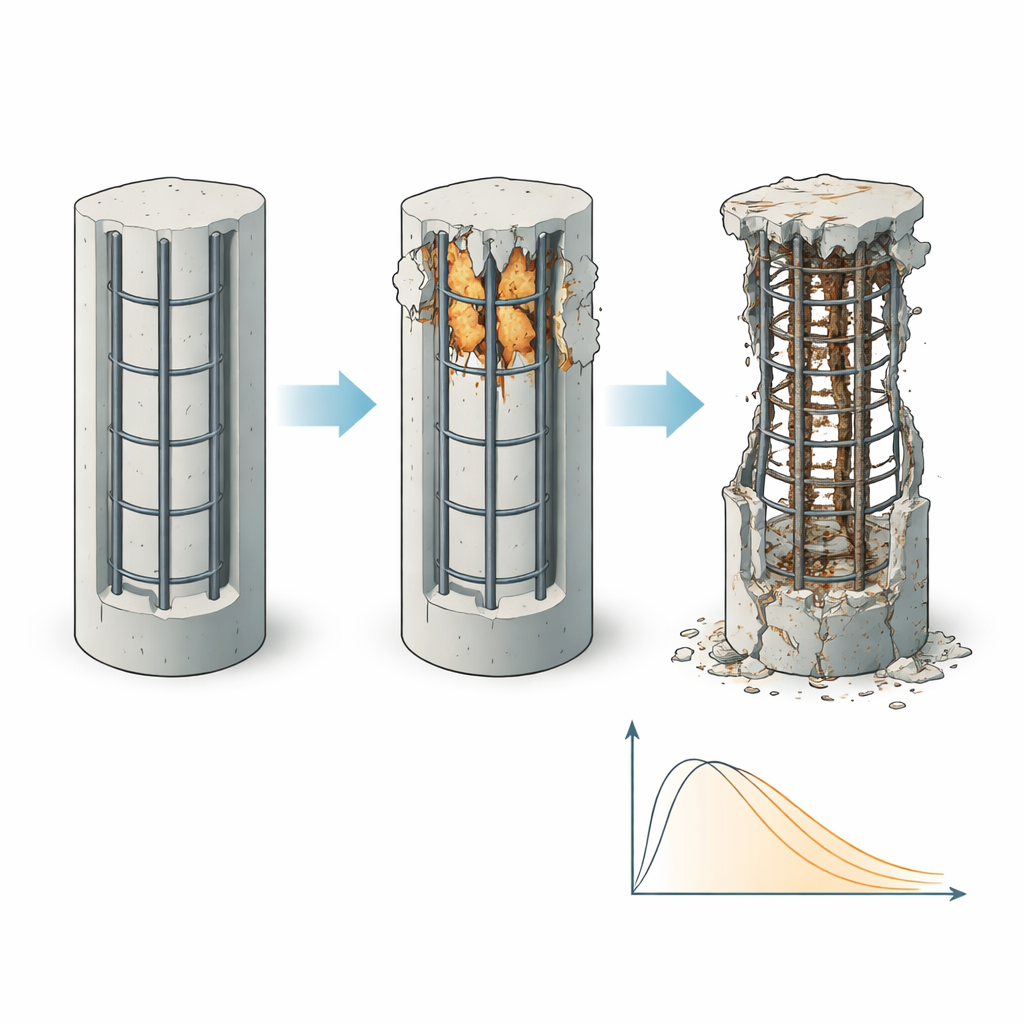
When steel inside a concrete column corrodes, the rust takes up more space than the original metal. This expansion cracks the surrounding concrete, first as fine internal lines and later as visible splitting and spalling. At the same time, the steel bars themselves lose cross‑section, strength, and ductility, and their grip on the concrete weakens. Under earthquake‑like back‑and‑forth loading, healthy columns trace out broad, rounded loops on a force–displacement plot, showing strong energy absorption. Corroded columns, by contrast, trace narrower, pinched loops and lose strength more quickly after they first yield, signaling a shift toward brittle, less forgiving behavior that can leave structures more vulnerable to collapse.
From scattered tests to a single big picture
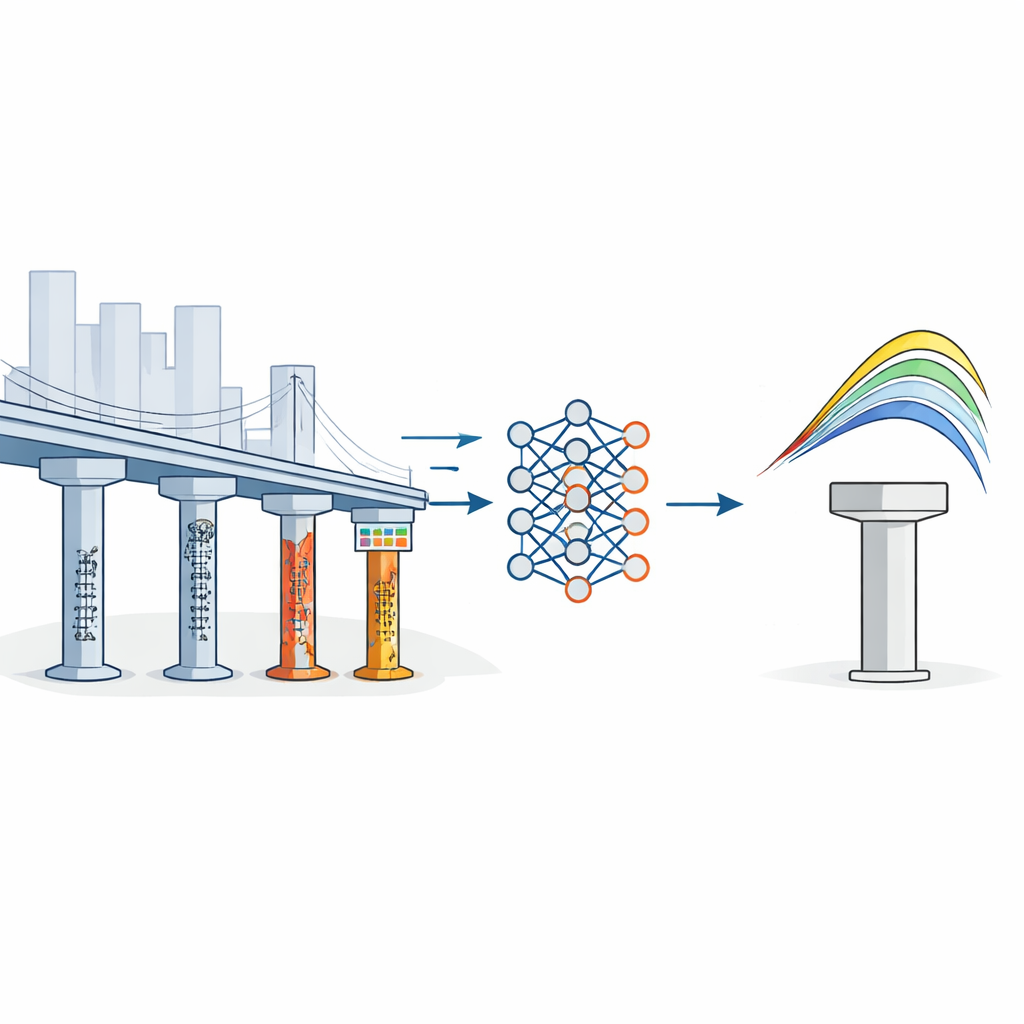
Researchers around the world have tested individual corroded columns in different laboratories, using a wide variety of sizes, bar layouts, materials, corrosion levels, and loading conditions. This study brings 200 such specimens together into a single experimental database that spans realistic ranges of column geometry, steel and concrete strength, axial load, and measured corrosion of both main bars and ties. Instead of simplifying each column’s behavior to a few ideal points, the authors extract the full backbone curve—the smooth envelope that traces how lateral resistance grows, peaks, and then falls as the column sways. They then use these measured curves as targets for data‑driven models that learn directly from the experiments, rather than from pre‑chosen formulas.
Teaching machines to read damage
The team trains several ensemble learning methods—families of many small decision trees that vote together—to predict key stages along each column’s backbone: the strength at first yield, the peak strength, and the remaining strength after severe damage. Using part of the database for training and keeping the rest aside for testing, they tune the models with Bayesian search so that they capture general patterns without memorizing individual specimens. Among all tested approaches, an extreme gradient boosting model proves most reliable, achieving high accuracy across yield, peak, and residual stages and, crucially, reproducing the steep post‑peak softening that simpler, idealized models often miss or underestimate.
Seeing which details matter most
To move beyond a black‑box prediction, the authors apply a technique called SHAP, borrowed from game theory, to measure how much each input factor nudges the predicted strength up or down. They find that basic shape and proportion—such as the shear span and overall depth of the column—along with the degraded strength of the steel bars, are most important when the column first yields and at peak strength. As damage advances, features linked to confinement and failure mode become more critical, reflecting how cracking, crushing, and bar buckling take over from simple geometry. This kind of insight lets engineers see whether a column’s weakness stems mainly from heavy axial load, poor detailing, or severe corrosion, guiding more targeted retrofits.
What this means for everyday safety
In practical terms, the study shows that a carefully trained, transparent machine‑learning model can reliably reconstruct the entire strength–drift path of a corroded concrete column using measurable properties and corrosion indicators. Compared with older, idealized backbone formulas, the new approach better captures how quickly strength falls away after the peak, especially in heavily corroded cases where residual capacity has often been overestimated. This gives bridge and building owners a sharper picture of how much seismic reserve remains in aging supports and helps them prioritize repairs before the next big earthquake, turning scattered laboratory tests into a powerful tool for real‑world decision‑making.
Citation: Sadeghi, M., Poorahad, P., Shiravand, M.R. et al. Ensemble learning-based prediction of the backbone curve for corroded reinforced concrete columns using experimental database. Sci Rep 16, 9367 (2026). https://doi.org/10.1038/s41598-026-40488-5
Keywords: reinforced concrete corrosion, seismic performance, machine learning in civil engineering, backbone curve prediction, aging infrastructure