Clear Sky Science · en
Hybrid prediction system for reliable multi-seasonal sustainable energy generation under meteorological and environmental volatility
Why Steadier Wind Power Matters
As more countries lean on wind turbines to replace fossil fuels, a hidden problem is emerging: the wind itself is fickle. Blustery days can overwhelm power lines, while sudden lulls leave gaps that must be filled quickly, often by fossil-fuel plants. This paper describes a new forecasting system that aims to tame that uncertainty. By looking carefully at both weather patterns and how turbines behave over days and across seasons, the authors design a smart, hybrid tool that predicts wind power more accurately and more reliably than existing methods.
Watching the Weather in Fine Detail
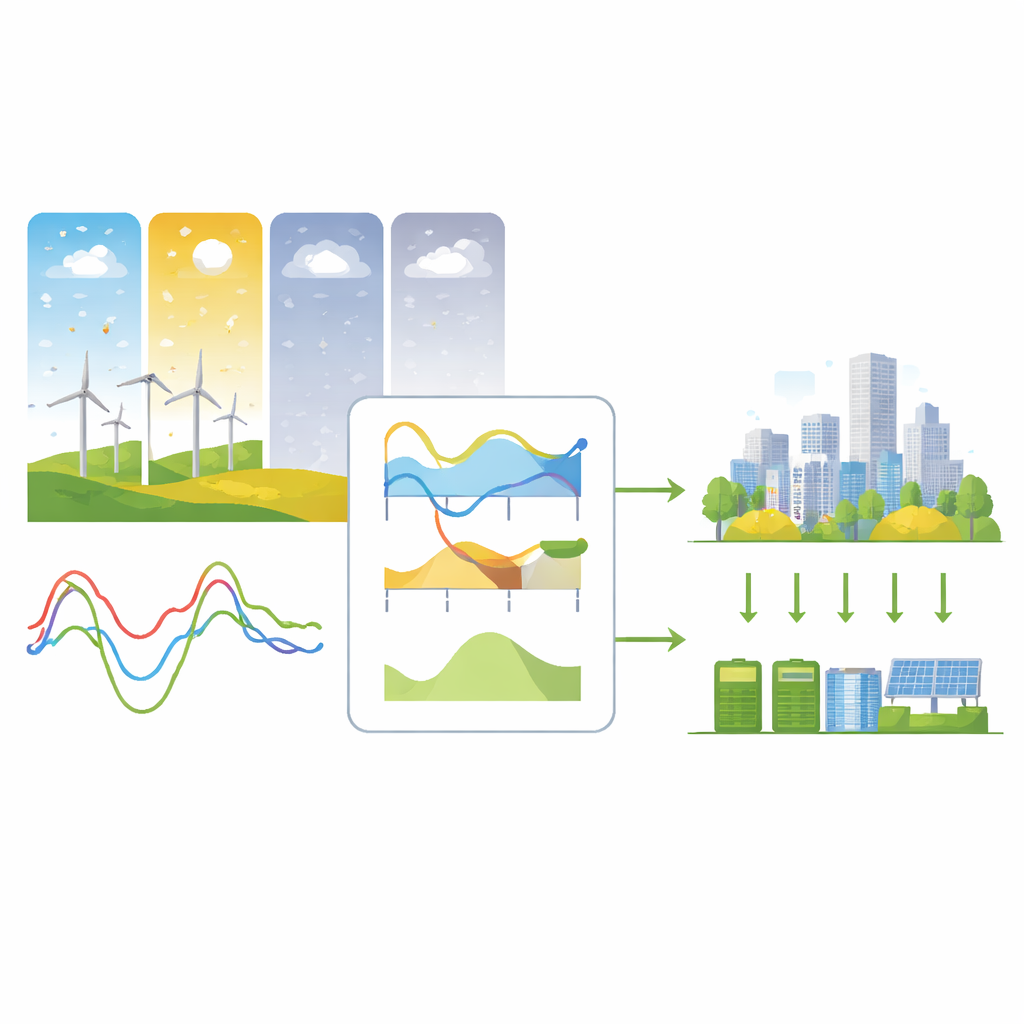
The work starts from a simple idea: to manage wind power well, you must understand not only how hard the wind blows, but how it changes from minute to minute, day to day, and season to season. The team analyzes a year of data from a large wind farm in Jiangsu Province, China, sampled every 15 minutes. These records include wind speed and direction at different heights, temperature, air pressure, humidity, and how the turbines themselves are operating. Spring and autumn bring shifting monsoon patterns, summer is hot and stormy, and winter is cold and gusty. Each season pushes wind output in different ways, creating a challenging test bed for any forecasting system.
Separating Long Swings from Sudden Jumps
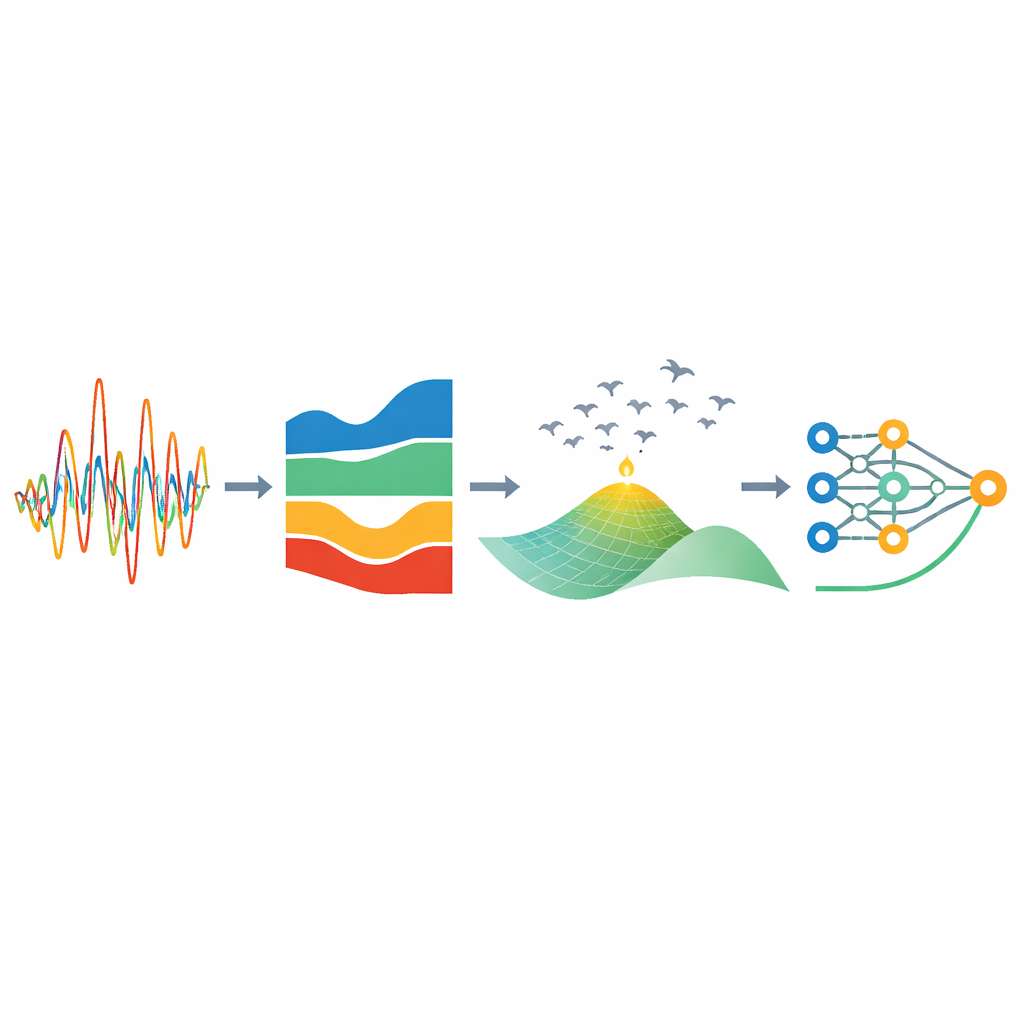
A central difficulty in wind forecasting is that the signal is a tangle of gentle trends and sharp spikes. Many earlier techniques either smooth too much and miss sudden drops, or follow every wiggle and become unstable. The authors tackle this with a sophisticated decomposition step called ICEEMDAN. In essence, it peels the raw power signal into several layers, each representing a different rhythm: slow seasonal changes, daily cycles, and rapid bursts. A key innovation is that the amount of artificial noise added during this process is adjusted on the fly to match the dominant frequencies in the data. This reduces a common flaw known as “mode mixing,” where different rhythms bleed into each other and blur the picture.
Letting a Digital Flock Hunt for the Best Settings
Once the signal is untangled, the system still needs a model that can learn how those layers relate to future power output. The authors choose a fast, lightweight neural network known as an Extreme Learning Machine, and then give it an important upgrade: an adaptive activation function that can reshape itself to match the data. Picking good internal settings for this network is a tricky search problem, so they introduce a new optimization algorithm inspired by the behavior of Red-billed Blue Magpies, social birds that explore, search, and adapt as a group. In the digital version, a swarm of candidate solutions roams across a landscape of possible parameter choices, sharing information, expanding its search when stuck, and preserving the best performers.
Testing Performance Across the Seasons
The authors do not simply present a clever design; they stress-test it against demanding numerical benchmarks and real wind farm data. Using a suite of standard test functions, their magpie-inspired optimizer outperforms several well-known algorithms in most cases, and does so quickly. Applied to the Jiangsu wind farm, the full system—combining decomposition, optimization, and adaptive learning—tracks actual power output closely in all four representative months: March, June, September, and December. Compared with a range of competing hybrid models, including deep learning approaches and other optimized networks, it delivers higher accuracy, smaller average errors, and more stable behavior during abrupt weather changes.
Turning Better Forecasts into Cleaner Grids
For non-specialists, the bottom line is straightforward: better forecasts mean a greener, more reliable power system. By more precisely predicting how much wind power will be available over the next several days, grid operators can schedule backup plants, charge or discharge batteries, and plan maintenance with greater confidence. The new hybrid system described in this paper boosts prediction accuracy by roughly a quarter compared with a basic neural network, while remaining fast enough for practical use. Though the study focuses on a single Chinese wind farm, the authors argue that their approach can be extended to other regions and even to other renewable sources, offering a promising tool for smoothing out the natural ups and downs of clean energy.
Citation: Liu, H., Cai, C., Li, P. et al. Hybrid prediction system for reliable multi-seasonal sustainable energy generation under meteorological and environmental volatility. Sci Rep 16, 8637 (2026). https://doi.org/10.1038/s41598-026-40486-7
Keywords: wind power forecasting, renewable energy, grid stability, machine learning, climate variability