Clear Sky Science · en
Proteomic analysis of plasma extracellular vesicles for predicting acute kidney injury following laparoscopic radical nephrectomy
Why this matters for people facing kidney surgery
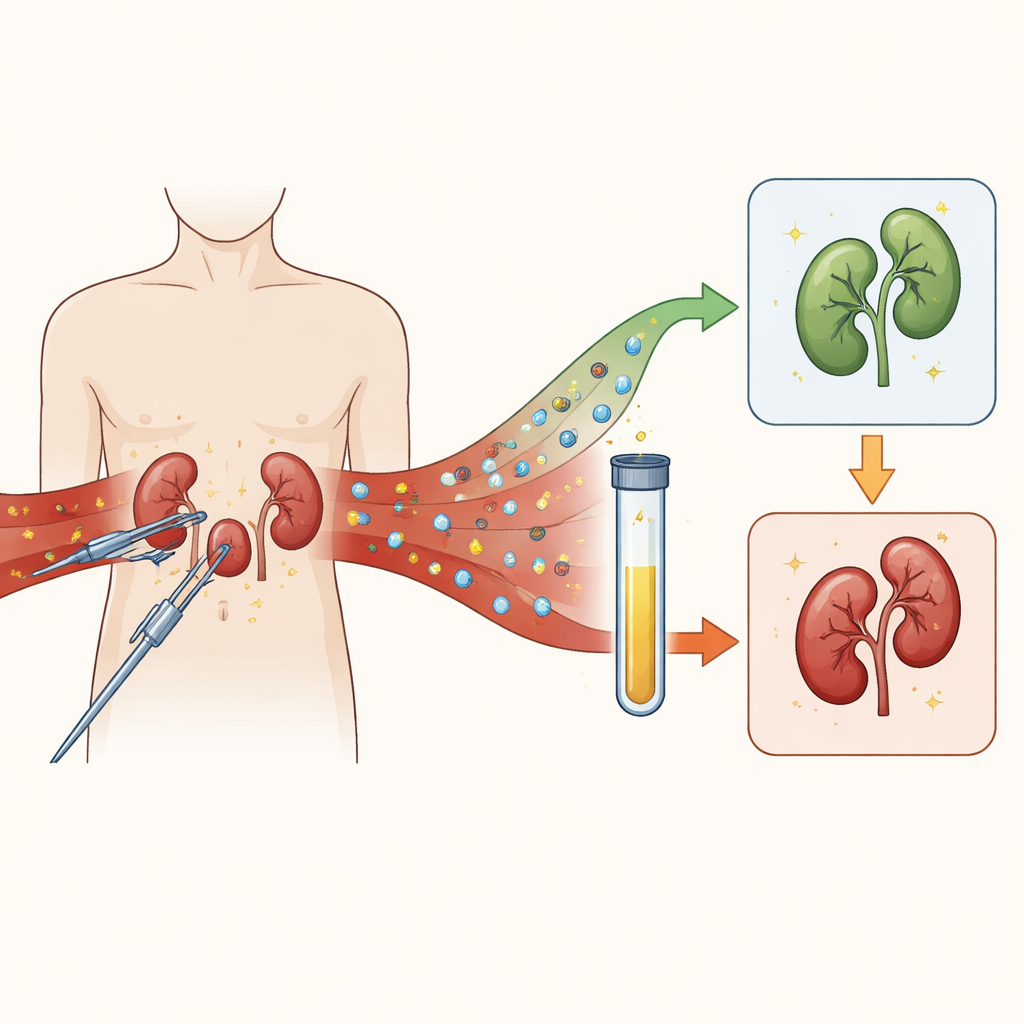
Each year, many people undergo surgery to remove a cancerous kidney. While the operation can be life‑saving, it also puts the remaining kidney under sudden stress, and about half of these patients develop acute kidney injury—a rapid loss of kidney function that can prolong hospital stays and harm long‑term health. Today’s blood tests often detect kidney trouble only after damage has already occurred. This study asks a hopeful question: can tiny particles floating in the blood before surgery quietly reveal who is most at risk, giving doctors time to protect the kidneys in advance?
Tiny messengers in the blood
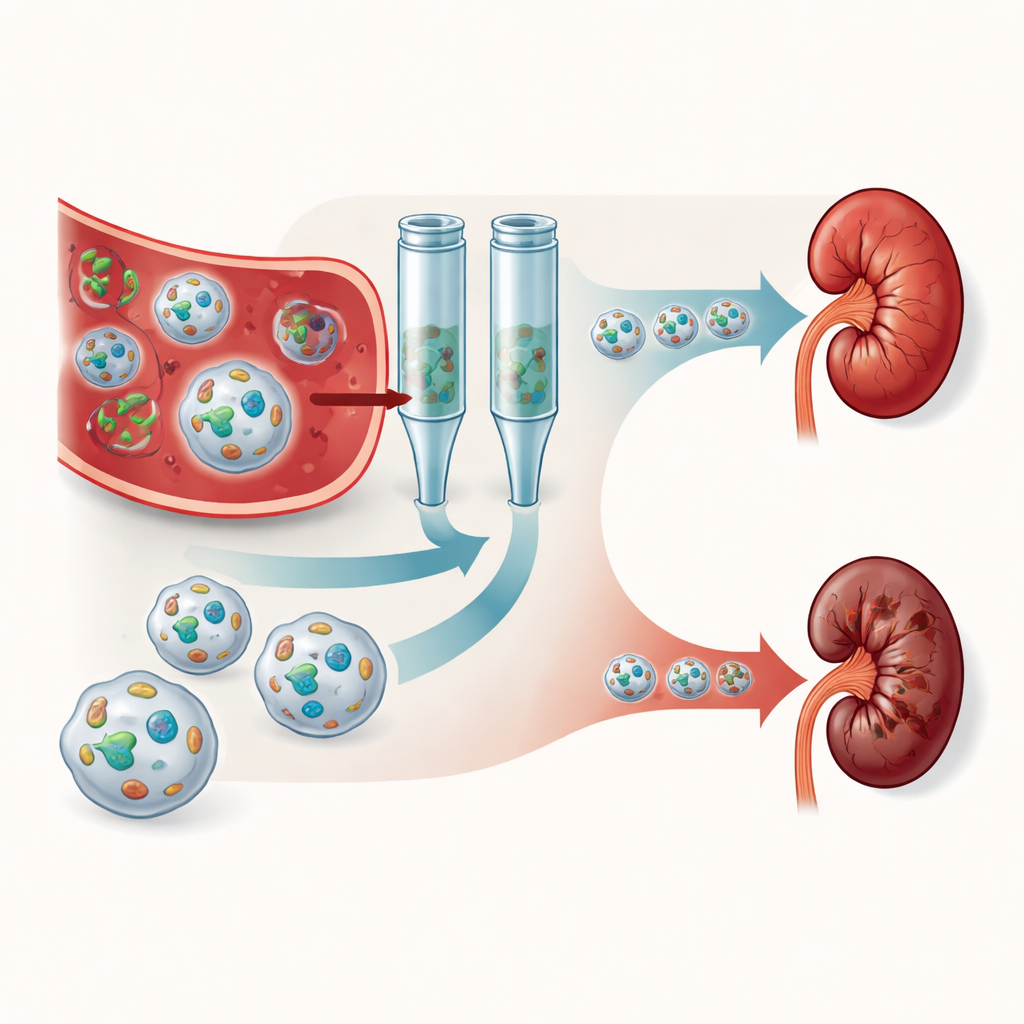
The researchers focused on extracellular vesicles, or EVs—microscopic bubbles released by cells into the bloodstream. These vesicles carry proteins and other molecules that reflect what is happening inside their cells of origin, making them attractive candidates as early warning signals for disease. The team collected small blood samples from patients scheduled for laparoscopic radical nephrectomy, a minimally invasive operation to remove a kidney with a tumor. All samples were drawn before anesthesia, when patients still had normal kidney function. The goal was to see whether the protein cargo of these vesicles, measured ahead of time, could predict who would suffer a sharp decline in kidney performance after surgery.
Hunting for risk signals in surgical patients
In an initial discovery phase, the scientists examined EVs from ten male patients—five who later developed acute kidney injury and five who did not. They purified vesicles from plasma using specialized chromatography columns, then used high‑resolution mass spectrometry to catalog and quantify their protein contents. This survey revealed 621 different proteins packaged inside plasma vesicles. Comparing the two patient groups, the team identified 43 proteins whose levels differed consistently, almost all of them present at lower levels in patients who went on to develop kidney injury. Network and pathway analyses suggested that many of these proteins were linked to energy production, iron handling, and the machinery that manages RNA and protein building inside cells.
Two standout proteins emerge
From this list, the researchers honed in on two proteins—PCBP2 and Profilin 1 (Pfn1)—based on prior evidence that they are involved in iron balance and the cell’s internal scaffolding, both important for kidney cell survival under stress. They first confirmed that these proteins actually sit on or within vesicles by using electron microscopy with gold‑tagged antibodies, and then developed sensitive plate‑based assays to measure their amounts in larger numbers of patients. In an independent group of 52 people undergoing the same surgery, they found that preoperative vesicular levels of PCBP2 and Pfn1 were clearly lower in those who later suffered acute kidney injury compared with those whose remaining kidney coped well.
From lab signal to clinical prediction
To understand how meaningful these differences might be in practice, the team compared each patient’s predicted kidney function—based on age, baseline filtration rate, tumor size, and other factors—to the actual kidney performance after surgery. Those with the lowest pre‑surgery levels of PCBP2 and Pfn1 experienced the greatest drop in kidney function beyond what could be explained by losing one kidney alone, suggesting an added layer of damage to the kidney’s filtering units and tubules. Statistical models showed that each protein on its own distinguished high‑risk from low‑risk patients with impressive accuracy, and their predictive power clearly surpassed simple clinical measures such as sex or common blood tests. When the researchers converted protein levels into practical cut‑off values, the resulting “high‑risk” and “low‑risk” classifications matched the standard clinical diagnosis of acute kidney injury remarkably well.
What this could mean for patients
The study suggests that a simple pre‑surgery blood test analyzing proteins carried by extracellular vesicles could one day help doctors foresee which patients are likely to struggle with kidney function after their operation. PCBP2 and Pfn1, in particular, behaved like advance warning lights: when their vesicle levels were low before surgery, kidney injury was much more likely afterward. Although larger, multi‑center studies are needed before such a test can be used routinely, and the biological role of these proteins in kidney damage remains to be fully worked out, the work points toward a future in which surgeons and anesthesiologists can tailor fluids, medications, and follow‑up care to each patient’s personal risk, potentially preventing serious kidney problems before they start.
Citation: Li, J., Xu, L., Liu, Y. et al. Proteomic analysis of plasma extracellular vesicles for predicting acute kidney injury following laparoscopic radical nephrectomy. Sci Rep 16, 9993 (2026). https://doi.org/10.1038/s41598-026-40480-z
Keywords: acute kidney injury, kidney cancer surgery, extracellular vesicles, blood biomarkers, proteomics