Clear Sky Science · en
Complete mitochondrial genome assembly and analysis of a Neotropical lineage of Ligula intestinalis reveals evolutionary and phylogenetic insights
A hidden passenger in high‑mountain waters
High in the Andes, Lake Titicaca is famed for its stunning scenery and unique fishes. Less visible is a long, ribbon‑like tapeworm that can silently hijack those fish, shutting down their ability to reproduce and reshaping the lake’s food web. This study explores that unseen world by decoding the complete “power‑plant” DNA of a South American strain of the tapeworm Ligula intestinalis, revealing how it fits into a global network of related parasites and what makes this lineage unique.
A parasite that rewires fish lives
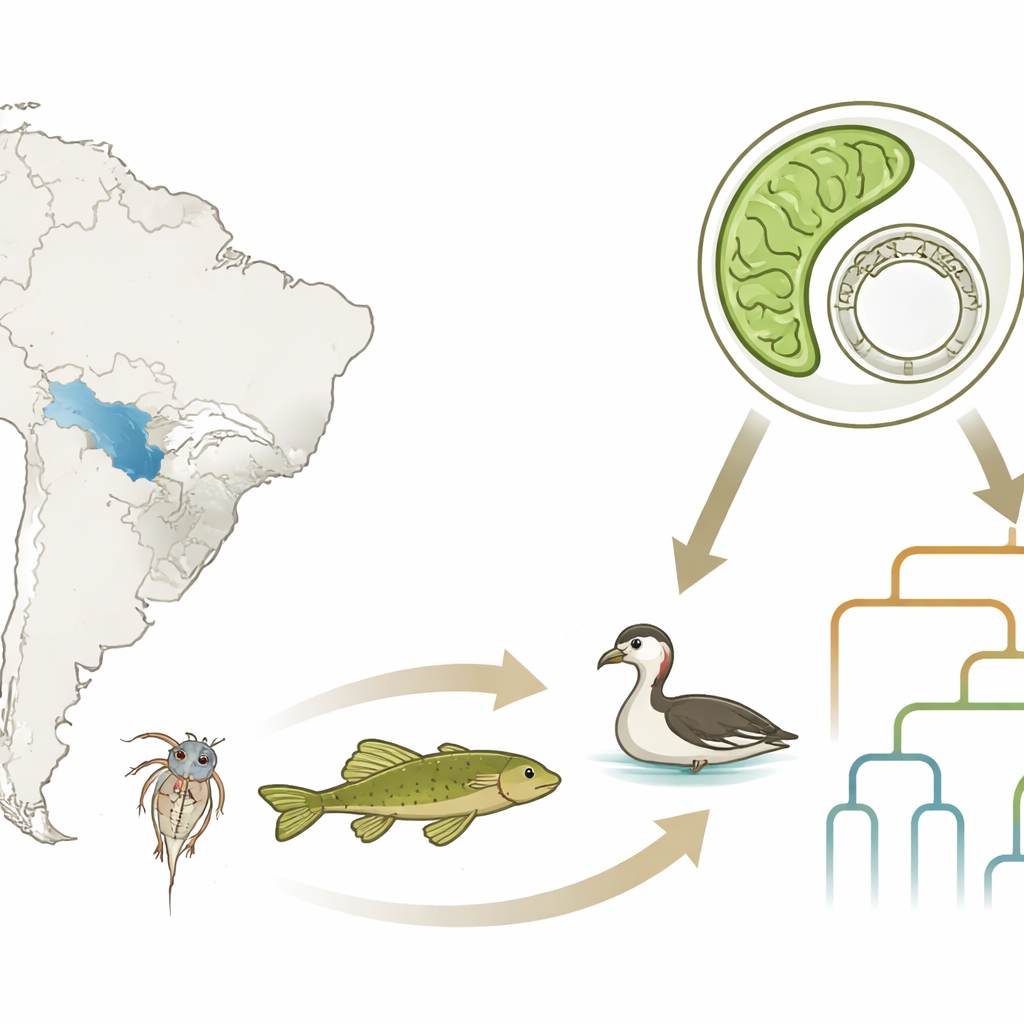
Ligula intestinalis has a three‑stage life story that ties together tiny crustaceans, freshwater fish, and fish‑eating birds. After eggs hatch in the water, microscopic larvae first infect small planktonic animals, then move into fish where they grow into long larvae that can fill much of the body cavity. Infected fish often stop reproducing and change their behavior, making them easier prey for birds, where the worm finally matures and lays eggs. This species has been reported from Europe, Asia, Africa, North America, and elsewhere—but until now, there were no confirmed genetic records from South America, leaving a major gap in understanding its global spread and diversity.
Reading the parasite’s tiny power plants
The researchers collected native killifish (Orestias agassizii) from the Peruvian side of Lake Titicaca and found four tapeworm larvae inside their body cavities. Using high‑throughput DNA sequencing, they focused on the parasite’s mitochondria—small cell structures that generate energy and carry their own compact circular genome. They assembled a complete mitochondrial genome of about 13,600 DNA “letters,” containing the usual set of protein‑coding genes and RNA genes seen in related tapeworms. The genome was strongly enriched in the DNA bases A and T and packed with more than 580 short repeated segments, especially in a control region involved in copying the mitochondrial DNA.
What makes the Titicaca strain special
By comparing this South American mitochondrial genome with counterparts from China and Finland, the team found a largely similar set of genes but subtle shifts in the building blocks of parasite proteins. Some genes, especially atp6, nad5, and nad6, showed more variation among regions, hinting they may be more free to change as the parasite adapts to local environments and hosts. In contrast, a widely used DNA barcode gene (cox1) was almost frozen in place within South America, with no changes that altered the protein, even though it differed more between continents. This pattern suggests that some parts of the mitochondrial machinery are under strict functional constraints, while others act as sensitive indicators of local evolutionary change.

Tracing family ties around the world
To place the Titicaca parasites on the global family tree of Ligula intestinalis, the researchers analyzed three mitochondrial genes from more than 160 samples collected across Europe, Asia, Africa, North America, and Australasia. The Lake Titicaca specimen formed its own well‑supported branch—a distinct South American lineage—most closely related to a North American group but clearly separated from it. This branching pattern supports the idea that geographic distance and historical barriers, combined with shifts between different fish hosts, have helped split what once seemed like a single, cosmopolitan species into multiple hidden lineages.
Why this matters for lakes, fish, and people
By delivering the first complete mitochondrial genome of Ligula intestinalis from South America, this work confirms that the parasite is established in Lake Titicaca and represents a unique evolutionary line. For ecologists and fishery managers, these data provide a genetic toolkit to track how the parasite moves among hosts and regions, and to gauge its impact on native fish that local communities rely on. For evolutionary biologists, the study shows how high‑altitude lakes and other isolated habitats can foster hidden diversity even in widespread parasites. In simple terms, the researchers have uncovered a new branch on the tapeworm’s family tree and provided a detailed genetic map that will help future studies understand, and perhaps better manage, this powerful but often overlooked player in freshwater ecosystems.
Citation: Mondragón-Martínez, A., Martínez-Rojas, R., Gárate, I. et al. Complete mitochondrial genome assembly and analysis of a Neotropical lineage of Ligula intestinalis reveals evolutionary and phylogenetic insights. Sci Rep 16, 9417 (2026). https://doi.org/10.1038/s41598-026-40478-7
Keywords: tapeworm, Lake Titicaca, mitochondrial genome, fish parasites, parasite evolution