Clear Sky Science · en
Study on the mechanical and fracturing characteristics of parallel slit groove sandstone at different angles under cyclic loading and unloading
Why cutting rock at just the right angle matters
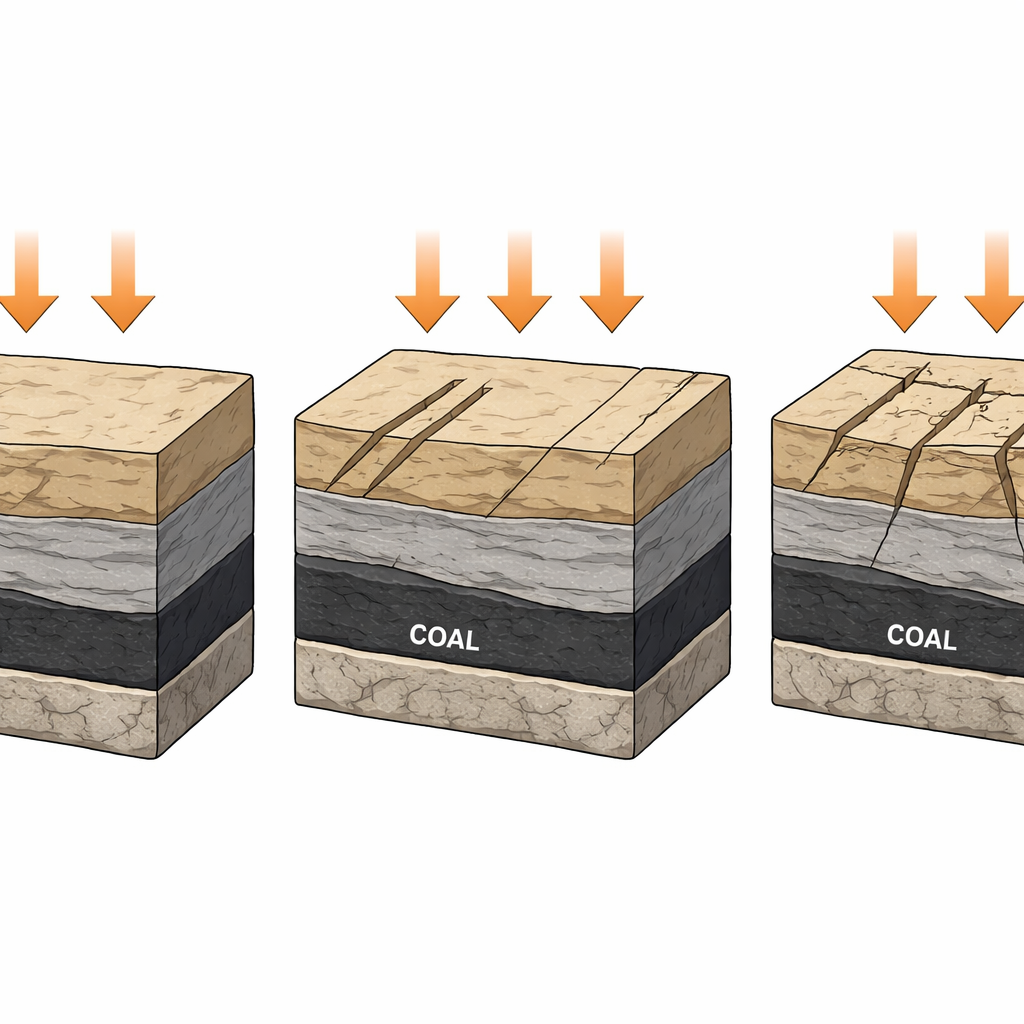
Deep underground, the rock above coal seams can suddenly break and release huge amounts of energy, triggering dangerous bursts of rock and gas. To make mining safer, engineers deliberately cut grooves into the rock roof so it cracks in a controlled way instead of failing without warning. This study asks a surprisingly simple but crucial question: at what angle should those man‑made cuts be made to encourage the roof to break safely and predictably?
Rock blocks prepared for the test
The researchers worked with sandstone blocks designed to mimic the hard roof above coal seams. Each block was cut with two narrow, parallel slits, like tiny saw cuts, placed in the middle of the specimen. Seven different angles between the slits and the horizontal direction were tested: from completely horizontal (0 degrees) through 15, 30, 45, 60, and 75 degrees, up to vertical (90 degrees). After drying the blocks to remove moisture, the team placed them in a hydraulic testing machine that could repeatedly squeeze and release the rock, imitating the rhythm of pressure changes a roof experiences as mining advances.
Simulating the push and pull underground
To mimic real mine conditions, the loading pattern combined two ingredients: a steadily increasing background force, representing the growing weight and stress as mining progresses, and a rapid up‑and‑down cycling, representing periodic disturbances. In each cycle, the stress rose from a lower “valley” level to a higher “peak” level and then dropped again, repeated ten times before the next step up in overall stress. As the machine worked, it continuously recorded how much the sandstone stretched or squeezed, allowing the team to track not just when the rock finally broke but also how its stiffness, internal damage, and stored energy evolved across dozens of cycles.
How angle changes strength, stiffness, and energy
The angle of the slits turned out to have a strong and non‑linear impact on behavior. The maximum stress the samples could withstand did not simply rise or fall with angle; instead, it first increased, then dropped sharply, then rose again. The weakest case was at 45 degrees, while the strongest was when the slits were vertical. As cycling continued, all samples gradually became stiffer during loading, but the rate of change differed with angle, reflecting how internal pores and microcracks were being compacted or growing. At the same time, two kinds of energy were tracked: elastic energy, which can be released if the load is removed, and plastic energy, which is permanently consumed to create cracks and irreversible deformation. At 45 degrees, both stored (elastic) and dissipated (plastic) energy stayed lower than for any other angle for the same number of cycles, meaning the rock reached failure with relatively little overall deformation and energy buildup.
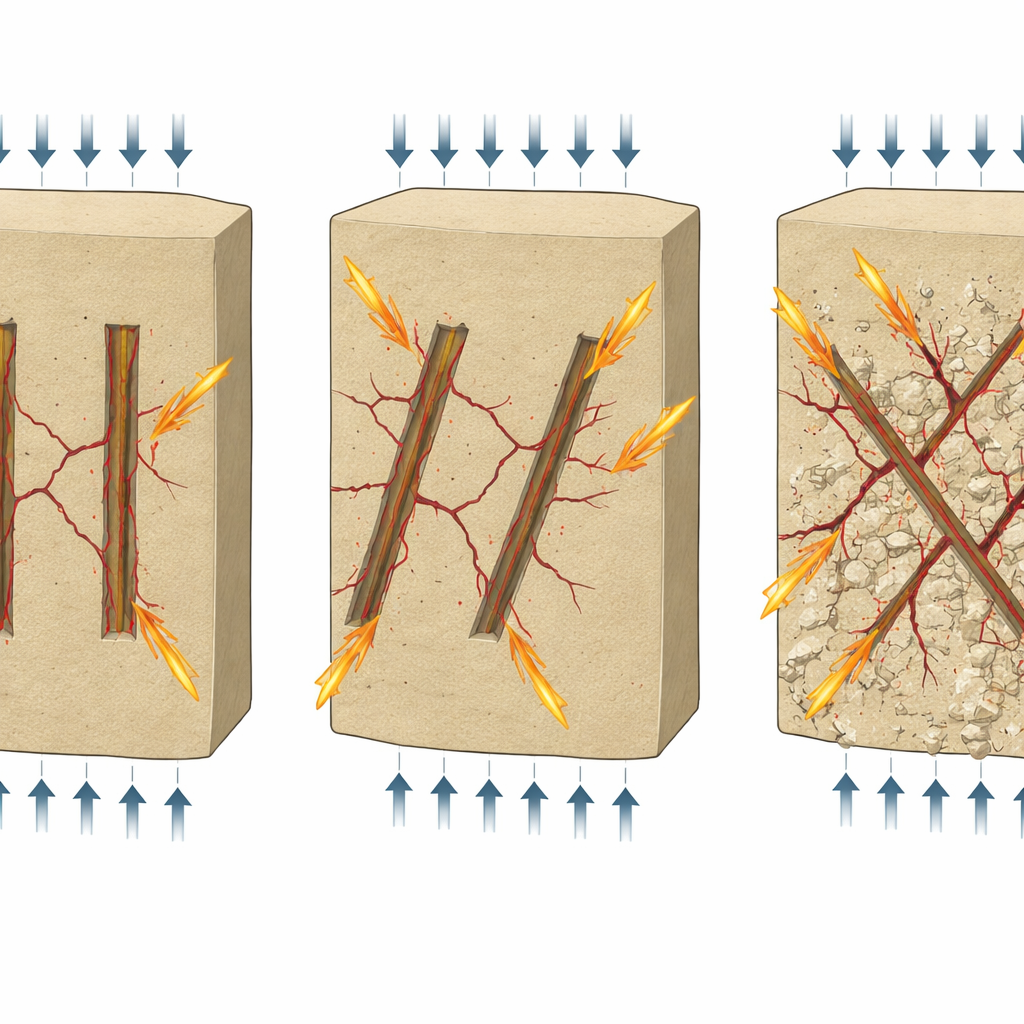
From gentle opening cracks to violent shear breakage
Watching how the visible fractures developed gave further insight into why angle mattered so much. When the slits were nearly horizontal, the rock mainly developed “opening” cracks that pulled apart the sandstone, a tensile‑dominated failure. As the angle increased toward 30 degrees, both opening and sliding cracks appeared and worked together. At 45 degrees and above, sliding (shear) cracks became dominant, slicing across the specimen and linking the slits to each other and to the boundaries. The paths that cracks used to connect the slits also changed: from direct, straight‑through links at low angles to more indirect and complex routes at high angles. This shift from tensile to shear‑dominated failure around 45 degrees marked a turning point in how the rock broke.
How the rock crumbled into pieces
After each test, the broken sandstone was carefully sieved and weighed to see how much material fell into different fragment sizes. Across all angles, most of the mass stayed in relatively large chunks, but the details of the size distribution varied. At 30 and 45 degrees, the spread of fragment sizes was widest, with a greater share of smaller pieces mixed among larger blocks. This wider range suggests that cracks were more numerous and more interconnected, slicing the rock into many differently sized fragments. In a mining context, that means the roof at these angles is more willing to cave and break up under pressure, instead of hanging as a single massive slab.
What this means for safer coal mining
Putting the mechanical, energy, and fragmentation evidence together, the study concludes that cutting the roof with parallel grooves at about 45 degrees to the horizontal is especially effective. At this angle, the rock develops strong shear‑dominated cracking, fails after relatively small deformation, and breaks into a broad mix of fragment sizes that encourage timely and uniform caving. In practice, this means that engineers designing roof‑cutting operations can use a 45‑degree groove angle as a practical target to relieve stress in the overlying sandstone and reduce the risk of sudden, hazardous rock‑and‑gas disasters during coal mining.
Citation: Enbing, Y. Study on the mechanical and fracturing characteristics of parallel slit groove sandstone at different angles under cyclic loading and unloading. Sci Rep 16, 9778 (2026). https://doi.org/10.1038/s41598-026-40476-9
Keywords: sandstone fracturing, cyclic loading, rock mechanics, coal mine roof control, pre-cut grooves